
Landmine rotations are one of my favorite exercises for swimmers to take core training off of the floor.
The usual core exercises that swimmers rely on—planks, dead bugs, Pallof presses—are all great for building the foundation of stability in the trunk, but eventually we need to be able to hold that stability through movement.
Landmine rotations are a great pick for doing just that.
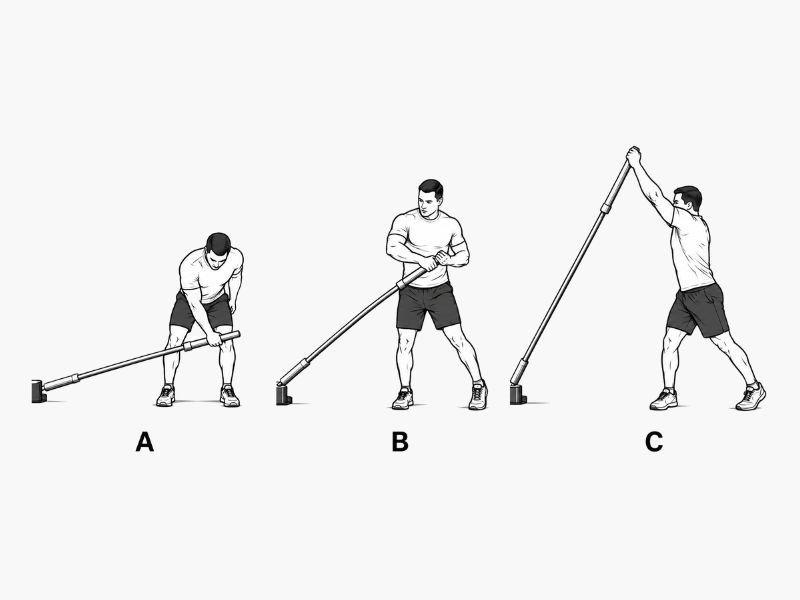
The set-up is simple enough: grab a barbell, anchor one end, and holding the other end, swimmers move the load in a controlled arc across the body, lighting up the trunk muscles that control rotation.
Here’s why this exercise belongs in your core training routine, some variations and progressions, technique tips, and how swimmers can get started with the exercise.
What Makes Landmine Rotations So Effective for Swimmers
Any swimmer or coach who has tried to put together a dryland and core training program knows that there are more core exercises than there are types of swim goggles and caps.
Which can make choosing the right core exercises challenging.
So let’s start off with why swimmers should add this exercise to their dryland training:
Trains force-transfer
The main reason swimmers do core training isn’t to get a chiseled six-pack or to look better in the mirror, although those benefits are a (very) nice side-effect.
It’s to build a core that efficiently transfers force up and down the body.
When we are swimming, whether rotating through freestyle and backstroke, undulating in the underwater dolphin kick, doing a flip turn, or pushing off the wall, force is constantly being transferred between the hips and shoulders.
See also: Does Core Training Improve Swimming Speed?
The core muscles create the stiffness and stability for this to happen—and that’s what makes landmine rotations such a useful exercise.
The same controlled movement of landmine rotations through the hips, core, and shoulders is what we are trying to improve in the water.
Builds rotational strength
Roll and rotation are a huge part of fast swimming.
It’s obvious in freestyle and backstroke how the body rotates, but even when doing turns (both flip turns and the hand touch turns) the trunk’s ability to rotate effectively is strongly linked to performance.
The landmine rotation gives swimmers a way to progressively load rotational movement while keeping both feet planted on the ground and using the entire kinetic chain.
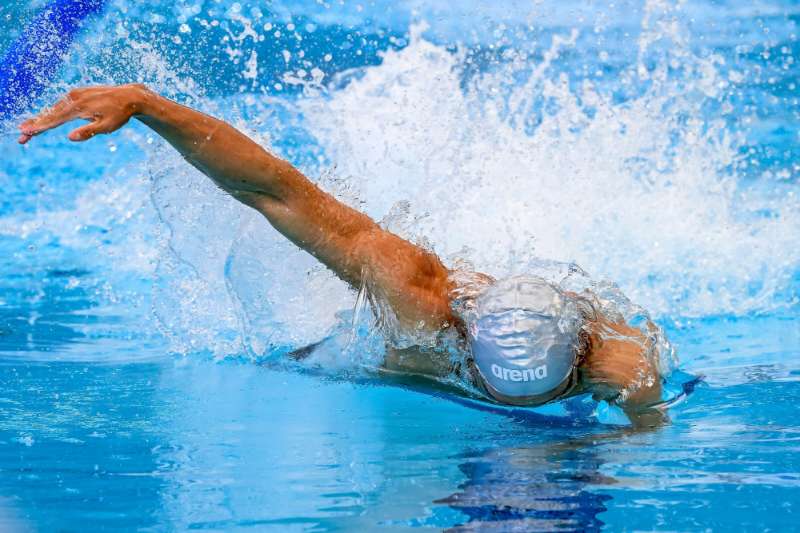
The same muscles that keep our body balanced and manage rotation in the water—erector spinae, internal obliques, and the external obliques—all work hard as we control the weight through the full arc.
EMG research with this exercise shows us exactly how the trunk works during rotational control. The ES works hard to keep the spine in neutral while the load moves around the body. The obliques activate to “brake” the arc at the end of the movement.
Both groups of core muscles are also very active during rotation and roll in the water, helping keep the body from spinning out of control.
How to Do the Landmine Rotation Like a Pro
Landmine rotations are a simple enough looking exercise, but there are some simple cues swimmers should use to ensure that they are doing the movement correctly.
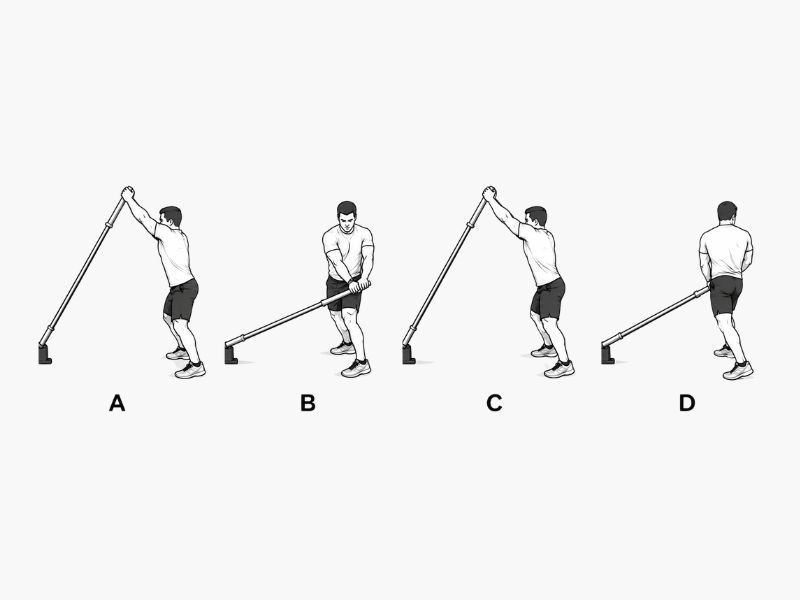
Start by setting up the barbell in a landmine attachment. Stand facing the barbell, feet shoulder-width apart, knees slightly bent. Starting position is holding the bar out and up, trunk braced, spine in neutral.
From there:
- Lower the bar toward one side in a controlled arc
- The torso and hips rotate with the bar
- Pivot the opposite foot so the hips can turn naturally instead of cranking rotation through the lower back
- Keep the arms relatively long and the bar in front of you
- Drive through the ground (focusing on the full body connection) and rotate the bar back toward the middle
- Continue toward the opposite side
- Keep the bar speed controlled and avoid swinging
It’s important to allow the hips to rotate through this exercise. When done properly, you will see that the amount of rotation is surprisingly similar to freestyle, with the shoulders using a range of rotation that is about twice as large as the hips.
The goal isn’t to create twist through the lower back, but to use the trunk and hips in tandem to control the movement.
The torso, hips, and back foot rotate together, rather than keeping the feet pinned in place and aggressively twisting the spine (Allen et al., 2025).
Landmine Rotation Variations
The standing version is the classic, but there are lots of ways to play around with this exercise. Small changes in stance and body position can switch up the training stimulus in some powerful ways.
Some of my favorite variations of this exercise include:
Standard landmine rotation. The classic—start with the bar in front of you, move it from side to side. This is the standard version and a good place for swimmers to learn coordinated rotation before making things more complicated.
Landmine anti-rotation. This looks really similar to the OG, but the goal is different. Instead of the hips and lower body rotating with the bar, the hips remain fixed as you move the bar from side to side. You’ll use less range of motion, but place more emphasis on resisting and controlling rotation rather than producing it—one of the key goals of anti-movement core training for swimmers.
Landmine rotation with press. Instead of facing the barbell, line up perpendicular to the barbell. Using the arm closest to the anchor, pull the barbell up and across, handing off to the other arm, which then completes a pressing action. Slowly return the bar back to the starting position in reverse order. This is a more explosive variation, with fast movement during the concentric phase.
Landmine rotation with lunge. Add a lateral or forward lunch as the bar moves across the body. This is a more advanced landmine, for sure, and can recruit the internal obliques and glute max like crazy. Another great way to get better at integrating the hips, legs, and trunk into one movement.
Landmine Rotation Tips for Swimmers
To get the most from the exercise, here are some tips on ensuring you are working the correct muscles, doing the exercise practically (and safely), and for programming.
- Start light. The barbell creates considerable leverage and load—you don’t need to stack tons of plates on a heavy bar (~45lbs to start) to make the exercise worthwhile.
- Keep the trunk braced. Classic mistake swimmers make with this exercise is swinging the bar with the arms. Stiffen the trunk, stack the rib cage and pelvis, and use a foundation of stability through the entire movement.
- Let the hips and feet move. For the classic version of landmine rotations, let the hips and feet move. Pivoting allows rotation to happen throughout the kinetic chain—like it does in the pool—and also reduces unnecessary twisting through the lower back.
- Use smaller plates. From a practical perspective, smaller plates on the barbell can be easier to move around the body.
- Earn the explosive variations. Start with mastering the rotation and coordination, build the stability, and progress to the more explosive versions.
- Start with low repetitions. The exercise is fundamentally a strength training exercise, so program it accordingly. Start with 2-4 sets of 4-6 controlled repetitions.
Wrapping Things Up
Landmine rotations are a great addition to your core training library as they create a direct connection between improved trunk stability and more effective movement in the pool.
By training the obliques and erector spinae, and doing so while involving the hips, shoulders, back and arms, we turn what can otherwise be somewhat boring, isolated core training and making it closer to a full-body athletic movement.
For swimmers, the biggest benefit isn’t necessarily a stronger core but that we are learning to brace the trunk and transfer force between the upper and lower body.
Which is exactly what the core has to do every time you get in the water.