
The core has an important but frequently misunderstood role in fast dolphin kicking.
The undulation, body wave, smooth timing between upkick and downkick—the core is at the center of all of it.
And for a long time, I was under the impression that to use the core meant to brace it as hard as possible.
(Yes, I took the concept 100% literally.)
Just flex that thing as hard as possible and then expect faster kicking.
Much to my surprise, turning my torso into a 2×4 didn’t have the anticipated results. Because fast dolphin kicking doesn’t require or use a core that is permanently braced and rigid.
Here’s why swimmers should focus on building a dynamic core that better matches the demands of fast dolphin kicking.
The Core’s Role in the Underwater Dolphin Kick
The core’s role in fast dolphin kicking is incredibly dynamic.
The core muscles bend, flex and control the trunk during the dolphin kick. This differs significantly from freestyle, backstroke, and even breaststroke where the core’s role is about creating stiffness and controlling unwanted movement as swim across the pool.
For dolphin kicking (and butterfly), the trunk has to flex and bend.
Think of the core as having three main jobs when dolphin kicking:
Start the body wave
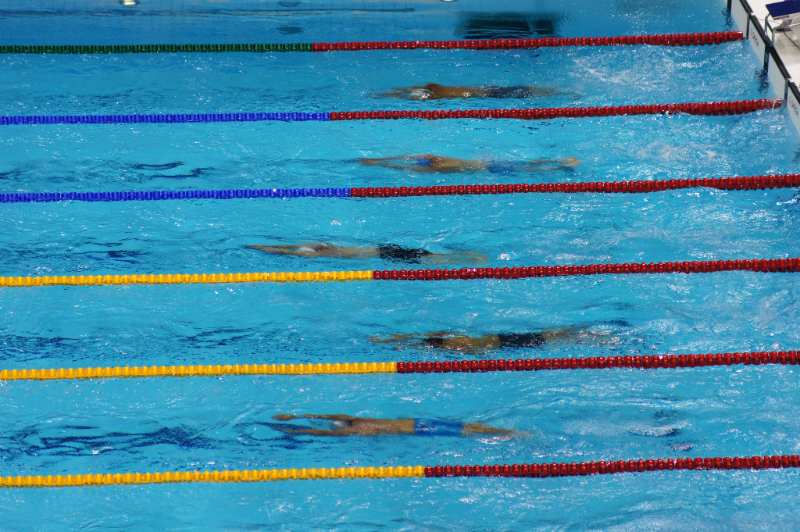
Fast dolphin kicking runs on undulation—this movement starts in the upper body and trunk before traveling down through the hips, knees, and ankles.
The core is what initiates this action (Ikeda et al., 2021).
When our core doesn’t start this process, and there is no undulation through the trunk, propulsive efficiency crashes (Nakashima, 2009).
The classic “stiff” dolphin kick that is clunky and slow is the natural result.
Transfer force through the body
Once the body wave gets moving, the core transmits and controls the movement between the upper and lower body.
Tanaka et al. (2022) showed that swimmers with high angular velocities in the waist and chest during the UDK kicked faster. The core moved and flexed more quickly, increasing vertical to speed and creating a stronger “whip” in the kicking movement.
Chen et al. (2022) also saw that increasing core activity boosted force at the ankles by 25% in the kicking motion.
Even though almost all of the actual propulsion when dolphin kicking happens at the feet, the core sets up your body to deliver more of it by the time the body wave gets to your feet.
Create and control movement
Through the kick cycle, the core is very dynamic. As mentioned earlier, simply bracing the core as hard as possible isn’t going to help you kick faster.
It’s using the right core muscles, at the right time.
A study by Matsuda et al. (2020) shows us how the core muscles cycle through the kick:
| Kick Cycle Phase | Primary Core Muscles Used | Secondary Core Muscles Used |
| Transition (upkick to downkick) | Rectus abdominis (“six-pack” muscles), internal obliques | Multifidus |
| Downkick | Erector spinae, multifidus | — |
| Upkick | Internal obliques, erector spinae | Rectus abdominis |
Fast dolphin kickers don’t turn the core “on” and leave it on.
They fire the right muscles to create and control movement and reduce co-contraction and wasted energy.
The end result is a kick that looks smooth and effortless.
Training the Core for Faster Dolphin Kicking
Faster dolphin kicking is the result of a lot of factors, from better breath holding to kick counts to increasing ankle range of motion.
But targeted dryland and core training gives you an excellent foundation for grooving the coordination and muscles worked during the underwater dolphin kick.
Dryland exercises to work the dynamic core capability in dolphin kicking:
- Kettlebell swings
- Back extensions
Core exercises:
- Stability ball roll outs with controlled return
- Super sets of Supermans + Hollow body holds
- Med ball slams
Wrapping Things Up
A strong core when dolphin kicking isn’t a stiff core.
It fires when necessary. Creates tension when it has to. Relaxes when not working. Activates in the right sequence.
And lets that body wave flow down the body smoothly and efficiently.
Happy kicking!