
Swimmers love their swim gear.
Whether we are talking about fins, paddles, pull buoys, or resistance tools, swimmers love playing with different kinds of swim equipment in their pursuit of chlorinated excellence.
Tools for resisted swimming—drag chutes, resistance tubing, power towers, DragSox—have especially become popular in recent years.
Makes sense why—resisted swimming is one of the best ways to overload the stroke while maintaining the general movement of swimming.
Most resisted swimming research is focused on freestyle—but what happens when we add resistance to butterfly?
In this article, we’ll look at how a little bit of drag can go a long way to improve butterfly technique.
How Different Types of Resistance Changes the Butterfly Stroke
A study (Telles et al., 2015) took a group of 13 national-level butterflyers and had them do a series of 25s butterfly fast:
- Swim (no equipment)
- With paddles
- With a drag chute
- With paddles and a drag chute
Researchers measured things like swimming velocity, stroke rate, stroke length, arm/kick phase durations, and arm-to-leg coordination were all measured and tracked.
Here’s how swimmers did across the four conditions:
| Condition | Swim Velocity | Stroke Rate | Stroke Length | Arm–leg coordination gap |
| Free | 1.63 m/s | 61.8/min | 1.59 m | Baseline (40.3%) |
| Paddles | 1.66 | 55.3 | 1.81 | 38.2% (not significant) |
| Parachute | 1.08 | 55.9 | 1.17 | 27.5% |
| Paddles + chute | 1.13 | 51.9 | 1.31 | 26.2% |
Lower numbers in the “arm-leg coordination gap” indicate less dead time between propulsive actions of the pull and kick.
Some things stand out pretty clearly:
Swimming with a chute cratered velocity. Soon as swimmers put the chute on, speed crashed by over 30%. This was to be expected, but still quite significant.
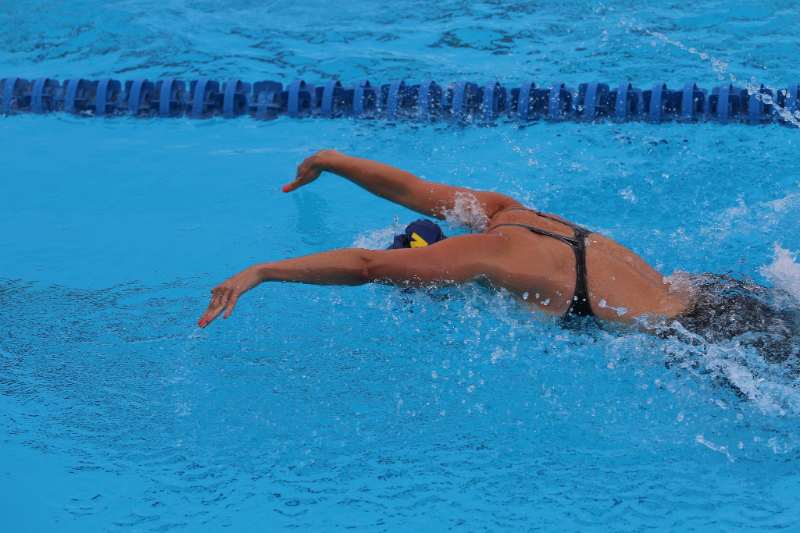
Stroke rate went down. Swimmers took longer to complete each stroke, which caused tempo to decline significantly. Particularly when using paddles and a chute.
Stroke length changed. Putting paddles on meant that swimmers had more propulsive surface on their hands and could displace more water—this meant longer strokes (1.81m per stroke with paddles versus 1.59m without). When swimming with just the chute, stroke length dropped big time—to 1.17m—but recovered slightly when swimmers used paddles and the chute.
Paddles didn’t change arm-leg coordination. When swimmers used only paddles, there was no meaningful changes in how the arms and legs coordinated.
But the big thing was how resistance improved arm-to-leg coordination.
Resistance Changes Arm-to-Leg Coordination in Butterfly
Swimmers know that butterfly is hard, not only because recovering both arms over the water at the same time is taxing, but because timing the arms and legs in a way that generates smooth, fast swimming is surprisingly difficult.
Getting the timing of the kicks and pull is essential—without it the stroke is clunky and expensive.
The two dolphin kicks have to line up with specific parts of the arm cycle to keep swimmers moving smoothly. Poor timing creates gaps in propulsion, creating a lot of “start and stop” in the stroke which is clunky and creates big fluctuations in speed.
And this is where resisted swimming encourages swimmers to use better timing.
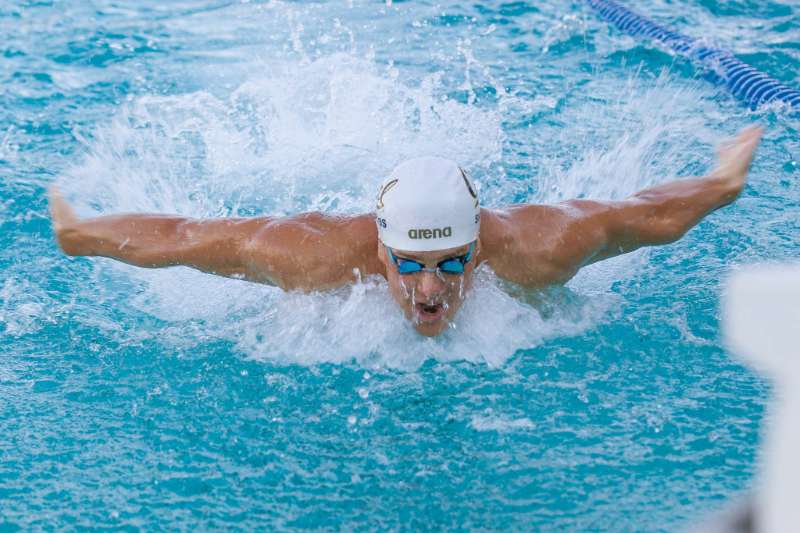
In the study, resistance changed how swimmers timed and coordinated their stroke in several important ways:
The first downkick moved closer to the hand entry. When using the drag chute, swimmers better timed the first dolphin kick so that it was closer to when the hands entered the water. This cuts down on that awkward period where the kick starts and the arms are still recovering.
Less gliding before the stroke started. At the top of the stroke, after swimmers’ hands entered the water, there was less dead time. Swimmers were less prone to glide out and instead moved the hands into the propulsive phase of the stroke sooner.
Improved timing between the second kick and push phase. Resistance also encouraged swimmers to more cleanly time the second dolphin kick with the later part of the pull/push.
Put together, these little changes substantially reduced the gaps between propulsive parts of the stroke.
Fluctuations in the Butterfly Stroke are Expensive
Fast butterflyers make it look easy. The undulation, the stroke timing, the arm rotation above the water.
And for many enterprising butterflyers, getting that stroke timing is the hardest part of the stroke. Because when we don’t, it costs us a lot in terms of speed and energy.
A separate study found that the more swimmers sped up and slowed down within each stroke cycle, the more energy they burned through to get to the other side of the pool (Barbosa et al., 2005).
In the Telles study, swimming with a drag chute reduced those time gaps in the stroke by over 30%— going from 40.3% to 27.5%.
Swimmers naturally shifted towards a butterfly stroke that was smoother and better coordinated, with less dead time between the arms and legs.
Put simply, the chute makes dead spots much more obvious. With resistance constantly pulling you backward, those big gaps in propulsion become way more obvious, encouraging the stroke to reorganize around a more continuous coordination.
Wrapping Things Up
Swimmers often use resisted swimming for one big, shiny reason—to build mega-watt power that crushes PBs and helps raise the roof on top end speed.
The idea is that by adding load, whether it’s resistance tubing, drag chutes, or hooking up to the power tower, that swimmers can improve peak and mean force in their stroke.
But resisted swimming can do much more than that.
As we see with butterfly, resisted swimming can also act as a coordination constraint, tightening up the stroke (in a good way) and shortening dead spots that cause those expensive accelerations and decelerations to drain the tank.
So hit the heavy, power-focused resisted sprint sets. They work great. But also throw in some lower load, lower intensity butterfly to get a better sense of what a smooth and coordinated butterfly feels like.
That’s what makes resisted swimming truly a versatile training tool. Depending on the load, intensity, and execution, it can be used to target force, power, technique, or coordination—not just “getting stronger” in the water.