
A fast underwater dolphin kick is a mesh bag of smooth undulation, kick phase timing, core stability, and more.
Dolphin kick drills like fish kick, vertical kicking, and rockets are an excellent way to fine-tune these skills and build a faster, more efficient kick.
Here are my favorite dolphin kick drills for swimmers and how they can improve every part of your underwaters.
Dolphin Kick Drills for Faster Dolphin Kicking
Each dolphin kick drill hits different parts of the kick. Here’s a quick breakdown of the five drills and what they can help you improve:
| UDK Drill | Best For | How it Helps |
| Fish Kicking | Undulation | Smoother body wave and better coordination |
| On Back Dolphin Kicking | Upkick | Faster upkick and smoother transitions |
| Vertical Kicking | Tempo | Faster, more consistent kick rhythm |
| Blast-Offs | Bodyline | Tighter streamline at high speeds |
| Resisted Kicking | Force | Stronger, more consistent propulsion |
Fish kicking
⭐ Best for improving undulation
Smooth undulation is essential for a fast dolphin kick. Being able to work the timing of the trunk, hips, and legs creates a smooth body wave that leads to increased kicking speed.
But getting that timing right can be a toughie to master.
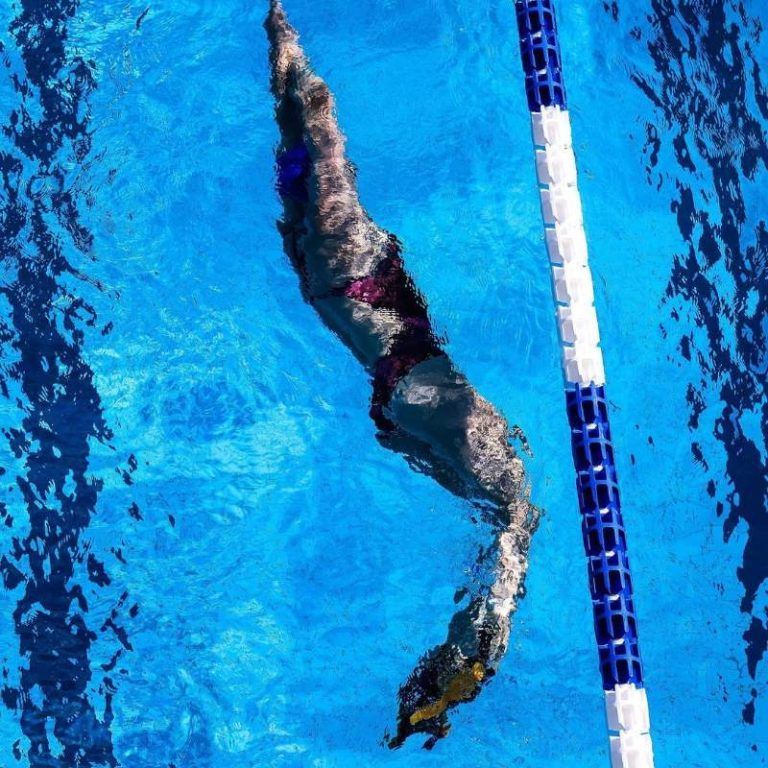
Fish kick—dolphin kicking on your side—is a great choice for smoothing things out.
Fun fact: Fish kicking can be faster than kicking on your front. Collard et al. (2008) had swimmers do dolphin kick sprints on their front, back, and side. Fish kicking led the pack for velocity.
Kicking on your side makes it easier to feel when the body wave gets choppy or clunky. You also get immediate feedback on whether or not your kick is balanced when your kick veers you in the lane rope.
The goal?
Smooth, buttery undulation from head to toe.
Dolphin kicking on your back
⭐ Best for improving the upkick
The upkick is the most underrated and underworked part of the dolphin kick.
Gretchen Walsh, one of the most elite swimmers and kickers on the planet, partly credited improving this part of her dolphin kick for her recent success in the pool.
Swimmers who move through this phase with more speed benefit from a faster kick tempo, reduced time in non-propulsive phases of the kick, and tend to be faster underwater kickers (Atkinson et al., 2014).
Dolphin kicking on your back, with your arms at your side, is an excellent way to give the upkick some much-needed TLC. In this position, the upkick drives your feet toward the bottom of the pool.
To generate smooth forward movement, this little switch emphasizes pushing and curling the feet down quickly.
Vertical kicking
⭐ Best for improving tempo
Fast dolphin kickers tend to have higher kick tempos.
But moving the legs crisply back and forth is tough work—especially given that underwaters don’t give us a ton of time to work on the kick before we must surface to breathe (important).
The goal is to build a faster tempo that doesn’t crumple under fatigue or sacrifice kick mechanics. Vertical kicking is an awesome and versatile drill for doing just that.
Find a deep end of the pool, get vertical, and quickly stack far more consecutive kicks without being limited by how long you can hold your breath.
With your head above water, you can also keep an eye on the pace clock and track kick tempo (e.g. two kicks per second) and how long you can hold it.
Plus, vertical kicking makes it easy to add resistance.
Raise your hands out of the water into a streamline, or for experienced swimmers with appropriate supervision, use a weight belt for added load.
This was one of the meat-and-potato dolphin kick strategies that Michael Phelps relied on while building his world class dolphin kick.
Blast offs
⭐ Best for maintaining a clean bodyline
Nothing slams the brakes on a fast and powerful dolphin kick faster than a sloppy bodyline when under the surface. A horizontal body position with a tight streamline is non-negotiable for getting the most out of your underwaters.
Blast-offs are a fun and feedback-friendly way to reinforce that clean bodyline.
In water that is around 2x your height, sink to the bottom, get into a tight streamline, push-off, and dolphin kick like a maniac towards the surface, exploding out of the water like a Trident missile.
If you aren’t kicking purely vertically, you’ll find out immediately. Apply this same attention to bodyline the next time you push off or dive into the water.
This UDK drill is also handy for hitting higher-than-normal kick tempos. For swimmers whose tempo can feel like they are kicking through Jell-o, a few reps of blast-offs can expose them to much faster kick tempo.
Resisted dolphin kicking
⭐ Best for improving force application
One of the biggest struggles of dolphin kicking is creating consistent propulsion.
This is partly a timing issue (i.e. proper undulation) but also applying pressure against the water with your feet through the whole kick cycle.
Resisted dolphin kicking is a powerful way to develop this ability.
Soon as you add resistance—whether it’s a drag chute, resistance tubing, buckling yourself to a power tower, or using DragSox—every little gap in propulsion becomes much more obvious.
The slow-down in the upkick. The slow transition between upkick and downkick. The kicking from the knees.
Adding resistance—and it doesn’t have to be super heavy resistance or all-out effort, even a little bit of load can do wonders—highlights gaps in propulsion and naturally forces you to kick with more consistent force.
Try doing a couple of 15m or 25m of dolphin kick efforts with light resistance, then pair it with unresisted dolphin kicking to carry that improved force application to your regular kick.
Fun fact: Resisted dolphin kicking can also improve underwater speed. Sengoku et al. (2020) had swimmers add a simple tethered dolphin kick set—4×5 kicks on a short tether—to their training. At the end of the season, underwater dolphin kick velocity increased substantially.
Which dolphin kick is best for beginners?
Fish kicking is an excellent drill for beginners and elite swimmers alike.
The lateral body position challenges your ability to control bodyline, work both phases of the kick, and really hone your undulation, which is the most important part of efficient dolphin kick technique.
Focus on a smooth, slow dolphin kick on your side, and extrapolate that to kicking on your front (or back).
Should I use resistance when doing dolphin kicking?
Yes! Resisted swimming is often thought of as an elite and sprint-only tool, but it can work wonders for swimmers of all levels.
By adding a little bit of resistance, all of the little gaps in your dolphin kick become much more obvious. Resisted kicking isn’t just a force or power tool, but a technique tool/drill when viewed in this context.
How often should swimmers do dolphin kick drills?
Swimmers should add dolphin kick drills into several practices per week, if not during every session.
An efficient dolphin kick has become crucial for swimmers of all strokes and levels, and sprinkling in some drills to your daily training is a great way to build the technique for faster underwaters.
A study that surveyed elite swim coaches (Thompson et al., 2022) on their dolphin kick practices found they averaged around 1h30 of dedicated dolphin kick training per week. This is a great benchmark for swimmers and reflects the importance of the fifth stroke.
Should young swimmers practice underwater dolphin kick drills?
Underwater dolphin kicking is a foundational skill that swimmers should develop from an early age.
Collard et al. (2013) had swimmers aged 9-10 years do a dolphin kick training program in addition to their regular swim training and saw improved 25m freestyle times and extended breakout distances.
For younger swimmers, drills can better help them grasp the fundamentals of dolphin kicking more quickly. Focus on undulation, coordination, and technique as opposed to kick out distances.
Wrapping Things Up
A fast dolphin kick takes a lot of work!
The metabolic cost of the UDK is no joke. Timing the undulation is tough. And holding onto tempo under rising fatigue? Can be brutal.
Developing the mechanics that make for truly fast underwaters means attention to detail and consistency.
Spice up your usual underwater training with these drills, sharpen the different parts of your kick, and build the speed, power, and efficiency that make an elite dolphin kick such a weapon.
Happy kicking!