
Fear of failure is a common experience for swimmers. Learn what it is, how it hurts swim performance, and how to overcome it.
The moments before a big race can be exciting… or they can be wrought with something else—paralyzing thoughts of failure.
What happens if I don’t go a best time? What happens if all that hard work was for nothing? What if I disappoint my teammates, coaches, and family?
Fear of failure isn’t fun. And while these thoughts are fairly common, when they take over, performance in the pool plummets.
In this guide to fear of failure for swimmers, we break down what it is, how it affects your swimming, and most importantly, what you can do to conquer it.
Let’s dive in.
In this article
What is Fear of Failure?
Fear of failure is when swimmers expect negative outcomes—like disappointment, embarrassment, or shame—and let those expectations shape their behavior before they even leave the starting block.
Although swimmers often conflate it with pre-race nerves, fear of failure is a different beast. It’s a learned emotional pattern where failure is seen as a threat—not just to performance, but to identity and future success.
Fear of failure works in two steps. First, we anticipate failure. And second, we assign meaning to what that failure says about us.
Here are some examples:
| The Situation | Step 1: Anticipating Failure | Step 2: What You’re Really Afraid Of |
| Big meet, fast heat | “I’m going to get lapped by the fastest swimmers in this heat.” | “Everyone will see I don’t belong here.” |
| Chasing a best time | “I’m not in good enough shape to drop time today.” | “My parents will think I’ve been wasting training.” |
| Racing a faster teammate | “There’s no way I’m keeping up with them.” | “This means I will never be successful.” |
| Coming back from injury | “I’m going to swim like hot garbage.” | “I’ll never get back to where I was and everyone will get a front row seat to this failure.” |
Fear of failure is best understood as the desire to avoid failure because of the shame attached to it.
That’s what makes it so powerful. It’s not just fear of a bad swim—it’s fear of what the swim says about you.
How Fear of Failure Impacts Swim Performance
Fear of failure is particularly nasty because it shows up precisely at the moment when we are trying to do big things in the pool.
A big race. A tough main set. These are the moments fear of failure creeps in and quietly takes control.
Increases anxiety, stress, and pressure
Fear of failure is rooted in shame and negative consequences, which makes swimmers interpret races and practices as threats instead of opportunities (Gustafsson et al., 2017).
This naturally leads to:
- Higher pre-race anxiety
- Elevated stress during training/competition
- Incessant worrying about outcomes and evaluation
Instead of viewing high-stakes moments as a challenge or opportunity, they are viewed as a threat, leading to tension and tentative swimming.
Shifts swimmers into avoidance mode
One of the biggest shifts is that swimmers stop chasing performance, and instead try to avoid failure.
This sounds like a bunch of semantics, but it leads to very real differences in how swimmers train and compete.
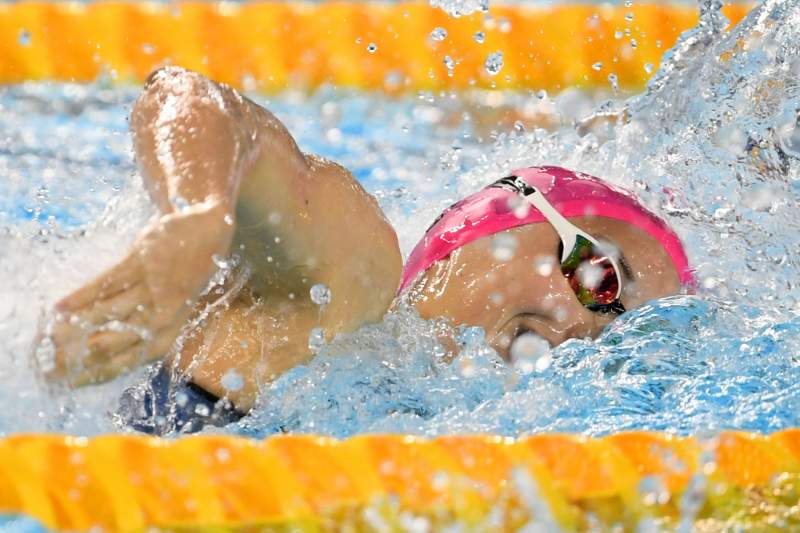
Instead of chasing excellence, swimmers:
- Play it safe in races
- Avoid challenging sets/intervals/competitors
- Hesitate and overthink in key moments
Avoidance is a classic tactic when we become fearful of failing.
Lowers perceived competence and confidence
When swimmers expect failure, confidence crumbles. I mean, this makes total sense on the face of it—if we expect to underperform, stacks of confidence are unlikely to follow.
This creates a performance-sapping feedback loop:
“I’m not fast enough” > Poorer performance > Reinforced fear
Studies with athletes show that fear of failure directly reduces perceived competence and motivation (Morena-Murcia et al., 2019).
Increases mistakes and disrupts performance
Fear-based thinking divides attention and increases cognitive load.
Instead of relying on the cues and thoughts that work for high-performance in the pool, swimmers:
- Overthink technique and stroke mechanics
- Move with tight, inefficient movement
- Make more mental mistakes
Swimming fast requires letting go, not tightening up. The worst time to consciously control every movement is race day or when pushing the pace in training.
Feeds into perfectionism
Fear of failure and perfectionism for swimmers go hand-in-paddle.
A 2026 review (Hill, 2026) of perfectionism with athletes found that out of every outcome measured—anxiety, depression, self-criticism, burnout—fear of failure was one of the strongest links to perfectionism.
And we aren’t talking about the excellence-driven type of perfectionism that drives effort.
The swimmer who works as hard as they can each day—and is satisfied. Or the athlete who judges their swimming by execution and process—and not what the clock says.
But the other kind with the impossible standards: harsh self-judgment, catastrophizing over mistakes, the sense that falling short means something is fundamentally wrong with you.
| Excellence-Chasing | Maladaptive Perfectionism | |
| Driven by | Focus on improvement | Focus on not falling short |
| After a bad race | “Where can I get better?” | “What does this say about me?” |
| Relationship with mistakes | Information | Threat |
| Standards | High but flexible | High and rigid |
| Self-worth | Separate from results; revolves around process | Tied directly to results |
| Effect on fear of failure | Slight reduction | Strongly increases it |
| Effect on anxiety | Minimal | Significantly increases it |
| Feels like | Drive; let’s go | Dread; let’s stop |
Perfectionism and fear of failure are a perfect doomsday tag team.
Perfectionism sets a standard you can’t reach. Fear of failure makes sure you feel like a bag of smashed pull buoys every time you don’t.
Drives burnout
One of the biggest risks that come with fear of failure is long-term disengagement from the sport. Yup–burnout.
Swimmers with higher fear of failure also report higher levels of burnout across all three of its core dimensions: emotional and physical exhaustion, reduced sense of accomplishment, and sport devaluation (Gustafsson et al., 2017).
When every race and practice feels like a threat, it stops being something swimmers look forward to and becomes exhausting, and not in a “that was a great workout!” kind of way.
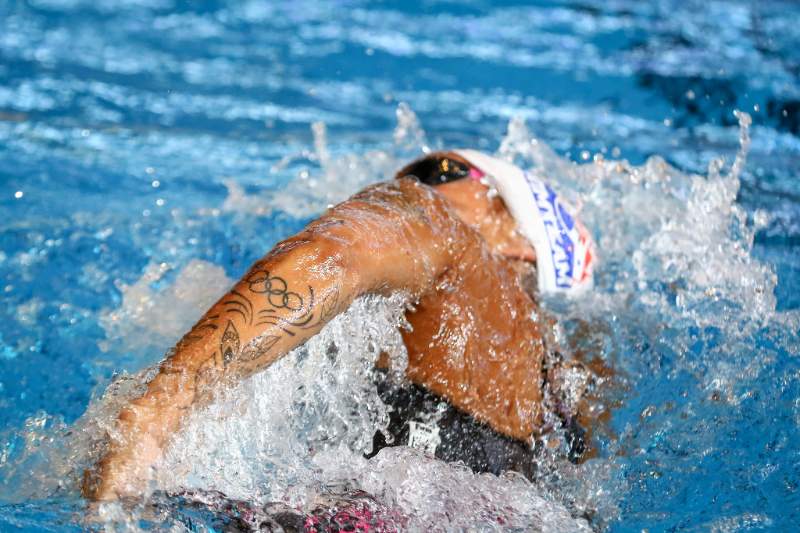
And once burnout takes hold, it has a nasty habit of pushing swimmers out of the sport entirely.
Research on burnout interventions in young athletes found that swimmers who burn out are more likely to withdraw from sport—and that walking away often doesn’t bring the relief they were hoping for (Wilczyńska et al., 2022).
Fear of failure doesn’t just make swimming harder on race day or in those sporadic moments that are important over the course of the season. It’s high-grade fuel for burnout.
How Swimmers Can Combat Fear of Failure
The good news is that fear of failure is not a fixed trait. It’s a learned response—which means we can unlearn that bad boy or at the very least manage it effectively.
Here are ways to do just that.
Understand the faces of fear of failure
Fear of failure isn’t “one” thing—it comes in a bunch of different flavors.
Conroy et al. (2002) studied the perceived consequences of failure in athletes and dancers and saw that there were five general beliefs associated with fear of failure:
| Fear of Failure Component | How It Shows Up for Swimmers |
| Experiencing shame and embarrassment | Feeling exposed after a bad swim—like everyone can see you don’t belong or that you aren’t as good as expected. |
| Having an uncertain future | Worrying that one poor swim or practice will lead to missed cuts, lost opportunities, or falling behind in the sport. |
| Devaluing self-estimate | Interpreting a bad race as a lack of ability (“Maybe I’m just not good enough”) |
| Important people to you losing interest | Concern that coaches, teammates, or others will take you less seriously or stop paying attention to your progress |
| Upsetting important people | Fear of disappointing coaches, parents, or supporters who have invested time, energy, and belief in you |
If you are the type of swimmer who has experienced fear of failure at some point–and we all have–I’m sure a couple of those components hit close to home.
Simply shining a light on what your fear of failure looks like is the starting point for addressing it head-on.
Mindfulness training
Mindfulness training can sound a bit hokey, but it’s more than a buzzword. It can be used to help a lot of the uncontrolled thinking that leads to fear of failure.
Athletes with higher levels of mindfulness exhibit lower levels of fear of failure, ego-depletion, and perfectionism (Zhong et al. 2025).
Mindfulness works well for fear of failure because it keeps our thoughts rooted in the present instead of letting them drift into the future where they can think up all sorts of worst-case scenarios.
It also works to improve awareness around physiological and psychological states such as tension and fear, helping swimmers to detach from emotional reactions and react with a more non-judgmental attitude.
| Fear Trigger | Typical Fear Response | Mindfulness Response |
| “I’m going to bomb this race” | Spiraling into worst-case scenarios before the race starts | Notice the thought, label it (“anxiety is energy”), and return focus to your pre-race routine. |
| “My legs are dying much earlier than expected.” | Catastrophizing fitness loss and assuming poor performance | Acknowledge the sensation without judgment and trust the work; stick to the race plan |
| “My coach will be disappointed” | Swimming to avoid failure instead of executing the race | Recognize the feeling, then redirect attention to stroke cues and race plan |
| “I haven’t been swimming well in practice” | Carrying past performance into the race and tightening up | Treat the race as a separate event and focus on executing at a high level in each moment |
| “Everyone is watching me” | Overwhelmed by pressure and external expectations | Notice the pressure, breathe through it, and narrow focus to the first task (e.g., breakout) |
Mindfulness is another term for arresting time travel thinking. Swimmers will “time travel” to the past (“oh man, that last workout did not go well!”) or to the future (“If I swim poorly my whole season is a huge waste of time”).
Mindfulness unplugs the time travel machine so that you can execute in the moment.
Improve your relationship with failure
Swimmers become fearful of failure when it feels personal.
- I’m not good enough.
- I’ll never be as fast as them.
- No matter how hard I work, it will never be good enough.
When failure is tied to how we view ourselves, it shuts down learning. Instead of asking “what can I take from this?”, swimmers start protecting themselves from the experience altogether.
To be clear, I’m not talking about pretending failure is good or going out and chasing it. It’s learning to see failure for what it is—high-grade performance feedback.
Think about how much time we spend in the water, working hard, hoping and wishing for improvement and for someone to shine a light on what we need to do to improve.
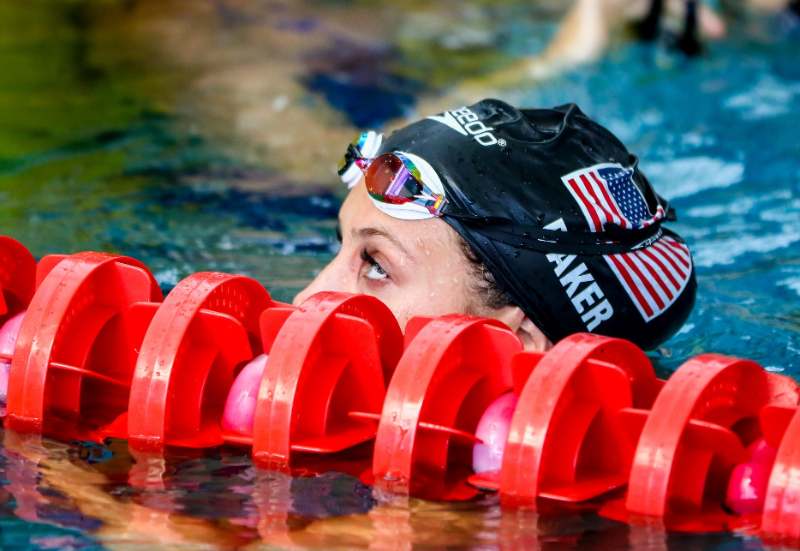
The answers are right there:
- Our technique broke down coming down the home stretch? Conditioning needs work.
- Half a body length behind off the start? Time to hit the gym and build horizontal power and work on better breakouts.
- Crashing halfway through the main sets at practice? Go to bed earlier each night and eat cleaner lunches and dinners.
Failure sucks, but it’s not something to be ashamed of.
Every hyper-elite swimmer to grace the Olympic pool—from Michael Phelps to Caeleb Dressel to Katie Ledecky to Sarah Sjostrom—have experienced searing setbacks and failures.
When failure does happen (and we both know that it will), treat it like an objective experience that can be constructive.
It’s one of the things that separate elite swimmers from non-elite. They frame mistakes as information rather than as verdicts (Kesler et al., 2026).
“Failing at something is the best way to learn what it takes to succeed at it. Failing to make the [1988] Olympic team was the beginning of my success, ironically enough.” – Summer Sanders, 1992 Olympic gold medalist
Coach feedback plays a role
Although fear of failure feels intensely personal (it sure does!), the environment plays a role, and that includes our swim coaches.
When we have a coach that adopts controlling interpersonal styles—external incentives, threats, pressure, and punishment—it ends up strengthening fear of failure.
But when coaches focus on personal progression and allow athletes to make decisions in the process, it can produce meaningful reductions in fear of failure (Moreno-Murcia et al., 2019).
You can’t always choose your coach, but if fear of failure is holding you back from swimming faster, have an honest conversation with your coach about how feedback is landing.
Orient towards process goals
Swimmers who struggle with fear of failure tend to be the classic outcome-focused goal setter.
They want the gold medal, the personal best time, the state cut—that big, greasy result.
The problem is that outcome goals are pass/fail tests. You either hit them or you don’t, and this lives right in the wheelhouse of fear of failure.
A smarter approach is to shift toward process and performance goals.
In a study with national-team swimmers, a structured goal-setting intervention that included short, medium, and long-term SMART goals produced significant improvements in confidence in success and overall motivation over a six-month period (Brat et al., 2025).
More importantly, swimmers who dropped out of the study cited lack of results. They weren’t seeing the outcomes they expected, suggesting that outcome-focused swimmers are more vulnerable when progress isn’t immediate.
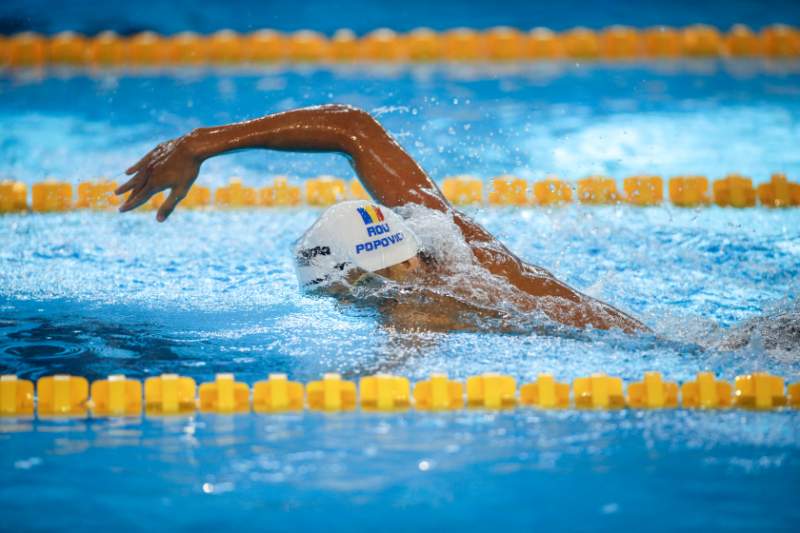
Process goals fix this by focusing on what you can control and giving you something that you can hang your motivational hat on that doesn’t require a PB or gold medal:
- Give a 9.5/10 effort in every main set
- Show up to every scheduled workout
- Arrive early for extra core or mobility work
- Execute your race plan when you step on the blocks
You end up outflanking your outcome goals by doing the things that actually produce them.
Instead of obsessing over the final result, you double down on the daily actions and habits that move you there anyway—without the fear and mental baggage that comes with chasing outcomes.
Process goals don’t eliminate fear of failure, but they redirect your focus and attention on the things you control.
Journal it out
Swimmers can better deal with fear of failure by dealing with bad races and performances in a smarter way. A quick structured journaling session can reduce self-criticism, stop overthinking mistakes, and help you recover emotionally faster.
A study (Neumann & McInnes, 2025) with competitive athletes showed that when they journaled out a performance, they were much better able to process what happened and move forward.
This wasn’t just venting—and it definitely was not rumination—it was a very specific framework that athletes followed right after a poor performance:
- Identify the mistake or failure
- Name the negative thought it triggered
- Reframe it as a learning opportunity
- Describe what they would do differently next time
Those last steps are the moneymakers. That’s what separates high-performance journaling from rumination (circling around and around a mistake or shortcoming) dressed up as reflection.
The beauty of this strategy is how low the barrier to entry is.
Five minutes in your training log after practice or a bad race. On the bus home from the meet. In the locker room after warming down.
Pen and paper. That’s it.
Fear of failure absolutely feasts on unexamined thoughts (remember that time traveling thought concept from earlier?).
Get it on paper, challenge it, reframe it, and let’s go.
The Bottom Line
Fear of failure is infuriating because it happens as the result of caring about your swimming.
You deeply want to succeed on race day. You want that state cut. That personal best time. To make the national team. You wouldn’t be afraid of failing if it didn’t mean something to you.
That’s raw competitive drive. It just needs to be pointed in the right direction.
The swimmers who walk the tightrope of caring too much and letting it overtake their performance don’t eliminate their fear of failure—but they do seek to understand how it works so that they can name it, redirect it, and get back to what drives fast swimming.
Ultimately, fear of failure will peak its head around the corner when race day or a big main set comes along.
But with the tips and strategies listed in this guide, you’ll be staring right back, ready to hit it with two barrels of excellence.
Want to keep building your mental game? Explore our complete guide to mental training for swimmers.