
Learn how long it takes to improve ankle flexibility for a faster underwater dolphin kick, what the research says about stretching and mobility, and how to safely build range for more speed and power in the water.
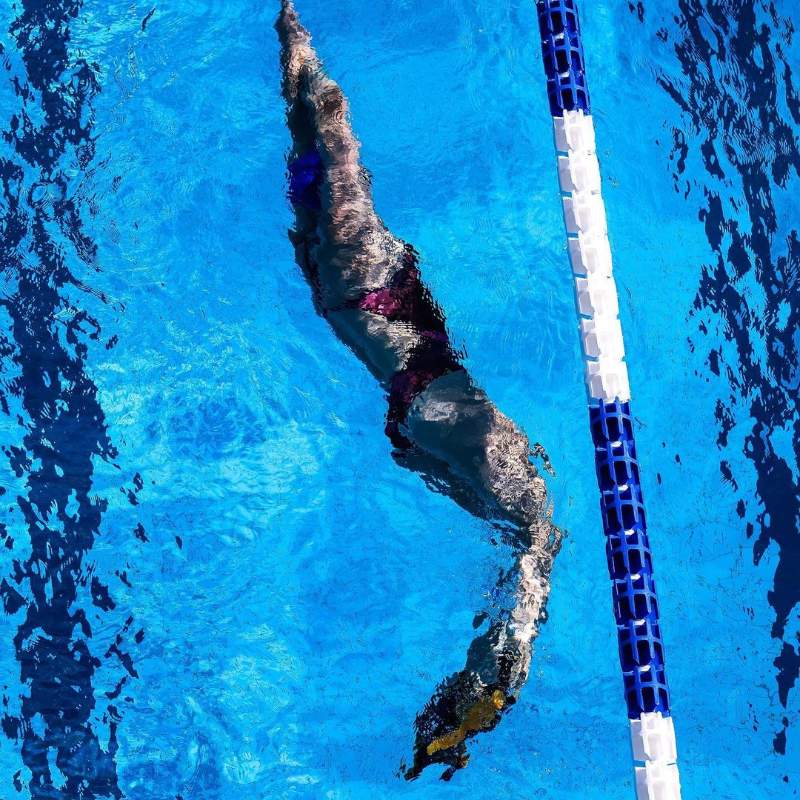
Flexible ankles are one of the biggest keys to a powerful underwater dolphin kick.
The more you can point your toes and rotate the feet inward, the more efficiently you kick through the water, pushing more water backward without having to kick wider.
Stiff ankles lead to excess knee bend, clunky undulation, and general sluggishness in the UDK.
Since almost all the propulsion in the dolphin kick comes from the feet, more ankle mobility generally means more speed.
It’s not a big shock that studies on dolphin kicking consistently show a strong link between ankle flexibility and faster kicking speeds (Shimojo et al., 2019; Sugimoto et al., 2008).
So how long does it take to actually loosen up those stiff cinderblocks on your legs?
We’ll take a look at what the research says, some best practices to maximize that new ROM, and let’s open up some faster dolphin kicking.
Ankle Flexibility – How Long Does It Take?
A study by Smith et al. (2019) compared three strategies for increasing ankle ROM—static stretching, foam rolling, and a combo of the two. Athletes did two stretching sessions per week over six weeks.
- Foam rolling took the win, with a 25.1% increase in dorsiflexion range of motion.
- Static stretching placed second with a 15% increase.
- And surprisingly, the combo approach came in at 13.5%.
The big takeaway from this study is that you can see significant improvement in just six weeks with two short stretching sessions per week.
What about more short-term effects? Like, just one session of mobility work?
In a study by Skarabot et al. (2015), 11 competitive swimmers did a series of ankle ROM sessions using a foam roller, static stretching, or a combination of the two. Measurements were taken after each session:
- Foam rolling and stretching: 9.1% increase in dorsiflexion
- Static stretching: 6.2% increase
- Foam rolling: no change
The effects were fleeting, however, with gains disappearing within ~10 minutes.
The moral of the story? Start today and implement ankle stretches 1-2 per week and see significant increases in range of motion in the ankles.
Why Improved Ankle Flexibility Doesn’t Always Increase Kick Speed
Alrighty, so you’re excited to loosen up those ankles. Time to hit the foam roller and stretching mat.
But before you do, keep in mind that increases in ankle ROM should be paired with ankle strengthening so that you can exert power at range.
For example: a study by Kuhn and Legerlotz (2022) found that acute increases in ankle range of motion did not immediately improve dolphin kick performance.
Researchers tested a group of swimmers to see if:
- Restricting ankle ROM (by 10.42%) slowed down their dolphin kick (it did).
- Increasing ankle ROM (by 6.87%) would increase kick performance (it did not).
Stretching out the ankle beyond the “normal” range of motion right before a swim practice didn’t improve kick speed.
Why?
- Static stretching before maximal efforts can reduce short-term power output. Studies in sprinting and weightlifting (e.g., Haddad et al., 2014) show that static stretching before explosive activity can decrease performance for up to 24 hours (!!!), due to temporary reductions in muscle-tendon stiffness and neuromuscular efficiency.
- Flexibility without strength is just slack. Stretching changes how your muscles and joints operate within their trained range of motion. Until strength “catches up” to the new flexibility, coordination and power can dip.
Increasing ankle flexibility is obviously important, but do it gradually and pair it with strength so that you can control and apply force through the full kicking motion.
Strength + Flexibility: Calf Stretch Cycles
Swimmers looking to get serious about developing a powerful underwater dolphin kick understand the importance of ankle strength.
Strong ankles point the toes faster, position the feet quickly during phase changes, and absorb the high amount of torque that the feet incur as a result of being at the tail of the whip.
Pairing them together—ankle flexibility and ankle strength—is an effective way to build strength in the ankles as they increase range.
Calf stretch cycles are my favorite type of exercise for this goal. Super simple, too:
- Stand on a raised surface (like the edge of a stair) so your heels can drop below your toes.
- Lower your heels slowly through the full range of motion.
- Pause briefly at the bottom.
- Raise your heels in a controlled motion to your “tippy toes.”
- Hold at the top for 2 seconds.
- Repeat 5–12 reps for two rounds.
This combination strengthens the ankle and calf through the entire motion—teaching the body to produce force even at the end-range of flexibility.
In-Water Mobility Work
While stretching and foam rolling get most of the attention, the water is a perfect place to improve ankle flexibility:
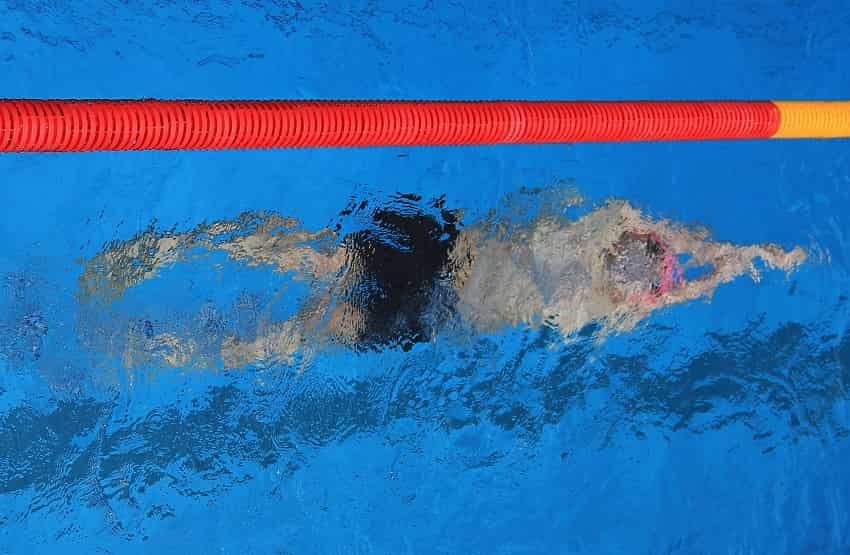
- Kick more! Thanks to the resistance of the water, each time you kick you are exceeding the ankle’s typical range of motion (Willems et al., 2014). So kick more!
- Kick with swim fins. Yup, every swimmer’s favorite tool—those soft, buttery training fins made for blister-free kicking—can also be used to increase ankle mobility. The added surface area on the fins creates a gentle pull of a stretch in the ankles.
- Exaggerate the movement. Increase kick amplitude (how “wide” your kick is) to 1.5-2x the normal width. Exaggerating the movement loosens the hips, back, and ankles, making it a perfect dynamic “stretch” in the water.
The Bottom Line
Improving ankle flexibility is important for swimmers looking to get more boom from their dolphin kick.
Work at it consistently and pair it with strength (jumping rope, calf cycles, etc.) to get long-lasting gains that not only help you catch more water, but to displace it for increased kicking speeds.
Happy kicking!
Grab the skipping rope. Add several minutes to your dryland workouts or pre-workout activation. Strengthen those ankles. And drop the boom on your underwater dolphin kick.