
Dryland training builds the strength, power, and stability sprint freestylers need to explode off the block, nail the turn, and hold speed to the wall. Here’s what to do and how to program it.
Sprint freestyle is a contest of power and small details—and it’s over in a chlorinated flash.
Good technique and smart training can get you most of the way there, but the strength, power, and stability that separate elite sprinters from the rest? Those are built out of the water.
That’s where dryland becomes essential.
Done correctly, it boosts start performance, adds propulsion to every part of the stroke, and keeps you driving to the wall instead of fading when it matters most.
In this guide, we’ll cover what dryland actually does for sprint performance, which exercises and training types sprinters should prioritize, and how to program it like a pro.
This article on dryland for sprint freestyle is part of our series on improving sprint performance. You can read more guides below.
Why Dryland Matters for Sprint Freestylers
The 50 freestyle is the most power-dependent event in swimming. Every part of the race, from the start to the finish, relies on your ability to generate lots of force, fast.
Dryland training develops exactly that.
Faster Starts
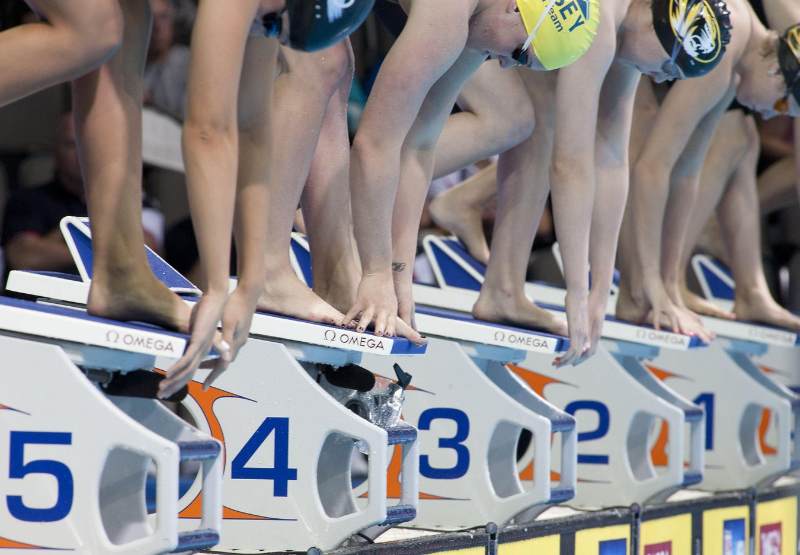
The start is the fastest part of the race—swimmers enter the water at 5-7 m/s—and sets the tone for everything that follows.
The block phase, flight, underwater dolphin kick, and breakout all depend heavily on lower-body strength and power. Stronger legs allow swimmers to generate more horizontal force during the launch of the block phase, carrying that speed into the flight and underwater phases.
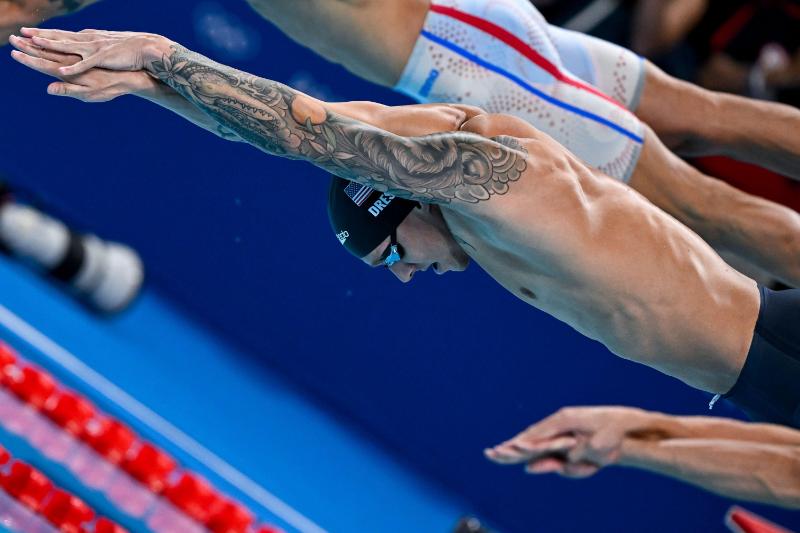
The result is faster times to the 5m, 10m, and 15m marks.
Research with sprinters of all levels support this connection:
- West et al. (2011) found a strong link between 1RM barbell back squat strength and start performance in world-class British sprinters.
- Keiner et al. (2021) also showed that max strength in squats explained a significant difference in start performance in swimmers.
Faster Turns
In short course 50s, the turn gives us an opportunity to inject a burst of added speed.
Dryland gives swimmers the strength, power and stability to charge into the turn quickly, rotate fast, and push off even faster.
- A study (Jones et al., 2018) showed that a strength training program that included squats, leg press, and countermovement jumps improved peak impulse by 21% in a group of youth swimmers.
- Various plyometric programs (Bahadoran et al., 2012; Potdevin et al., 2011) showed swimmers got to 5m faster after the turn.
The push-off on the other side of the flip turn is essentially a squat jump turned horizontally, so dryland to support this movement makes sense.
Faster Swimming
Dryland training also supports faster sprinting once swimmers reach the surface.
Sprint freestyle relies heavily on the ability to produce large amounts of force through the upper body, trunk, and legs over the duration of the race.
Several studies highlight the connection between dryland strength and sprint swimming performance:
- Amara et al. (2021) found a perfect connection between 1RM push-up strength and sprint freestyle velocity and stroke rate.
- Morouco et al. (2011) also saw a strong link between explosive bench press and swim power (measured on a tether) and subsequent sprint performance.
- Sammoud et al. (2021) saw a big boost in sprint kick times with an eight-week plyometric training intervention.
And so on.
While dryland research with swimmers can show mixed results, particularly with non-sprint performances, the evidence for sprinters is robust.
Greater strength and explosiveness on land consistently translates into faster propulsion in the water.
What Dryland is Best for Sprint Freestylers
The best dryland for improving sprint freestyle performance are strength training, plyometrics, and core training.
Together, they give sprinters the force, power, and stability to maximize what they are doing in the water.
Strength Training
Strength training—lifting weights in the gym—is the foundation for sprint freestyle. It gives swimmers the raw strength to apply more force during key parts of the race, from the start to a rooster-tail sprint freestyle kick that powers you to the wall.
Essential strength training exercises for sprinters include:
| Lower Body | Upper Body |
| Squats | Bench press |
| Deadlifts | Pull-ups |
| Hip thrusts | Bench pulls |
| Hamstring curls | Shoulder press |
Girold et al. (2007) saw that sprint freestylers improved 100 free times by 2.8% after three months of strength training, outperforming both a resisted/assisted group and a control group.
The best part about strength training is that it also works fast.
Yang et al. (2025) compared three types of dryland—maximal strength training, plyometrics, and muscular endurance training.
The heavy lifting group won convincingly, posting significantly faster 25m and 50m times—and showed clear improvements in just three weeks.
The plyometrics group needed the full six weeks to catch up, while the muscular endurance group lagged at every stage.
Effective, fast-acting—exactly what every sprint freestyler wants to see from their dryland training.
Plyometrics
Plyometrics train explosive power by targeting the stretch-shortening cycle (SSC the rapid stretch-then-contract sequence that allows the body to generate force quickly.
For sprinters, that means more explosive starts, faster turns, and quicker force production throughout the race.
Most swimmers default to vertical jumps when it comes to plyos—squat jumps, box jumps, countermovement jumps. These are important, but sprinters should also be training horizontal jump.
The start is essentially a horizontal jump, and horizontal force is what gets swimmers off the block with more distance and velocity.
In one study with swimmers, a nine-week broad jump intervention with saw big jumps (ha) in horizontal force, take-off velocity, and a 22% faster entry velocity (Rebutini et al., 2016).
Plyometrics can also boost kick speed (Sammoud et al., 2021) and even sprint swimming performance (Potdevin et al., 2011; Sammoud et al., 2019).
Essential jump exercises for sprinters include:
| Vertical Jumps | Horizontal Jumps |
| Squat jumps | Broad jump |
| CMJs | Bounding jump |
| Box jumps | Horizontal hops |
| Depth jump into vertical jump | Depth jump into horizontal jump |
The key is quality over quantity when it comes to plyometrics. Eager sprinters tend to load up on jumps, both within a session and over the course of a week.
Even though they are “easy” in comparison to the grunting and barbell-shaking effort of near-max strength training, the goal is speed and power, not endurance.
Core training
The 50 freestyle is organized chaos—limbs flying everywhere, maximal effort, redlining tempo from wall to wall.
The core is what holds everything together. It gives sprinters the stability to chase the high stroke rates required of the 50 freestyle. It exerts force through the limbs, helping you pull a little more forcefully with each stroke.
And yes—core training can directly boost sprint performance.
Karpinski et al. (2020) saw a 1.2% improvement in freestyle velocity with national-level swimmers. Age group swimmers saw even bigger gains—1.4s over a timed 50 free—in a study by Khiymai et al. (2022).
Sprinters should train all three types of core work:
| Stability | Strength | Power |
| Plank | Cable rotations | Med ball slams |
| Side plank | Pot stirrers | Med ball chest passes |
| Pallof press | Roll outs | Rotational throws |
The stability exercises give you the basic framework for body control when sprinting. The strength exercises level up your ability to exert force in every part of the stroke. And the power exercises increase explosiveness across the race.
Tips for Programming Sprint Freestyle Dryland
Dryland can be an effective tool for sprint freestylers, but like everything else in the water, execution matters.
Here are some key principles for structuring dryland training so that it actually improves sprint performance.
Train the full stability, strength, and power continuum
Sprinters are power-obsessed, which is fair. Sprint freestyle makes light bulbs explode with all of that power.
But elite sprinters build power on top of a foundation, following the stability > strength > power continuum.
This gives swimmers the fullest range of performance on race day.
- Stability training improves joint control and coordination, particularly around the hips, shoulders, and core. This helps swimmers hold strong positions. Streamline. Stable catch. Tight kick.
- Strength builds the raw force capacity of the muscles that drive the start, push-offs, kick and pull.
- And of course, power—teaching the body to apply that strength quickly, critical for explosive movements like the start, push-offs, and high-rate sprinting.
These three characteristics work as a system and should all be developed.
Recover between dryland and swim training
Dryland training—especially strength training and plyometrics—places significant stress on the neuromuscular system.
Heavy lifting, explosive jumping, and medicine ball work all tax the same power-producing systems swimmers rely on for sprinting. If these sessions are piled on top of demanding swim practices without consideration for recovery, the quality of both will crash.
Space out the sessions, even if it’s just a short break. A study by Arsoniadis et al. (2022) found that a 30-40 minute recovery break between strength training and swim training was enough for blood lactate, heart rate, and oxygen uptake to recover.
Obviously, pool and gym schedules play a decisive role in what happens here, but whenever you can carve out a short a short break, you’ll get more from both sessions.
Protect your sprint power
High-volume aerobic swim training blunts the power qualities sprinters rely on for fast swimming.
Haycraft and Robertson (2015) examined what happened to national-level swimmers during periods of high-volume aerobic training. As weekly swim volume peaked, the swimmers experienced significant drops in neuromuscular function and anaerobic power.
Strength and power development needs to be balanced against what’s happening in the water, not treated as an add-on.
Pair dryland with resisted swimming
Dryland training is most effective when paired with resisted swimming.
Wang et al. (2025) compared the effectiveness of different types of dryland training and found that combining resisted swimming with strength training outperformed other types of dryland.
In other words, swimmers got stronger in the gym, applied that strength to in-water resisted swimming, and then came out the other side with faster swimming speeds.
Resisted swimming tools include:
- DragSox
- Resistance tubing
- Power towers
- Parachutes
There are a ton of benefits of resisted sprint training—not the least of which is that it is the strongest in-water intervention for improving sprint swim speed—but it also best leverages what you are doing in the gym to the water.
Dryland Leads to Improved Sprint Performance
Sprint freestyle runs on power. Explosive leg drive off the block. Fast force recruitment into and off the wall. The ability to sustain high force output, stroke by stroke, all the way to the finish, and the podium.
Dryland training gives you the raw materials to do all of it better.
Build stability, strength and power in the gym. Pair with sound sprint mechanics and resisted training in the water.
And reap the speed on race day.
Happy sprinting!