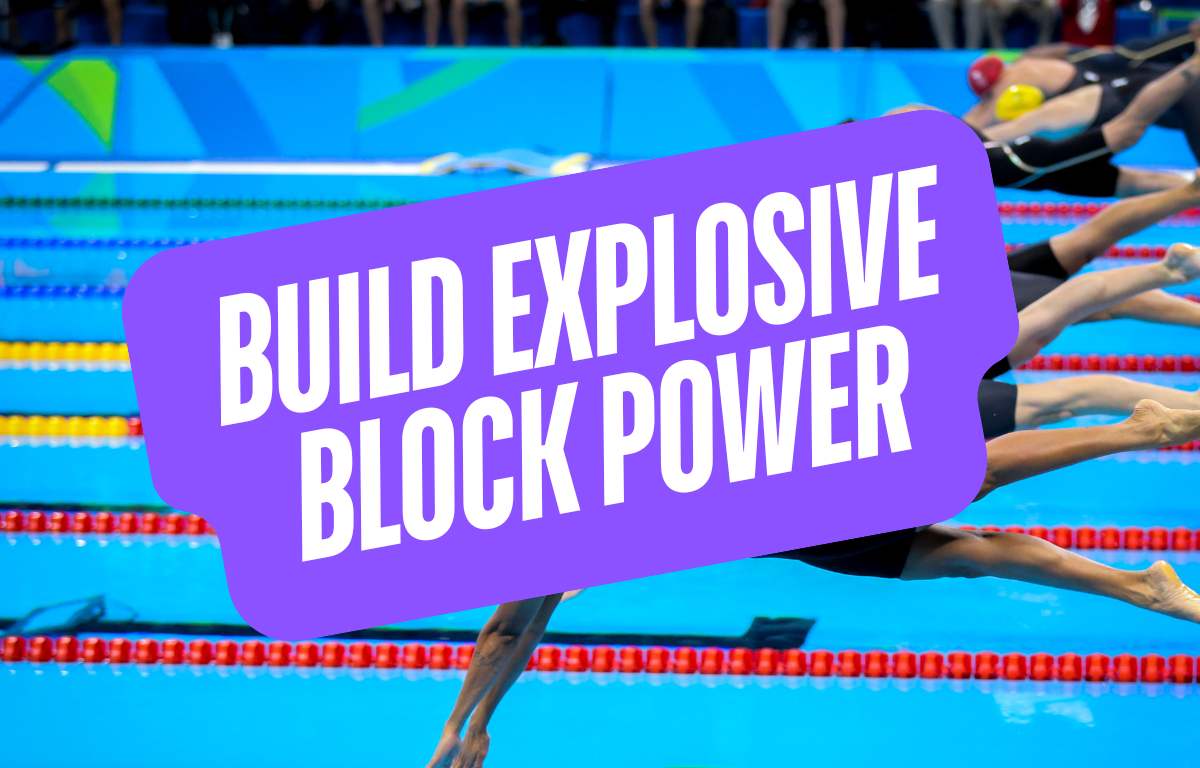

Powerful starts are a combination of horizontal force, sequencing, and the right training. Here’s how to build explosive power in the block phase of the start.
Getting off the block faster means a quick reaction time, force production, horizontal velocity generation, and sequencing the arms and legs to quickly and violently launch you off the block.
Previously we looked at how to set up the block phase—stance, leg positioning, and sequencing.
With that foundation in place, it’s time to generate block-rattling power to build a faster start.
How to Get Off the Block Faster
Fast starts are typically measured via reaction time. In swimming, this measures the time between the starter’s beep and your toes leaving the starting block, rather than the neural “first movement” measured in track and field.
Reaction time is the default metric for fast starts not because it’s the best way to measure start performance, but because it’s what the scoreboards and blocks measure. Time-to-15m would tell us much more (one day, maybe).
And there is some indication that reaction time matters at the margins.
A study (Valvassori et al., 2017) tracking sprinters across seven World Championship meets found reaction times were enough to potentially change final placings in around 4% of races.
Pro Tip: Practice starts to the actual competition horn, not a coach’s voice. Swimmers who did this for four weeks shaved ~13ms off their reaction time. The brain gets faster at processing the exact sound it’s trained to react to (Papic et al., 2018).
But a good reaction time doesn’t tell the whole story. It says nothing about the really important stuff that goes into a booming start, things like force, power, and velocity being generated on the block.
Research (Thng et al.) with over 150 elite swimmers looked at on-block factors to see what best predicted start performance. Spoiler: It wasn’t reaction time.
Instead, it was:
- Total force applied against the block
- Peak power output during the drive
- Horizontal velocity at toe-off
- Rate of acceleration from beep to leave
Reaction time is a general metric. It tells us that a swimmer got off the block quickly, but now how or why.
The goal isn’t to spend as little time on the block as possible—it’s to leave it with as much horizontal velocity as possible. A fast reaction time is the downstream effect of training for power, not a target in itself.
Build horizontal force for more power
When you leave the block, lots of horizontal velocity is everything. How fast you are travelling forward, parallel to the water, is what matters.
Shepherd et al. (2023) analyzed starts from national to international level swimmers and found that horizontal velocity at toe-off was the single biggest predictor of start performance.
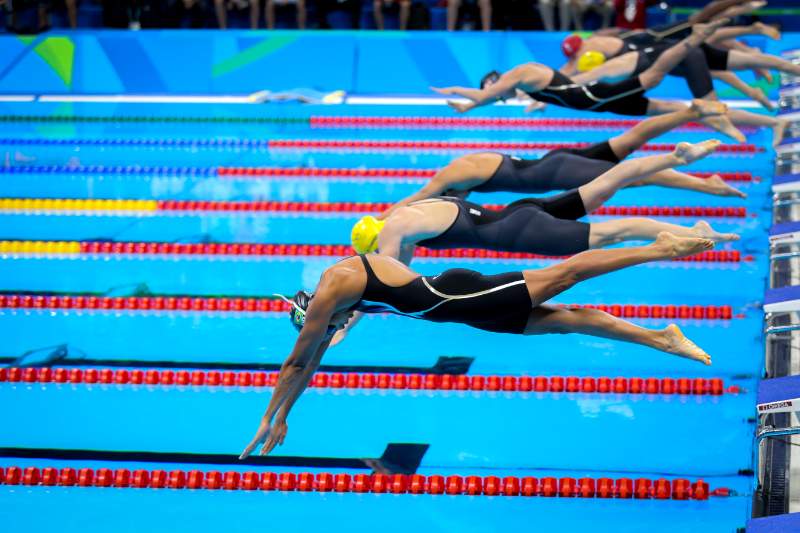
It was also the primary reason male swimmers were 0.17 seconds faster to 5m than females—not body position, which was nearly identical between the sexes, but the greater force males were able to produce off the block.
Getting your technique on the block is obviously important, but force production is where the chlorinated rubber meets the road.
Horizontal vs vertical
A study (Garcia-Ramos et al., 2015) of 21 elite women from the Slovenian national swimming team drives this point home with hard numbers.
Researchers had swimmers perform starts using a force plate, then tracked how various push-off variables correlated with times to 5, 10, and 15 meters.
The big winner: horizontal take-off velocity and average horizontal acceleration — essentially how hard you drive forward divided by your body weight. Swimmers who generated more horizontal force had faster starts.
What about vertical force—the “jump” component? None of the vertical force variables correlated with performance at all. Pushing high off the block doesn’t make you faster. Pushing forward does.
Use the arms to slingshot you off the block
The arms play a quiet but fundamental role in the start—they trigger the start and direct where your body goes as you leave the starting block.
Takeda et al. (2016) measured hand, front foot, and rear foot forces independently during the start. The arms fired first, accelerating the center of mass forward before the legs have completed their push.
At this point the arms are actually pulling down on the starting block—which loads the legs and creates tension to give the body has something to push against.
Ther arms are also vital for “pointing” the body horizontally as you leave the block.
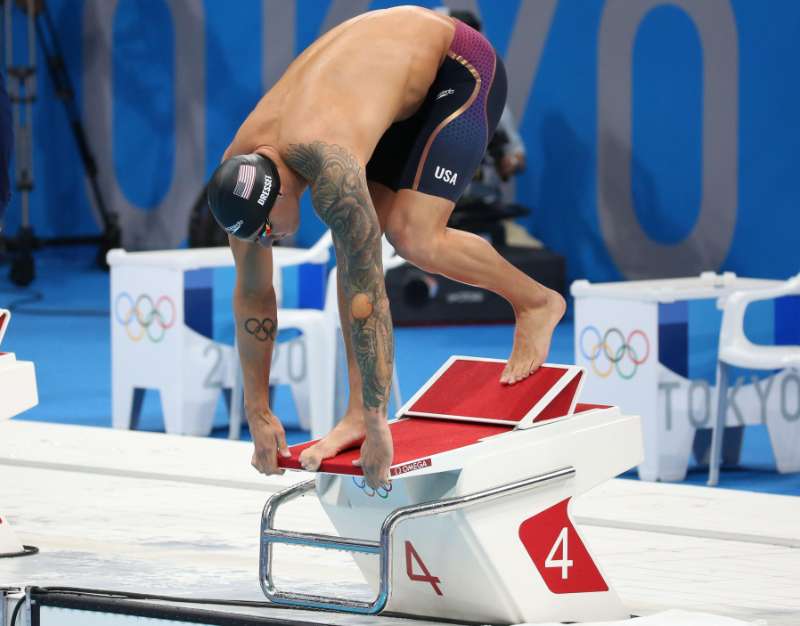
Hyodo and Wada (2023) showed that using the arms at take-off improved forward velocity by around 7%. When swimmers didn’t use their hands, they tended to drift vertically when leaving the block.
The arm pull helps keep the trunk oriented horizontally so that all that leg power gets directed forward instead of sending us up into orbit.
The legs generate way more raw force than the arms—the rear foot contributes roughly seven times more horizontal force than the hands. But the arms’ job isn’t to out-power the legs. It’s to start the movement and steer it.
During the start, the arms:
- Pre-load tension into the block before the starter’s beep
- Fire aggressively to initiate forward acceleration
- Help keep the trunk oriented horizontally so the legs can drive the body forward instead of upward
The arms start and direct the movement, so use them to grip and rip.
Sequence the launch
Although the start feels like a unified movement, things happen sequentially. The legs and arms don’t all take the wheel at once—they have different roles during the start.
Thng et al. (2021) broke down the block phase piece by piece:
- The rear leg, the engine, fires first and sustains force application all the way to toe-off.
- The grab phase peaks in the first half of the block phase, the arms pulling on the block to create full-body tension.
- The front leg fires last and briefly, but its horizontal peak force was a strong predictor in start performance. Which means you should be trying to push backward with that front foot and not just pushing down.
[call out box] Rear leg → grab → front leg must fire in the right order and at the right intensity for a powerful block phase.
Here’s a detailed look at how this sequence plays out:
| Phase | What’s Happening | % of Block Time |
| Reaction | Brain processes beep; muscles prepare to fire | 0-15% |
| Early | Rear leg initiates drive | ~15% onward |
| First half | Grab/pull force peaks | 25-50% |
| Late middle | Rear horizontal and resultant peak | 60-80% |
| Final push | Front leg horizontal peak | 88-95% |
Two other findings from Thng et al. (2021) have direct implications for how swimmers and coaches should train the start:
- First, average power was the big predictor for 15m start times. Stronger than take-off velocity or total work. This means being fast across the whole block phase matters more than being explosive at just one moment.
- And second, for swimmers who already generate lots of power, the next performance lever is orientating more force horizontally. If you’re already strong, get stronger in the right direction.
The start isn’t just a blind jump and dive into the water.
When done at a high level, it follows a reliable sequence, and understanding that sequence is what separates technical development from just telling swimmers to push harder.
Build maximal force in the gym
Faster block phases require stronger legs. And those stronger legs get built in the gym.
West et al. (2011) tested eleven British international sprinters and—surprise, surprise—found that swimmers who got to 15m were also the strongest and most powerful in the gym. Barbell back squat 1RM correlated strongly with time to 15m.
Big squat numbers also lined up with how much horizontal and vertical force swimmers produced on the block itself—and as we have seen:
Horizontal force on the block = more speed into the water.
Squats in particular are important as they train the same muscles—quads, glutes, hamstrings—that extend the hips and knees explosively during the start.
The stronger the squat, the more maximal force production, and the faster the start.
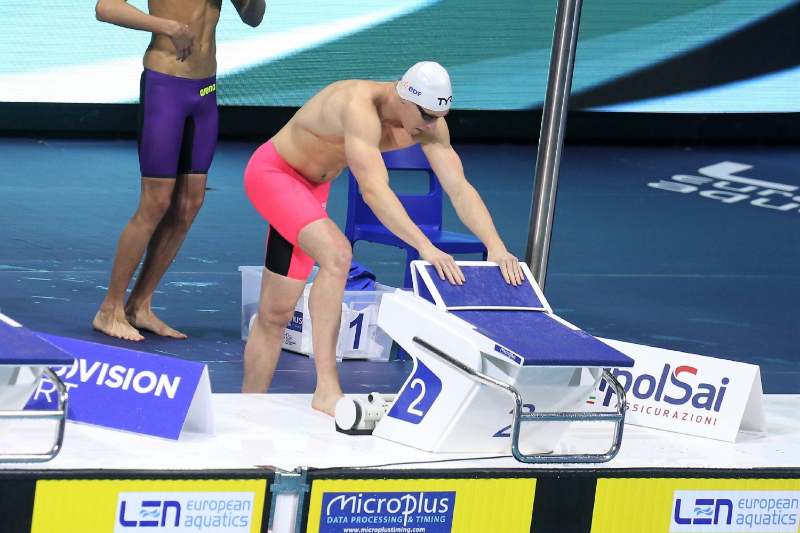
In terms of what to prioritize in the gym:
- Heavy squats to build the maximal force base that underpins everything else
- Dumbbell jump squats to develop rate of force development
- Split squats and Bulgarian split squats to build single-leg strength and stability to match the staggered stance on the block
A well-rounded strength training program includes all three to give swimmers the force for a powerful block phase and fast start.
Build power with plyometrics
Plyometrics (jump training) are a classic training tool for improving start performance as the start is an explosive jump movement. The key is training them in a way that actually replicates the forward power demands of the block phase.
Rejman et al. (2017) showed that six weeks of plyometric training with national-level swimmers saw big gains in take-off velocity, entry angle, and flight velocity.
Exercises included power skipping, squat jumps, alternate sprint bounding, knee-tuck jumps, step-up jumps, horizontal hops, and medicine ball throws for the upper body.
See also: 6 Benefits of Plyometrics for Swimmers
Overall start time dropped by around 7.5%, entry velocity increased, and swimmers entered the water flatter, carrying more speed into the underwater phase.
Rebutini et al. (2014) pushed this idea further with nine weeks of horizontal long jump training off an inclined platform (just like a starting block).
The results were pretty awesome:
- Horizontal force on the block increased 7%
- Total impulse increased 9%
- Direction of force shifted 19% more horizontal—swimmers were pushing more forward and less upward
- Horizontal take-off velocity improved by 16%.
And here comes the caveat. Standard plyometric training that focuses on vertical jump height has little carryover to start performance.
Benjanuvatra et al. (2007) found that among elite swimmers, jumping ability had virtually no relationship with start performance. A separate study (Davies et al., 2001) found that a 10% improvement in vertical jump produced zero improvement in start performance.
The swim start is a horizontal event. Train it that way.
Strengthen the core
Core strength improves the swim start by enabling better force transfer across the kinetic chain—meaning the power your legs generate on the block actually reaches the water instead of being absorbed by an unstable and floppy trunk.
A study (Karpinski et al., 2020) had sixteen national-level swimmers do six weeks of core training. Simple core exercises most swimmers will recognize: flutter kicks, single leg v-ups, Russian twists, and so on.
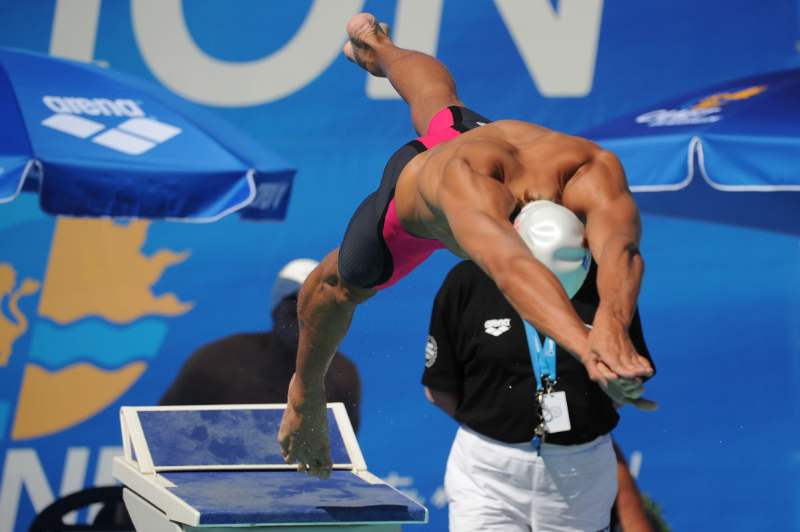
The biggest change in swim performance after six weeks—which included faster 50 freestyle performances—was how core training affected the start:
- Reaction time improved by nearly 12%
- Total time on the block reduced by almost 10%
- Entry velocity jumped by 4.3%.
The control group, doing everything else the same, actually got slower on entry.
Better core stability means more of the force you generate on the block makes it into the water.
Train hard in the gym, work start technique, do your plyos and heavy squats, but layer on core training to put those things together on the starting block.
Block Power Checklist for Faster Starts
The job of the block phase is to leave the block with as much horizontal velocity as possible—fast, flat, and forward.
- Train for power, not reaction time
- Drive hard and horizontally; we are going forward, not up and not steeply down
- Grip and rip with the arms to initiate movement and keep the body pointed forward
- Fire in sequence—rear leg, grab, front leg, in the right order and at the right intensity
- Push backward with the front foot, not just down
- Build strength and power in the gym. Heavy squats, horizontal plyo
- Core training to lock in and project all that force
You’ve set up with a stance and body position on the block that rewards power. Now develop and unleash that power in a way that sends you flying off the block.
Next in our series of articles on building a legendary start, we will examine the flight phase.