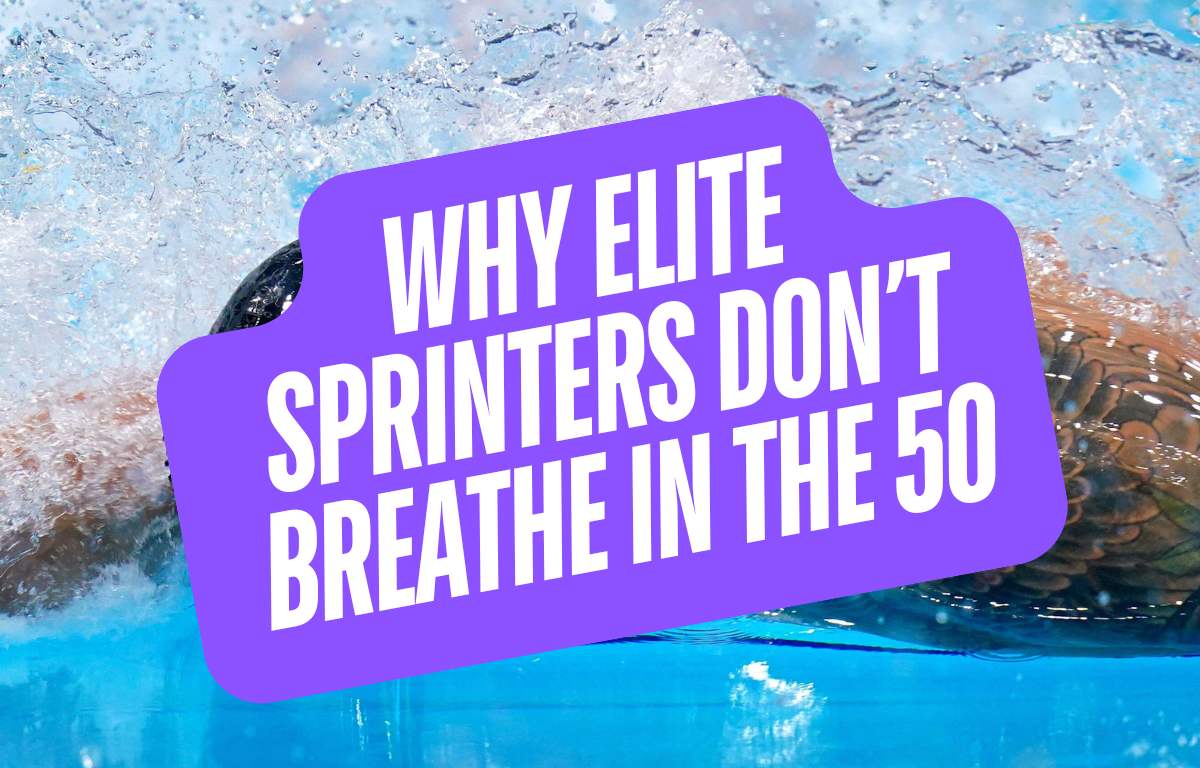

Should you breathe in the 50 freestyle? Here’s why elite sprinters avoid breathing—and how to train yourself to breathe less.
The 50 freestyle is a race of competing compromises. In a perfect race, you put your head down, pull and kick your chlorinated brains out, hit the wall, and boom—new PB.
But for most swimmers, as the race goes on, there’s that unmistakable panic to slurp down air rising in their throat.
While taking that breath can quench that air thirst, it also disrupts stroke mechanics and costs speed.
Understanding why this happens, why elite swimmers opt for few to no breaths, and how to train yourself to breathe less—can get you closer to that perfect splash and dash.
This article is part of our series on improving freestyle sprint performance. You can read more guides below.
Should You Breathe in the 50 Freestyle?
Elite swimmers take zero to one breaths in the 50 freestyle because breathing disrupts stroke mechanics and reduces speed. Some swimmers still take a quick breath late in the race if it helps them maintain power and stroke rhythm.
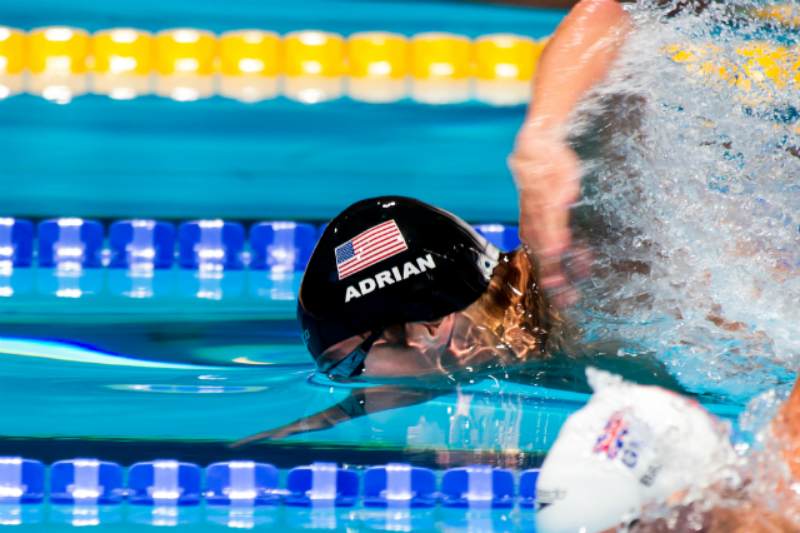
The common explanation for why the elite 50 freestylers on the planet—Cam McEvoy, Caeleb Dressel, Jordan Crooks—hold their breath is because the 50 free runs purely on the ATP-PC system.
This energy system is explosive—true boom-boom—and powers the start, breakout, and those early powerful strokes.
But it has a shelf life of an over-priced tech suit, lasting only around 8-10 seconds before depleting quickly.
The other part of the anaerobic system—the glycolytic system—is also on the job right from the starter’s beep, contributing significantly from start to finish.
For example:
- Mavroudi et al. (2023) found that lactate production was fastest in the first 25m of the 50m free.
- Sengoku et al. (2024) tested 17 international-level sprinters and found that the fastest swimmers were also the fastest lactate producers.
The 50m freestyle is almost completely anaerobic—Rodriguez and Mader (2011) pegged the aerobic system’s contribution at around just ~4%. This means that metabolically speaking, swimmers don’t actually need oxygen to finish the race.
This tells us something important—that the urge to breathe mid-race is almost always a CO2 alarm, and not an oxygen alarm.
How Breathing Changes Sprint Freestyle Technique
Even a single breath when sprinting can have measurable effects.
Proper sprint freestyle technique relies on continuous stroke overlap, the pull remains uninterrupted, and the hand accelerates powerfully under the body. Breathing disrupts all three.
McCabe et al. (2015) had swimmers do a 25m freestyle sprint with one breath and with no breath. The headline finding—swimmers slowed by 2.8% when breathing just once.
The slowdown came from changes in stroke mechanics:
- Hand entry slowed down by 3.3%
- Shoulder flexion dropped by 8%
- Duration of the pull phase increased by 14%
Another study (Psycharakis & McCabe, 2011) saw an identical slowdown in speed (1.81 m/s vs 1.76 m/s) in 25m sprint times when swimmers took a breath.
They noted other technical changes in the stroke:
- Breathing increased shoulder roll by 15% and hip roll by 21% on the breathing side
- Swimmers reached peak shoulder roll earlier in the stroke, disrupting stroke timing
And there’s another small but useful advantage to skipping the breath: lungs full of air increase buoyancy.
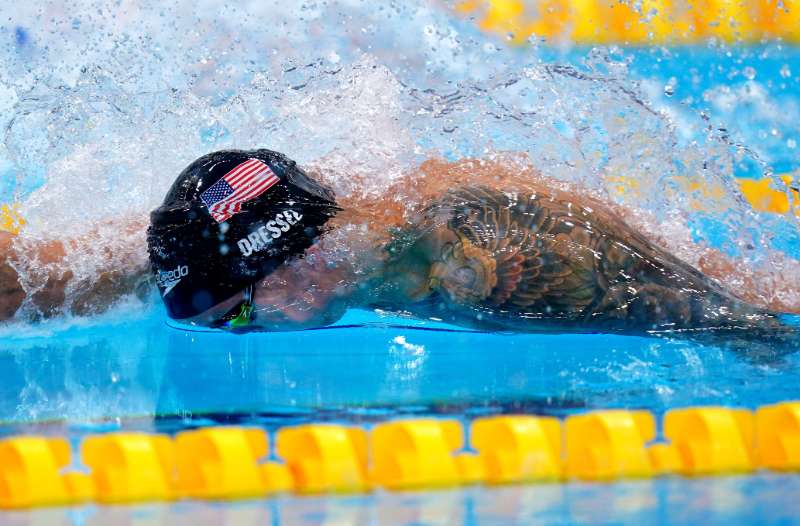
That extra buoyancy helps keep the body higher in the water, improving body line and reducing drag. When we exhale underwater or turn our head to breathe, we release that buoyancy and then have to reinflate the lungs mid-stroke, which can subtly affect body position.
For this reason, swimmers trying to go breathless in the 50 free should avoid exhaling during the race, as keeping the lungs full helps maintain buoyancy and body position.
Breathing is a constraint that changes how we coordinate the stroke during regular freestyle swimming, but when sprinting it can turn into a parking brake.
The Main Physiological Limitation – C02 Build Up
That familiar and uncomfortable urge to breathe when face-down in the water is driven almost entirely by rising carbon dioxide (CO2) levels in the blood, not by falling oxygen.
Your body is telling you to breathe, but for short duration sprints, you have more than enough oxygen on board to complete the lap.
Getting comfortable with that feeling of creeping panic is trainable. Consider Caeleb Dressel or Josh Liendo, who sprint 100-yard butterfly races and don’t take a breath on that final lap.
That’s not genetic or some superhuman ability to race without the need of oxygen, but the result of progressive training over years, acclimatizing their bodies to know the difference between truly needing air and the overly cautious alarm bells of CO2 buildup.
Safety Note: Breath-holding in training should always be done progressively and under supervision. Shallow water blackout is real, and swimmers should never attempt prolonged or extreme breath-holding challenges. Build CO₂ tolerance gradually and safely.
The good news is that even small manipulations in breathing can boost sprint performance.
A study (Jacob et al., 2015) took a group of swimmers and had them do 6 maximal breaths within 30 seconds, take 30s rest, and then swim a 50 free for time.
After the six-pack of maximal breaths, swimmers:
- Swam 0.29s faster
- Took fewer breaths (1.88 vs 2.66 on average)
- Swam 6m further before their first breath
- Stroke rate increased slightly
- Lactate levels were identical in both conditions
That final point is particularly important. Improvement didn’t come from additional energy production, but from lower CO2 levels reducing the urgency to breathe.
There’s a lot that goes into mastering sprint freestyle, but breathing less is a trainable performance advantage, especially for swimmers who currently have to suck down half-a-dozen breaths to complete a long course 50 free.
How to Breathe Less in the 50 Freestyle
Breath control has to be trained at swim practice. Some strategies to get more comfortable with reducing your breath count:
Set the baseline
Before changing anything, you need to know where you are starting. How many breaths do you currently take in a 50 freestyle? Two? Three? Breathing every two strokes the whole way?
This number gives us a useful benchmark and something to progressively improve from.
Breath count sets
Work breath count sets into your training. Instead of vague goals like “breathe less,” be intentional!
Examples:
- 8×50 freestyle swim cruise, two breaths per 25
- 16×25 freestyle swim cruise, one breath per 25
That simple!
Sets like these are awesome for just making you more aware of the effects of C02 buildup and gradually get you more comfortable with it.
Once you get past that early surge of discomfort, swimmers often realize they can go much further without breathing than they originally thought. Potential side effects include making eye contact with the tiles at the bottom of the pool longer.
Respiratory muscle training (RMT) devices
Respiratory muscle training devices are essentially weight training for your breathing muscles. You set a resistance level, and then inhale and exhale against it.
They strengthen the muscles responsible for inhalation and help swimmers take in air faster and more forcefully.
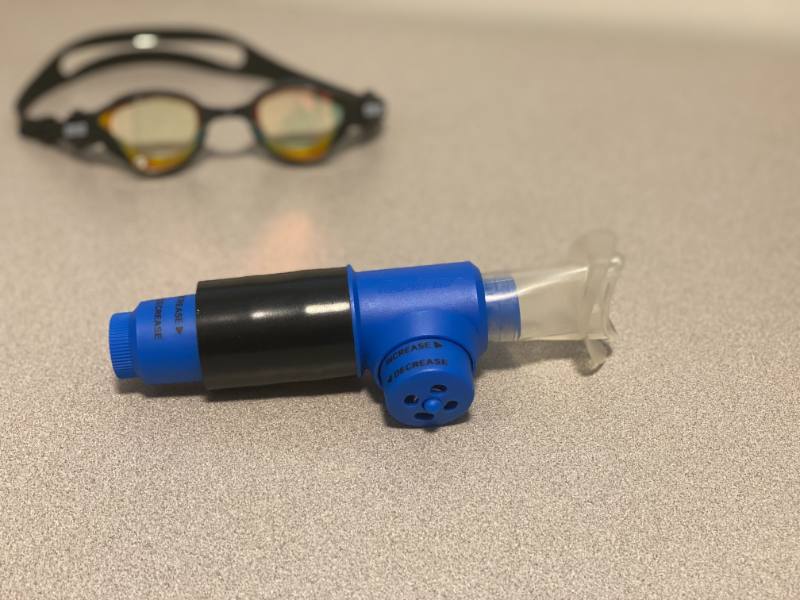
Research with swimmers has shown that respiratory muscle training can improve swimming speed, inspiratory volume, inhalation speed, and even CO₂ clearance under high-intensity conditions (Tan et al., 2023; Salazar-Martinez et al., 2017).
Best of all, no pool or additional meters required—they can be used at home or on the road.
Sprint sets with no breath
And by sprint sets, I don’t mean banging out 30×25 fast on short rest—but full 25s off blocks, tons of rest, no breathing.
For example:
- 8x15m freestyle all-out with drag chute on 3:00 (no breaths)
- 6×25 free sprint off the blocks on 2:00 (no breaths)
One of the defining characteristics of 50 freestyle sets is that they are short on intensity, long on rest—holding your breath during this work should be relatively easy.
The breath-control skills developed during moderate-intensity breath-count sets carry over nicely to these maximal efforts.
Over time, these sets build the confidence and physiological tolerance needed to control your breathing in the 50 freestyle. On race day, the number of breaths you take—or don’t take—becomes a choice rather than a necessity.
Breath or No Breath – Performance First
Breathing in the 50 freestyle is a compromise. Well-trained swimmers will better be able to deploy this skill, while developing swimmers will want to start with a baseline and steadily work their way down.
For sprinters who need a mid-race breath or three, take them quickly, build stronger inspiratory muscles (ahem, the RMT device), and avoid stroke mechanic breakdown so you maintain speed.
An elite 50 freestyle is built by accumulating small advantages, and reducing the need to breathe is another one of those little performance-boosters you can take with you to the block.
Happy sprinting!