
The sprint freestyle kick is one of the most undertrained skills in the 50 free. Here’s how to develop the power, tempo, and mechanics that make it a weapon.
The freestyle kick is one of the more misunderstood parts of sprint freestyle performance.
We see the big rooster tail of white water, the feet spitting up chlorinated water into a frothy fountain, but tend to focus on the pull.
At sprint speeds, the kick is far from passive. It drives propulsion, elevates body position, controls the rotational chaos of the upper body, extends the arm stroke, and powers faster breakouts.
Training the freestyle kick is often done on the kickboard, with long, steady-speed sets. While that builds a solid kick foundation, a sprint freestyle kick is a different beast altogether.
Powerful, high frequency, tight and controlled, and built to coordinate with the upper body.
Building it requires understanding what it actually does, what it looks like, and how to train it to match the demands of the 50 freestyle.
Let’s get to kicking.
This guide to sprint free kick is part of our collection of articles on improving sprint freestyle performance. You can find other resources below.
Why the Sprint Kick Matters
Sprint freestyle is a contest of power, and the legs are a bigger part of that equation than most swimmers realize.
For starters, a strong kick means faster sprinting.
A study by Strzala et al. (2021) found that a 20s tethered kick test was a stronger predictor of 50m freestyle speed than a 20s tethered pull test or several common dryland tests. Morouco et al. (2015) did some sprint tests with national-level swimmers and saw that the legs produced between 29.7% and 33.4% of mean force.
In other words, fast kickers generate more swimming power in the water.
But wait, there’s more!
At sprint speeds, the kick:
- Elevates body position. A powerful kick narrows the body angle when sprinting and reduces frontal drag.
- Controls rotational chaos. At peak speeds, the body is moving fast and working hard to balance itself. High stroke tempos mean aggressive shoulder rotation and arm recoveries. The kick acts as an anchor, keeping this hips from spinning out of control.
- Extends the arm stroke. Stroke rate gets all the attention in sprint freestyle, but at the elite level, stroke length is what separates medalists from the rest (Staunton et al., 2025). The kick slightly extends the arm stroke, giving sprinters more water to grab at the front of the stroke.
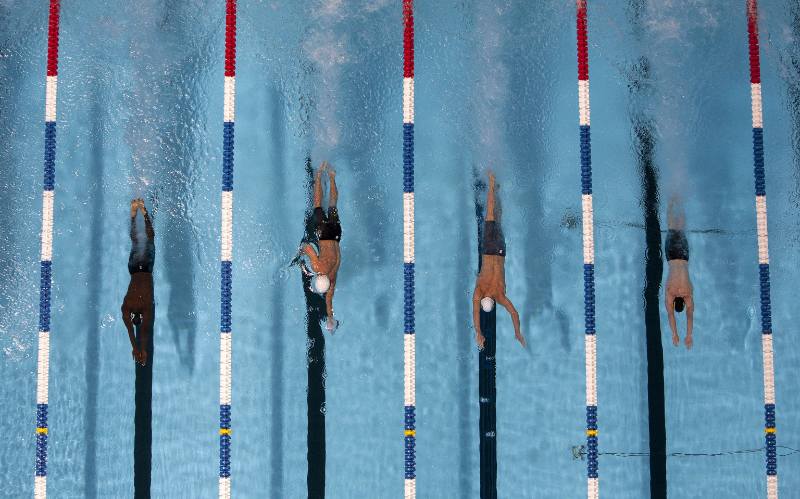
- Powers faster breakouts. The kick is also helpful in getting us to explode through the breakout. Leg-generated force is strongly linked with faster breakouts (Strzala et al., 2021).
Additionally, a sprint kick is essential for successful sprinting. It’s one of the things that makes sprint freestyle technique totally unique from other speeds of freestyle.
At cruise to slow freestyle swimming speeds, swimmers use a variety of kicking strategies. Some use a feather-light two-beat kick. Others a more moderate flutter. But once you hit sprint mode, that variability disappears.
At top-end speeds, everyone is tapping into a strong, fast kick.
Here’s an overview of how the sprint version differs from your standard freestyle kick:
| Freestyle Kick | Sprint Freestyle Kick | |
| Primary role | Stabilization and body position | Propulsion, stabilization, body position |
| Direct propulsion | 0-6% | 10-15% |
| Kick pattern | 2-beat, 4-beat or 6-beat | 6-beat |
| Tempo | Slow to moderate | Very high (~150 kicks/min) |
| Amplitude | Wider range of motion | Tight and compact |
| Training focus | Endurance and technique | Power |
What a Sprint Freestyle Kick Looks Like
Fast sprint freestyle kicking looks violent and chaotic from the stands. Up close, it is really controlled and precise.
Here’s what’s happening under all of the exploding water:
- Powerful. Each kick displaces a lot of water, pushing it backward rather than downward. Flexible ankles, strong legs, and powerful hips all contribute.
- High frequency. Elite sprinters have been clocked at around 150 kicks per minute (Gatta et al., 2012). That cadence demands muscular endurance and fast neuromuscular firing.
- Tight and controlled. Sprint kicking uses less amplitude than regular swimming. The legs don’t travel as far up and down, keeping the kick snappy and reducing drag.
- Well-conditioned. The kick is much more metabolically expensive than the arm stroke. Energy cost per meter is much higher in the legs than the arms. Fast legs are fit legs.
- Connected. Kicking fast on a kickboard is one thing. Linking it to the full stroke and the sprint freestyle pull is where the real gains happen.
Fun fact: Kick power actually drops at top swimming speeds, decreasing by as much as 68% as swim velocity increases. Why? Because amplitude shrinks, coordination becomes more demanding, and the higher arm tempo means the kick has to speed up just to slot its beats into the arm stroke.
How to Build a Thunderous Sprint Freestyle Kick
Building a sprint kick for a faster 50 freestyle requires attacking it from several angles. Mobility, strength, power, and in-water specificity.
Which means sprinters should focus on:
- Ankle flexibility. How much range of motion you have in the feet is one of the strongest predictors of kick speed (McCullough et al., 2009). Flexible ankles catch and displace more water with each kick, crucial at sprint speeds where every inch of range of motion matters. Ankle rockers, wall calf stretch, and simply kicking more are the most effective ways to develop it.
- Ankle strength. Ankle strength is a key (and often overlooked) ingredient for a fast sprint kick. Strong ankles transfer power from the hips and legs into the water, and withstand the high torque of fast kicking. Banded plantar flexion, calf raises, and jump rope are the go-to dryland tools.
- Core stability. The quiet foundation of fast kicking. The core prevents the hips from fishtailing, stabilizes the platform the legs kick against, and becomes even more critical at sprint tempos where shoulder rotation and torso twist demand precise control. Two-point planks, pot stirrers, and roll outs give the stability to exert more force.
- Lower body power. Time to hit the gym. Squats, plyometrics, and conditioning work targeting the quadriceps, hamstrings, glutes, hip flexors, and calves. A fast kick is built in the water, but the foundation of power is built on land.
Pro Tip: Pair strength training in the gym with in-water resisted kicking with a drag chute for maximal gains. This combo led to 30m kick time improvements of 1.2s in one study (Amara et al., 2022).
And of course, train your legs in the water:
- Kick fast in a tight window. Sprint kicking uses less amplitude than most swimmers expect. Training with a smaller, more compact kick range builds the neuromuscular pattern that actually shows up at race speed.
- Target high tempo. Short, fast bursts of vertical kicking are the most effective way to build kick cadence. Use cues like “kick like a hummingbird” or “fast and tight” to dial in the right feel.
- Break the surface. Feet should exit the water on the upbeat for maximum propulsion—when the foot leaves the water, velocity increases and more backward-directed force is generated with each kick.
- Resisted kicking. DragSox, chutes, and tubing build sprint-specific strength while retaining mechanics. Use resisted kicking for post-activation potentiation, pure power development, and even to promote a smoother upkick phase.
Kick for Sprint Success
The sprint freestyle kick is one of those skills that should be developed alongside full-stroke swimming.
Isolating the movement and muscle groups allows you to generate more force and power than you would when sprint swimming. Then take those gains and apply them to your regular stroke.
Start with the fundamentals—ankle flexibility, ankle strength, and core stability. Steadily layer in strength and power work in the gym. Then bring it home with high-tempo, tight-window kicking in the water, resisted kicking, and plug that newly developed kick into your stroke.
For swimmers who want to get serious about their sprint freestyle, including how the kick fits into a complete sprint performance system, check out our complete sprint freestyle guide—or for swimmers ready to go all-in, my book The 50 Freestyle Blueprint covers everything in depth.
Learn more at the link below, and happy sprinting!