
Looking to swim the 50 freestyle faster? Here are seven proven strategies for uncorking more speed in the splash and dash.
The 50 freestyle is a race of pure power and white water, where every tenth of a second counts.
Sprint freestyle relies on a powerful stroke, high stroke rate, explosive start, thunderous underwaters, and using the right stroke coordination to hit and sustain high speeds.
Despite the short length and relative simplicity of the race—it’s over in 20-30 seconds and tasks swimmers with swimming just one or two lengths of the pool—it can be tough to master. Small mistakes are amplified, and because it is so short, dropping time gets exponentially harder the faster you get.
In this guide to swimming a faster 50 freestyle, we’ll discuss some evidence-based and battle-tested ways to improve sprint freestyle performance. Some obvious, some not so obvious.
Work through them, and you will start to drop those precious tenths or even seconds in the fastest event on the swimming program.
Let’s begin.
This guide to improving 50 free performance is part of our series on boosting sprint freestyle. You can read more guides below.
What Actually Determines Speed in the 50 Free
Tips to improve 50 freestyle performance include:
- Resisted swimming
- Increase stroke rate
- Build an explosive start
- Use the right technique
- Breathe less
- Kick like a monster
- Improve core strength
Next, we will look at each tip in more detail, offering some training advice for implementation, and more.
Resisted swimming
Resisted swimming, using different types of gear and equipment like drag chutes, DragSox, resistance tubing, and power racks, is a way to improve your ability to generate power in the water.
Power (force x velocity) demonstrates how much force you can quickly create in the water, and to swim a fast 50 freestyle, you need to be able to create a lot of force and make it last for the duration of the race.
Resisted swimming is the perfect tool for this job.
One study (Grznár et al., 2018) with elite swimmers had them do parachute-resisted sprint training over eight weeks. These swimmers saw 25m sprint time improve by ~3.7%. Peak swimming power also jumped by ~11%.
Even more importantly, resisted sprint training significantly outperformed a control group that sprinted without resistance.
The resisted group showed bigger gains in short-distance speed and stroke power, indicating better transfer of force into forward velocity—exactly what separates fast 50 freestylers from merely strong ones.
Sample maximum power set: 8×10 seconds all out freestyle swimming against maximum resistance tubing on 2:00
This type of set works for the 50 freestyle when use full power and full recovery:
- Use lots of rest. 90-120s between repetitions to replenish phosphagen stores.
- Low repetitions. 5-10 reps to promote peak power output. This type of training is very hard on your nervous system, so don’t overdo it.
- Short bursts of effort. 6-15s long to focus on building alactic power.
Sprint training is simple, powerful, and requires full recovery, and yet countless swimmers train in a way that encourages power decay and insufficient rate of force development.
Increase stroke rate
Sprinters use a much higher stroke rate compared to other freestyle events.
For example, at the Paris Olympics, the average stroke rate of the finalists in the men’s 50m freestyle was 62.21. Compare that to the finalists in the 100m freestyle (51.4) and the 200m freestyle (42.3).
That’s almost a 50% difference between the 50 and 200!
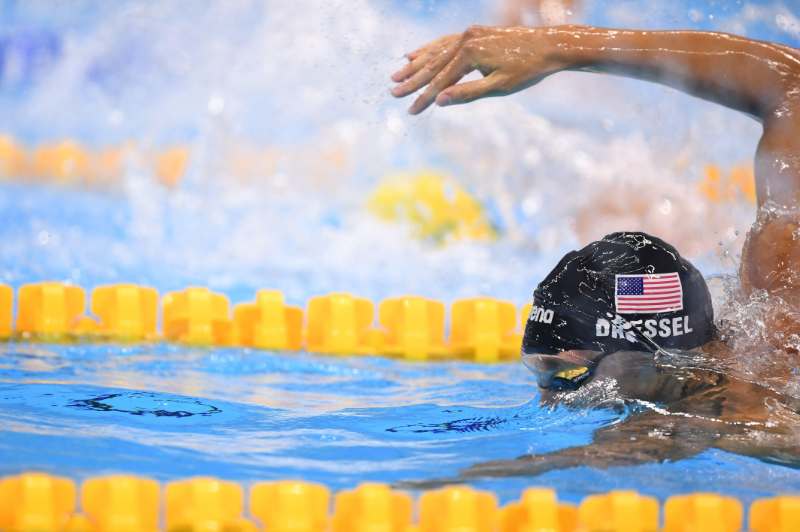
A faster stroke rate is an obvious way to increase speed; the more often you complete a stroke cycle, the more distance you are going to cover, the faster you are going to swim.
The challenge is building the power and endurance to maintain that elevated stroke rate and sustain velocity for the full 50m, which means hitting your target 50 freestyle tempo much more often in training.
Ways to do this include:
- Resisted sprint training – Try and hit your race tempo with light resistance
- Tempo training – Use a FINIS Tempo Trainer Pro to spend more time training race-specific tempo
- Drills – Freestyle drills like Tarzan drill (head-up freestyle) and freestyle arms with dolphin kick shorten the glide and promote a higher tempo
Increasing tempo naturally promotes a more “sprinty” technique, reducing the glide phase, decreasing gaps in propulsion between arm strokes, and promoting increased hand acceleration through the pull-push phase.
Build an explosive start
An explosive start is essential for a fast 50 freestyle. The start doesn’t just include the block phase, but the flight phase, entry, glide, and underwater dolphin kick, until the moment you explode to the surface of the water and begin surface swimming.
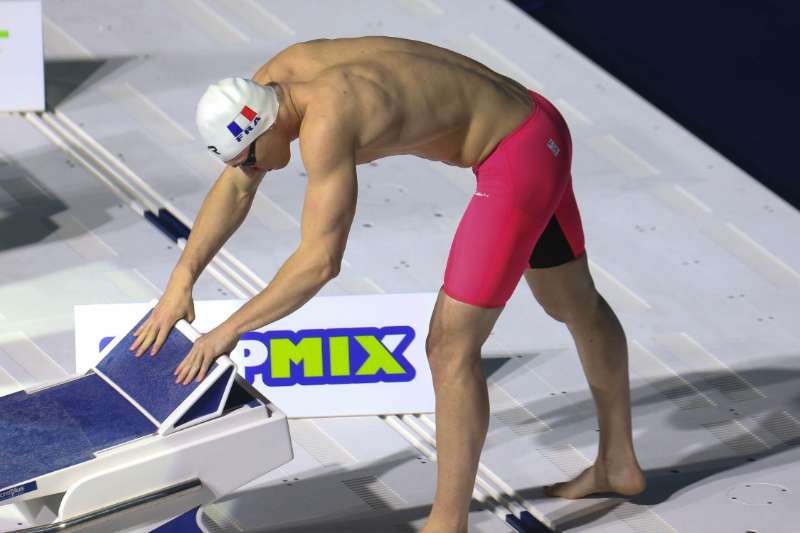
If you surface at 10m, that means 20% of your race is just the start. If you surface at 15m, that’s a whopping 30% of the race.
That’s a huge opportunity to improve!
A more explosive start begins with proper technique and positioning on the block (front load the block, place your feet narrower than shoulder-width) and generating lots of horizontal power for maximum velocity and distance off the block.
From there, strength training, plyometrics, and even core training should be used to develop control and power off the starting block.
See also: Dryland for Sprinters — What to Do and How to Program It
Here’s a breakdown of Cam McEvoy’s start performance during his gold-medal winning 50 freestyle at the Paris Olympics:
| Variable | Value | Notes |
| Reaction time | 0.56 s | Fastest reaction time of the finalists |
| Breakout distance | 12.04m | Moderate underwater distance, taking five dolphin kicks |
| Underwater time | 3.25s | Short underwater duration, prioritizing early surface speed and locking in stroke tempo |
| Average underwater speed | 3.70m/s | High underwater velocity; confirms quality over distance |
| Time to 15m | 5.11s | Elite start outcome metric; among the fastest in the field |
| 25m split | 9.59s | Blistering speed built on the back of an explosive start, fast underwaters, and clean breakout |
Reaction time is important–both Olympic champions in the 50m freestyle in Paris had the fastest reaction times in the field–but rapidly generating power on the block is the real key.
Horizontal power (generated by your back, dominant leg) dictates your velocity when leaving the starting block and entering the water (Chen et al., 2025).
To build the kind of explosive power for a booming start, the best strength training exercise you can do is the broad jump. One study with competitive swimmers found that a 9-week horizontal jump training program increased horizontal dive velocity by 16%.
The start sets the stage for everything that comes next, so give it the attention it deserves!
Use the right freestyle technique
Freestyle technique may look the same across the board, whether you are sprinting or banging out a distance workout in the Animal Lane.
But the technique sprinters use compared sub-maximal freestyle swimming differs in some significant ways.
In particular, the stroke timing is much different.
- When sprinting, there is much more symmetry in the pull, with the arms in a constant state of propulsion, with the arms even overlapping propulsive phases. Sprinters reduce the glide and eliminate catch-up timing. This type of technique is really fast and powerful but also very taxing.
- When cruising, swimmers switch to a gallop or hitch freestyle that has gaps in propulsion between the strokes. This type of stroke is more uneven in terms of propulsion, but is wildly more efficient and can be done for longer sets and workouts.
Arm recovery types like straight arm can help swimmers settle into the specific coordination and power demands of sprint freestyle, but it’s not necessary.
What matters is using the right head position (up high) so that the shoulders can rotate aggressively.
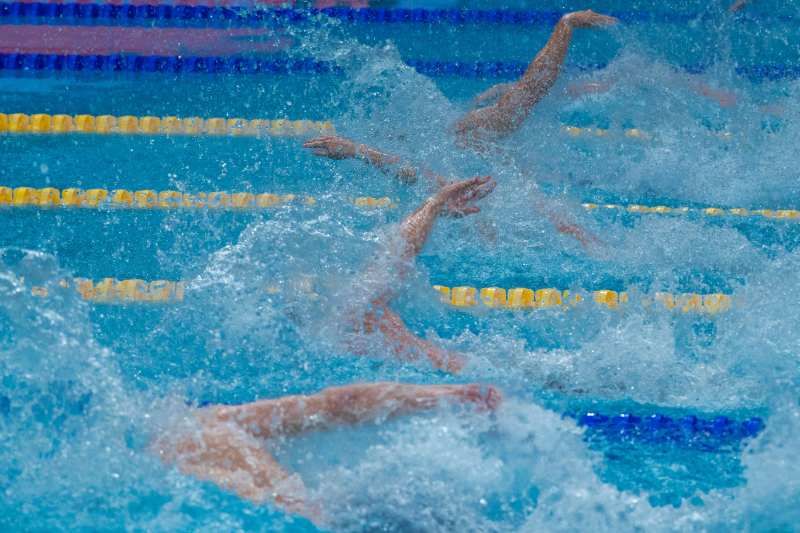
To use a stroke timing coordination that is more relevant to sprint freestyle technique, once again lean on adding resistance tools like a drag chute.
The added resistance behind you promotes a more balanced stroke cycle that mirrors the technique and stroke timing used when sprinting.
Breathe less
Elite sprint freestylers take as few breaths as possible when swimming the 50m freestyle.
By keeping the head stationary and breathing less, swimmers maintain a more streamlined body position, keep stroke rhythm bee-boppin’, and prevents the avalanche of technique errors that happens when swimmers have to surface the head over a huge bow wave to suck down a breath.
More importantly, fewer breaths mean increased swim velocity. For example, McCabe et al. (2015) had experienced competitive swimmers do a series of sprint 25s without breathing and breathing to their preferred side.
Speed decreased by 3% in the trials when they took a breath (over a 30s race, this loosely translates to 0.9s).
Breath training is something swimmers already do whether they realize it or not (timing breaths into turns, breathing patterns, holding the breath for breakouts, etcetera).
Take it to another level by building stronger pulmonary muscles with breathing exercises like longer breakouts, breathing patterns, and resisted respiratory training.
Kick like a monster
A fast 50 freestyle requires a white-water freestyle kick. Although the pull gets a lot of the attention, the kick is fundamental for fast sprinting, as it generates a significant amount of propulsion (representing ~30% of total tethered force with experienced competitive sprinters).
The kick keeps the hips stable, providing a base for the trunk to twist powerfully and the upper body to exert even more power. An unconditioned kick can also cause you technique issues like increased hip roll when the legs turn to jelly towards the end of your sprint events.
Building a stronger freestyle kick is fairly straightforward: do more kick!
Add resistance (DragSox are an excellent tool for this), tack on 25s of kick after sprints in training to promote a stronger, more conditioned kick, and increase ankle flexibility so that you can kick in a tight window and decrease drag from the legs.
Improve core strength
A strong and stable core is crucial for every aspect of a fast 50 freestyle, from maintaining balance on the block to positioning the arms and body while diving into the water to positioning the pelvis properly so that you can drop some massive dolphin kicks into the breakout.
Core strength minimizes drag by helping you maintain a more efficient body position and perhaps most importantly, provides a strong and stable foundation to exert maximal power through limbs, generating a stronger kick and pull from start to finish.
Core training interventions with swimmers have frequently found significant improvement in sprint swimming speed (Karpinski et al., 2020; Khiyami et al., 2022) with relatively little time investment required (~1-2hrs per week).
The good news is that core strength and stability won’t just help you swim like a demon when it comes to the 50 but will also reduce injury risk and improve general movement patterns.
Win-win!
Train for Speed and Power
The 50 freestyle is one of the most exciting events on the program, and for good reason!
It’s the purest expression of speed and power in the pool. Mastering the event looks easy for the novice or uninitiated to the demands and challenges of sprint training, but it offers a long list of ways to improve.
Choose one or two of the tips above and incorporate them into your sprint preparation this week and propel yourself to a faster 50 freestyle on race day!