
Looking to master sprint freestyle? This complete guide breaks down the technique, training, and race execution skills that separate elite sprinters from everyone else.
The 50 freestyle is called the splash and dash, the grip and rip, the “blink and the white water fireworks are over!”
But sprint freestyle isn’t just regular freestyle done with more effort. It’s a distinct version of the stroke built around maximum speed, continuous propulsion, and explosive power—and most swimmers never master it because they train and race using distance-style mechanics.
Elite sprinters swim different.
This guide breaks down what sprint freestyle actually is, how it works, and how swimmers can develop the technique, training, and race skills to do the same.
This is the main guide in our sprint freestyle series. You can learn more about the different parts of sprint freestyle in these articles:
What is Sprint Freestyle?
Sprint freestyle refers to freestyle swimming performed at maximal or near-maximal velocity, specifically in the 50 freestyle. The 100 freestyle, while fast, is not a sprint as it relies heavily on the aerobic system in ways the 50 free simply doesn’t.
Unlike middle-distance or distance freestyle, sprint freestyle prioritizes velocity over efficiency, propulsion continuity over gliding, and power production over energy conservation.
The goal is simple, but not easy:
Produce as much forward speed as possible while minimizing deceleration.
At sprint speeds, water resistance increases dramatically. Every little increase in speed means much more drag and much more power output required to sustain propulsion.
Small technical differences—kick tempo, stroke timing, breakout velocity—have outsized effects on performance.
Sprint vs Distance Freestyle
Although the two types of freestyle look similar on the surface, sprint and distance freestyle operate under very different constraints. Swimmers who don’t understand the differences end up training and racing the wrong way.
The most common mistake is treating sprint freestyle as your regular or distance freestyle stroke performed with more effort. More intensity, same mechanics. But that approach has a ceiling, because the technical demands of sprinting are fundamentally different.
Sprint freestyle technique uses:
- Much higher stroke rates
- More aggressive kicking
- Reduced glide phases
- Higher head position
- Straight/bent arm recoveries
- Limited breathing
- Different roll angles and velocities
- A pull that is continuous and even choppy
Distance freestyle emphasizes efficiency and sustainability. Sprint freestyle hands out medals for uninterrupted, powerful propulsion.
The Physical Demands of Sprint Freestyle
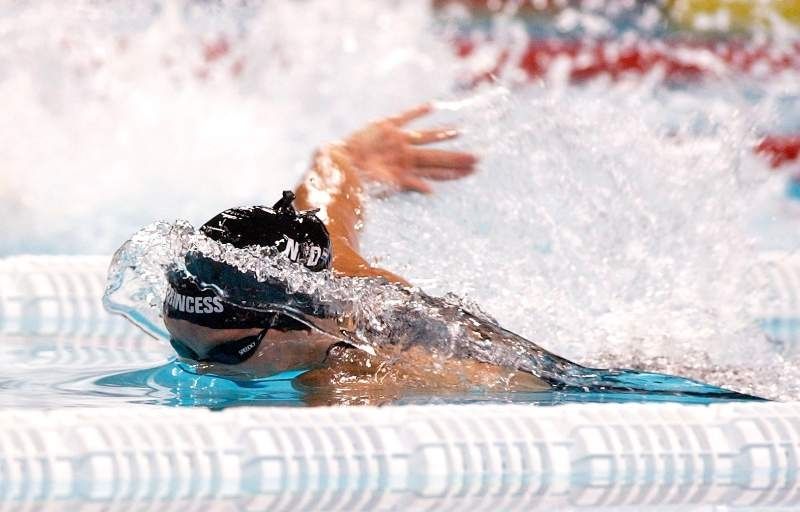
Sprint swimming is the most explosive activity performed in the water.
The 50 freestyle is powered almost completely by the anaerobic system—with the phosphagen element giving us that booming, explosive power, and the glycolytic system taking over as the race progresses. The aerobic system plays a very small, almost negligible role at the elite level.
This is far different from other events in the pool, even the 100m freestyle, which has a substantial aerobic element (~40%). This has major implications for both training and tapering.
Sprinters need longer recovery between efforts to replenish phosphocreatine stores, which is why sprints set look nothing like distance sets. Fewer reps, longer rest, maximal effort every time.
Beyond energy systems, sprinters depend heavily on:
- Neuromuscular power
- Rate of force development
- Coordination under fatigue
Elite sprinters generate large forces quickly and repeatedly while maintaining technical precision.
Dryland and Strength Training
Sprint freestyle is won and lost on power—and power is built as much in the gym as it is in the water.
Unlike distance swimmers, who can compensate for limited strength with technique and pacing, sprinters have nowhere to hide. The 50 free is a pure expression of how much force you can produce and how fast you can produce it.
That makes dryland essential for sprint freestyle performance.
- Strength training builds the raw force production that underpins every pull, kick, and push-off. Heavy, explosive work trains the neuromuscular system to fire fast and hard.
- Plyometrics improve rate of force development—how quickly you can express power. This is obviously key for sprint freestyle, where start, turn, and stroke explosiveness defines the event.
- Core training is the quiet glue that links the upper and lower body, creating a coordinated and powerful full-stroke sprint freestyle. A weak core maximizes the sum of the parts.
Dryland, and strength training in particular, are essential for giving sprinters the raw materials to build power in the water.
Stroke Rate and Tempo
One of the defining characteristics of sprint freestyle is stroke tempo. It’s what drives the arm pull, changes stroke coordination, shortens the glide, and even how much your shoulders and hips roll when sprinting.
Sprint freestyle is totally reliant on stroke rate—case in point, at the Paris Olympics, the men’s finalists in the 50m freestyle had stroke rates that were almost 50% higher than finalists in the 200m freestyle.
While higher turnover is essential, it’s not enough to just spin the arms—elite sprint freestylers also maintain stroke length, holding water in tandem with faster turnovers to generate incredible amounts of power.
“I’d actually swim faster if I backed off a little bit. I found it helpful to throttle back [tempo] the first eight, nine stroke.” — Matt Biondi, former world record holder and 50m Olympic gold medalist
Kick Demands in Sprint Freestyle
The freestyle kick shifts dramatically when sprinting.
At slower freestyle speeds, the kick is used mainly for stabilization and keeping the hips close to the surface, reducing drag. At sprint speeds, it contributes significantly to propulsion.
Sprint freestylers rely on their legs to:
- Six-beat, high tempo – very fast frequency with minimal pauses between beats.
- Tight window – a smaller, more compact kick than most swimmers expect
- Clean coordination – kick tempo and stroke rate are tied at the hip. As stroke rate climbs, the kick adjusts to match it or the whole stroke falls apart.
A powerful kick also stabilizes the hips so the torso can twist violently against them, giving each arm pull more leverage and length.
Breathing in Sprint Freestyle
Breathing strategy changes significantly in the 50 freestyle—and the difference between the 50 free and every other freestyle event is significant.
Middle distance and distance freestyle rely heavily on oxygen. Swimmers breathe frequently, and their stroke is built around accommodating that. Even the 100 freestyle relies massively on frequent breathing, with Olympic champions typically breathing every two strokes to power their aerobic engines on the back half of the race.
The 50 free is different. It runs almost entirely on anaerobic energy–both the phosphagen and glycolytic pathways–which means the body doesn’t actually need a breath to complete the race, and taking one comes with a real cost.
When swimmers turn their head to breathe at full-max velocity, it introduces drag, disrupts body alignment, and throws off stroke coordination. Turning the head changes shoulder roll, hip roll, and the timing between rotation, pull, and kick.
At sprint speeds, those disruptions aren’t subtle, especially when you consider the mechanics of trying to breathe over a huge bow wave.
Starts and Underwater Performance
In sprint freestyle, races are often decided before swimmers reach mid-pool.
Starts, underwater dolphin kicking, and an explosive breakout allows swimmers to travel at velocities significantly faster than surface swimming. Developing this speed advantage is one of the defining characteristics of elite sprint performance.
A great start is built on the block and in the water.
The block phase—how a swimmer loads, reacts and launches. Optimal block mechanics, like stance, using the right leg at the back, and weights the hips, sets you up for power.
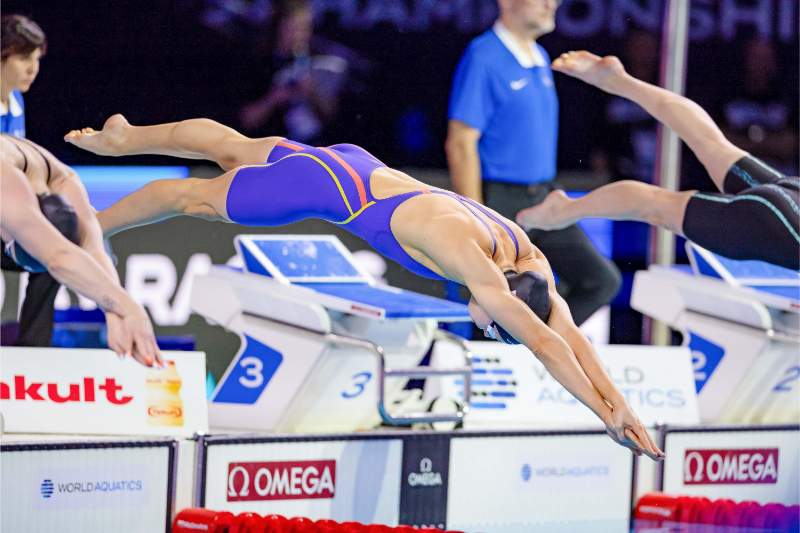
Once set up, it’s about making the starting block rattle with power, balancing reaction time with force development, and angling off the block for max velocity.
Fast, powerful underwater dolphin kicking is where that speed advantage is either built or squandered. Swimmers charge to the surface, breakout cleanly, and they are off to the races.
Together, the block phase and initial underwater phase make up to 30% of the total race distance—making them non-negotiable for sprint freestylers.
For short course sprinters, underwaters become even more of focus, as the race can be done up to 60% under the surface—and even longer in a yards pool.
How Sprinters Train Differently
Sprint training looks and behaves very different from traditional high-yardage swim workouts. And swimmers who apply distance logic to sprint training are going to be perpetually stuck in first gear.
Which means training to sprint. The right sets for the 50 freestyle emphasize:
- Quality over volume. Fewer yards, but every rep swum at race speed or faster. A sprinter doing 6×25 at maximal effort with full recovery will develop more usable speed than one grinding through 20×100 at threshold pace.
- Race-speed specificity. The body adapts to the speeds it trains at. If a swimmer never practices moving at 50 free pace in training, they won’t suddenly produce it on race day.
- Power development in the water. Resisted sprint swim training—short maximal efforts with parachutes, bands, tethers—is one of the most reliable ways to train speed. It overloads the specific strength required to move water at sprint speeds—most importantly while retaining sprint mechanics.
The result is a training environment that looks easy to the swimmers in the distance lane—lots of rest, short distances, explosive efforts—but specifically designed to boost the qualities that sprinters need for success on race day.
Race Execution in Sprint Freestyle
The 50 free is over in seconds—which means there’s no room to recover from mistakes, and no time to find a rhythm that wasn’t already there.
Fast sprint freestyle races depend on executing several phases seamlessly:
- The racer’s mindset – controlled intensity and ability to compete under pressure.
- Explosive start – balancing force and reaction time
- Velocity preservation underwater – nailing the dolphin kick, seamless breakout
- Pacing — the 50 free is not a blind sprint. Swimmers who spin out in the first few strokes don’t just slow down, they fall apart technically
- Timing the finish and finishing on a full stroke, hand and finger outstretched
Small inefficiencies in any of these phases compound fast. Execution is what separates swimmers with similar physical tools.
Putting it all Together
The key to sprinting a faster 50 freestyle is not taking your usual stroke and forcing more effort or muscling through it—elite sprinting is a coordinated system built around power, timing, and velocity maintenance.
Swimmers who understand these demands can train more effectively, apply technique more intentionally, and execute races with greater confidence.
Happy sprinting!
This is the main sprint freestyle guide that contains general information on faster freestyle sprinting. To go into more detail in what makes an elite sprint freestyle, learn more at the articles below: