The 50 freestyle and 100 freestyle share a lot of similarities: plenty of white water, big bow waves, lane rope-creaking speed.
But they are very different in subtle but important ways. From energy systems to pacing to stroke coordination, the two races are quite distinct. And training them the same is one of the most common mistakes swimmers make.
If you want to excel at both, it’s important to respect how differently they are raced and trained.
Here’s a look at how the 50 free and 100 free are different and similar, giving you the intel to train both smartly.
Let’s dive in.
This is the guide on the differences between the 50 and 100 freestyle. You can read our other articles on how to improve sprint freestyle performance below.
Energy systems
At first glance, the 100 looks like a doubled-up version of the 50. Twice the distance, twice the sprint. But metabolically, they are very different.
A study by Rodriguez and Mader (2011) broke down how the two events differ:
| Event | Phosphagen (Explosive) | Glycolytic (Anaerobic) | Aerobic |
| 50 Free | ~38% | ~58% | ~4% |
| 100 Free | ~20% | ~39% | ~41% |
The thing that sticks out most is the big jump in terms of aerobic contribution. In the 50 free, we are essentially detonating from the blocks and letting it rip for 20ish seconds. The aerobic system barely shows up.
In the 100, the race is ~40% aerobic. Which means that if you train the 100 like the 50, you are going to crash out hard on the back half.
The 100 is one of the most anticipated events precisely because it is the most challenging to train for. Unlike the pure power of the 50, or the aerobic-dominant 200 and up, the 100 requires all three energy systems to be on point:
- Explosive power (phosphagen)
- Lactate tolerance (glycolytic)
- Aerobic capacity
While it feels like a sprint (we are going basically all-out from stroke one to the finish), the 100 is substantially aerobic in nature.
Stroke rate
Stroke rate—how quickly we turn the arms over when swimming freestyle—are high in both the 50 and 100 freestyle compared to other freestyle events. But the 50 free is where stroke rate is essentially red lining:
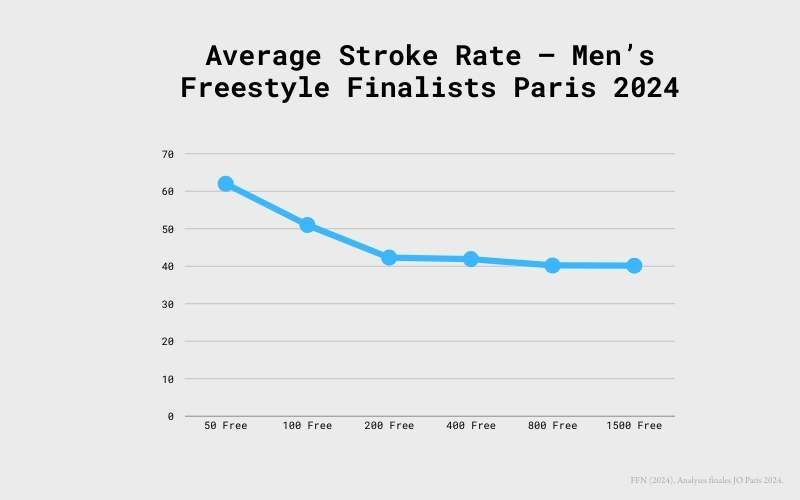
As you can see in the chart above, the 50 rules in terms of stroke rate. There is a drop in the 100, and then another substantial drop to the 200 free, where stroke rate levels out.
In the 50, swimmers can let it all hang out in terms of turnover. The high stroke rate leads coordination—how much overlap swimmers use with each stroke’s propulsive phases.
In the 100, tempo is moderated (still significantly higher than stroke rate in the 200, however), lengthening out the stroke slightly to preserve speed over distance.
Swimming the 100 with 50-style stroke rate is an express route to imploding. This means targeting the correct stroke rate in training:
- 50 specialists focus on peak turnover and explosive acceleration
- 100 swimmers need to focus on a longer, more controlled stroke at high speed
Stroke coordination shifts
Stroke coordination—how swimmers time their arms in relation to one another—also changes from the 50 to the 100 freestyle.
In the splash and dash, swimmers use overlapped stroke timing to create maximum propulsion. There is constant propulsion being generated. In other words, there is no catch-up timing when sprinting.
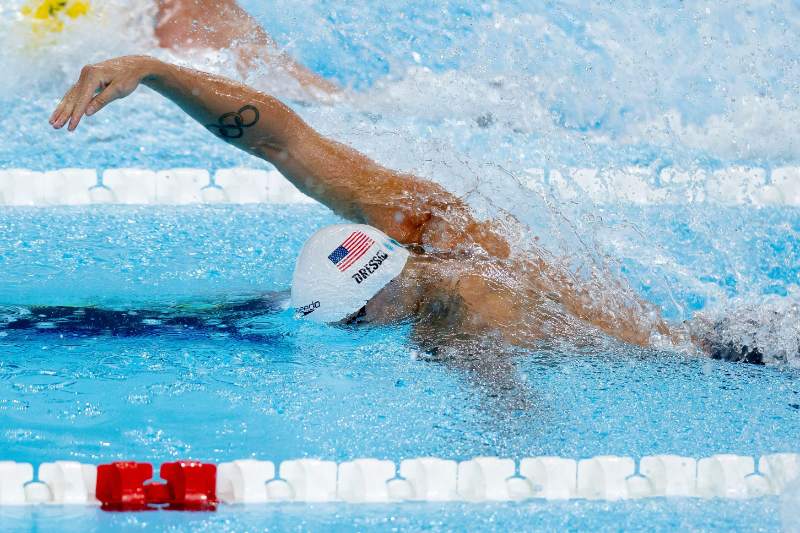
In the 100 freestyle, the stroke opens up a little bit, with a slightly more economical timing pattern (aka a very slight catch-up) appearing to manage energy and stabilize the stroke under mounting fatigue.
A study by Seifert and Bardy (2004) examined the differences in stroke coordination—as measured by Index of Coordination, a score that indicates how much overlap there is between strokes—with a group of elite freestylers at various speeds.
Here is how the stroke coordination differed at the fastest freestyle velocities, from max to 200m pace:
| Pace | IdC | Interpretation |
| 200m | –5.9% | Catch-up |
| 100m | –1.0% | Very slight catch-up |
| 50m | +1.1% | Superposition → Overlap for max sprint speed. |
| Maximal velocity | +2.6% | Increased overlap |
This gets to the heart of using the right technique when sprinting. For the 50, you can’t go all out with a distance stroke—catch-up timing is not designed for maximum propulsion.
And for the 100, swimmers need to walk that line between creating lots of propulsion in the stroke with the energy management benefits of a slight catch-up and glide.
Pace like a pro
Alright, now let’s get into the nitty gritty about peak performance in the 50 and 100 freestyle.
For starters, the 50 freestyle does have a slight pacing component to it. Elite sprinters aren’t going 100% from start to finish—close, but not quite. There is a micro-pacing element to it.
In Seifert et al. (2004), swimmers reached higher stroke rates and greater coordination overlap at maximal velocity than at 50m race pace. The 50 isn’t a blind redline—it’s a near-maximal controlled sprint where speed is regulated just enough to sustain it to the wall.
This pacing—if you even want to call it that—is very subtle but real.
In the 100 freestyle, there is a substantial pacing element at work. Elite freestylers use a positive splitting strategy with a ~2 second differential. In other words, if you go out in 26 seconds, you should be coming back in 28 seconds.
A study by Robertson et al. (2009) looked at the pacing patterns of Olympic and World championship finalists and found this pacing pattern was consistent among men (2.06s) and women (1.95s).
And if we look at the performance data from the finalists at the Paris Olympics, this pacing profile holds up:
- Men – 2.07s
- Women – 1.99s
Drilling down even further, the third 25 is really where gold medals are won in the 100 freestyle.
Postiglione et al (2025) looked at 204 male swimmers’ 100m freestyle performances—from truly world class to national-level—and reconstructed a list of the most important features of a gold-medal winning 100 free.
The big winner?
Not the start. Not the breakout. And not the turn. It was velocity during the third 25.
At this point of the race, phosphocreatine stores are nearly depleted, lactate levels are rising, and the aerobic system is carrying a heavy share of the load.
Swimmers who can maintain stroke rate, coordination, and body position here are the ones who separate from the field.
Training the 50 and 100 Free Like a Pro
Understanding the differences between the 50 and 100 freestyle is key to training and racing them properly.
And once you get a sense of how they differ, you can better apply the nuances and subtleties of the events into your preparation.
- Prioritize explosive power and alactic speed (short sprints, full recovery)
- Spend time at peak stroke rate and coordination overlap
- Master “easy” power—95-98% of intensity
- Emphasize the start, underwater and breakout (it’s ~30% of the race)
The goal: maximum velocity and power.
To improve your 100 freestyle:
- Train all three energy systems—use them to diagnose where you stand to improve most
- Target race-specific stroke rate (not 50 or 200-style turnover)
- Hammer the third 25 like a boss
- Target relevant goal splits in training
The goal: hold speed when others fall apart.
The Bottom Line
At the elite level, few swimmers are able to master both events, illustrating how different they are.
At the Paris Olympics, no male swimmer finaled in both the 50 and 100 freestyle. In the women’s events, just three made it to both finals (including the legend Sarah Sjöström, who won both).
For the swimmer who wants to excel at both, understanding how the two events differ is the first step in preparing for success in both events.
More Sprint Freestyle Resources
A Classic Race Pace Set That Trains and Predicts a Fast 100 Freestyle. Looking for a set to train and predict 100m freestyle performance? Here’s a classic set for preparing the exact skills for fast sprinting on race day.
A Race Pace Set for Winning the Back Half of the 100 Freestyle. This tough 100 race pace set from Richard Quick teaches swimmers how to sustain speed when rest disappears and fatigue hits hard.
How Cam McEvoy Trains for Pure Speed in the 50 Freestyle. Curious how the fastest man in the 50 freestyle prepares for the splash and dash? Here’s a look at what Cam McEvoy is doing in training to win the fastest race on the Olympic program.