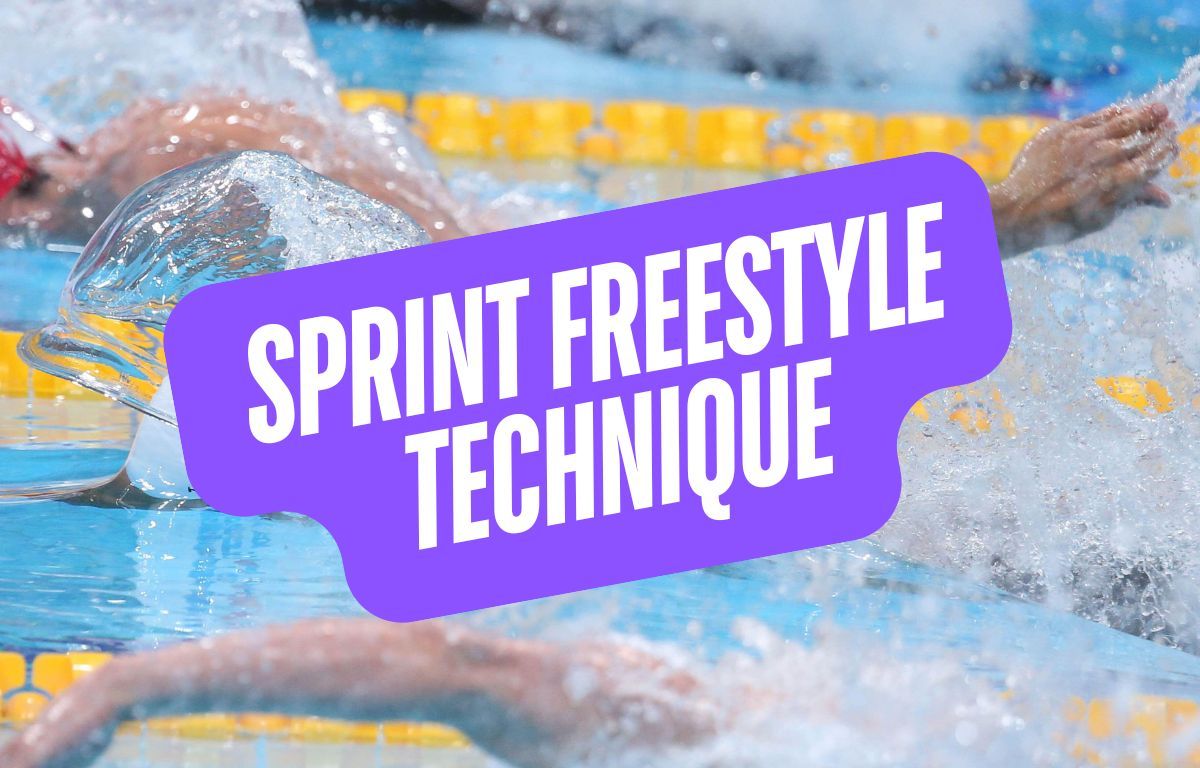

Sprint freestyle isn’t distance freestyle done harder—it’s a different technique built specifically for speed. Here’s what changes with body position, stroke rate, kick, and coordination, and how to use it in your 50 free.
The splash and dash, the 50 freestyle, is the fastest event in swimming.
And for many swimmers, it is also one of the more frustrating. You try to sprint harder, spin faster, and push more effort into the stroke… but the speed doesn’t show up.
That’s usually not a conditioning problem. It’s a technique problem.
Sprint freestyle technique is fundamentally different from the freestyle you use most of the time at practice. Body position changes. The kick changes. Stroke rate rises. Timing tightens. Even how the arms and torso work together shifts.
Swimmers who try to sprint their regular freestyle often feel stuck in second gear because they’re using the wrong version of the stroke.
Sprint freestyle isn’t distance freestyle done harder—it’s a different technique built for speed.
This guide is part of our series on improving sprint freestyle performance. You can find other articles below.
Sprint Freestyle Technique vs Regular Freestyle
Before getting into the nitty gritty, it’s worth understanding the core shift between the two types of freestyles.
- Sprint freestyle is built around power—doesn’t have to be efficient or even all that pretty, just explosive and controlled for long enough to get us to 50m or 50y.
- Regular freestyle is built around efficiency—the goal is to swim far and fast with as little energy expenditure as possible.
Here’s an overview of how sprint and regular freestyle technique differ:
| Sprint Freestyle | Regular Freestyle | |
| Stroke Rate | Near maximal stroke rate | Low to moderate stroke rate |
| Stroke Length | Slightly reduced; priority is turnover | Longer stroke length emphasized |
| Stroke Coordination | Symmetrical, overlapping stroke (no hitch or gallop) | A variation of catch-up timing |
| Pull Mechanics | Accelerated pull with force spike (“choppy power”) | Smooth, progressive force application |
| Kick Amplitude | Smaller, faster amplitude (“turbo-prop” kick) | Slightly larger, more economical amplitude |
| Breathing Strategy | Minimal or no breathing | Regular rhythmic breathing |
| Body Position | Elevated head and shoulders | Flatter, partially submerged |
| Body Roll | Reduced hip roll; faster shoulder rotation | Increased hip roll |
| Hand Entry & Extension | Full extension over water directly into catch | Entry followed by forward underwater glide |
Technique is just as essential in sprint freestyle, but understanding what sprint freestyle is and its specific constraints and demands are what opens the door to improving your 50 freestyle.
Stroke rate
Stroke rate is the primary technical lever in sprint freestyle. Nearly every change that occurs in sprint free technique happens in response to increased tempo.
Higher stroke rates reduce non-propulsive gaps, tighten coordination, and create more continuous propulsion.
When swimmers switch into sprint mode, the instinct is to spin the arms as fast as possible. Higher turnover is necessary—but only if propulsion per stroke is maintained.
Research analyzing 324 elite swimmers at the European Short-Course Championships (Staunton et al., 2025) showed that stroke rate alone had little relationship with speed in the 50 freestyle.
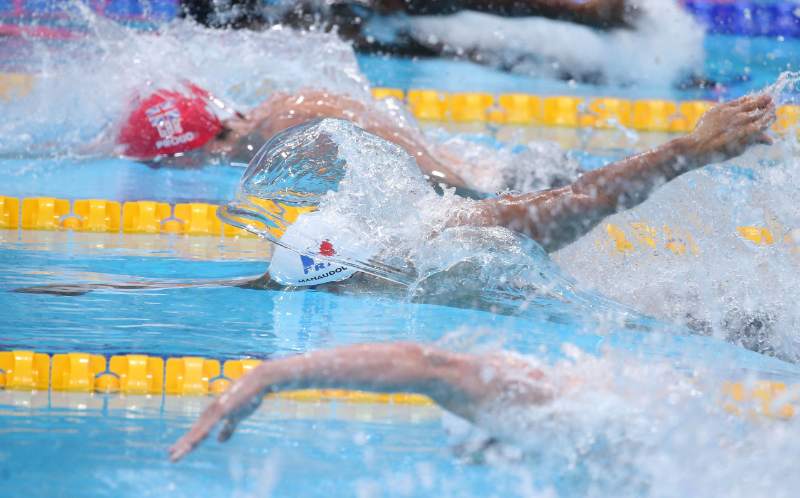
The fastest swimmers weren’t simply moving their arms faster—they were able to sustain effective propulsion at higher tempos. Gold medalists consistently operated at elevated stroke rates without their stroke effectiveness breaking down.
In sprint freestyle, success comes from increasing tempo without losing your ability to hold water.
That requires:
- Maintaining proper hand pitch and orientation to push water backward
- Allowing enough time for pressure to build against the water
- Letting vortices and pressure differences develop for propulsion
- Giving the catch time to “anchor” instead of collapsing
When tempo exceeds technical capacity, swimmers start spinning instead of accelerating. Sprint freestyle technique looks powerful and urgent—not panicked and rushed.
Stroke coordination
Stroke coordination—how swimmers time the arms to each other during the stroke—changes big time between sprint and regular freestyle.
And once you understand how this works, you will be able to immediately identify whether you are using a sprint technique or not.
- Sprint freestyle coordination – The arms overlap more aggressively so propulsion never fully stops. As one arm finishes the push phase, the opposite arm is already engaging the catch. This timing reduces dead spots and helps maintain velocity between strokes.
- Regular freestyle coordination – The arms use a slight to major catch-up timing. One arm begins the pull while the other remains extended forward, creating brief glides and gaps in propulsion.
Biomechanical research on elite freestyle coordination (Chollet et al., 2000; Siefert et al., 2007) describe this using the Index of Coordination (IdC).
Regular, middle, and distance freestyle result in negative IdC values (short glide between arm actions) while sprint freestyle shifts scores toward zero or slightly positive IdC, where propulsive phases overlap.
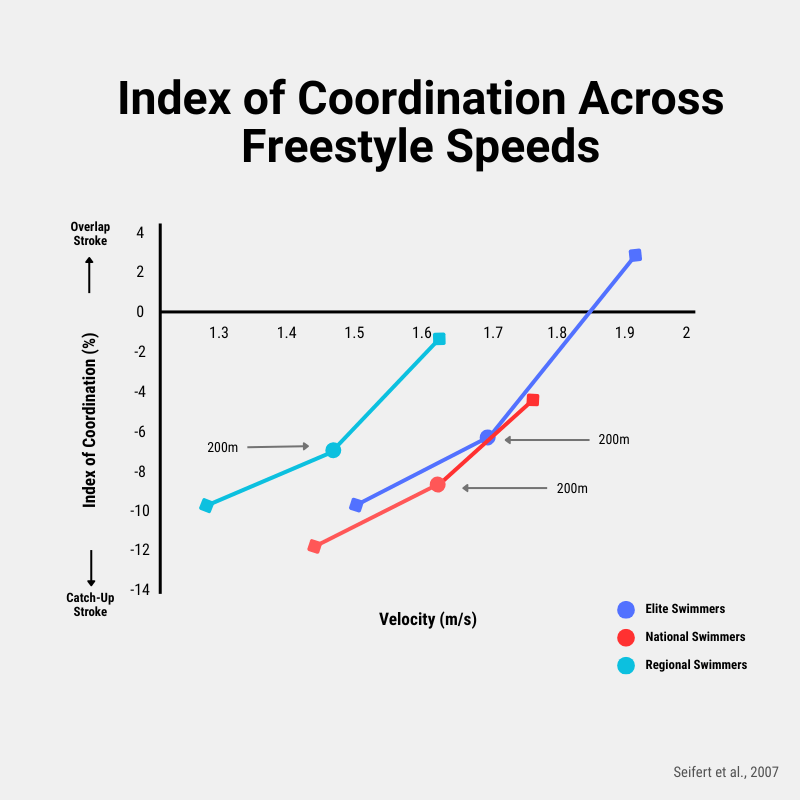
Practically, this coordination pattern helps to explain a lot of what is happening with sprint technique:
- Minimal or eliminated glide phase
- Earlier catch initiation
- Continuous propulsion between strokes
- Increased power output
- Reduced hip roll
This is why the sprint freestyle pull can often look choppy or busier than the regular freestyle version. The objective isn’t a stroke that is smoother than a new swim cap—it’s preventing gaps in propulsion and pushing more power.
Regular freestyle manages velocity. Sprint freestyle grabs speed and runs through the wall with it like the Kool-Aid Man.
Body roll
Body roll changes significantly when we shift from regular freestyle to sprint freestyle. While rotation remains essential—regardless of the distance—sprinters roll in a way that is fundamentally different.
During regular freestyle, the hips and shoulders rotate through a larger total range of motion. This helps swimmers breathe comfortably, extend further in the glide, and maximize efficiency with each stroke.
Sprint freestyle technique shifts the priority from efficiency to power.
See also: The Best Sets for 50 Freestyle: Power, Speed, and Explosive Starts
The amount of shoulder rotation remains largely the same—but it’s done much faster, while hip rotation narrows. Andersen et al. (2020) compared body roll at 50m and 400m freestyle pace and saw that at sprint speeds:
- Hip roll range decreased from ~49.9° at 400m pace to ~36.8° at sprint speed
- Shoulder roll range stayed nearly the same
- Shoulder roll velocity increased by 37%
- Torso twist velocity increased by 71.6%
The flatter hips create a stable platform for force production. Instead of rocking from side to side, the stroke has a more powerful platform to rotate explosively against and support faster arm turnover.
Sprinters still use body roll, but it’s tighter, faster, and built for power.
Body position
Sprint freestylers ride high and fast across the surface of the water. The head and shoulders resemble a hovercraft skimming the pool, perched high, the upper back nearly dry and they charge down the pool.
This looks very different from regular freestyle, where swimmers maintain a more submerged, neutral, and relaxed body position made for efficiency.
This difference isn’t stylistic, or something sprinters even really have to “try” to do—it’s a natural mechanical result of freestyle sprint technique. By eliminating the glide and going straight into the catch with more force, the water pushes back.
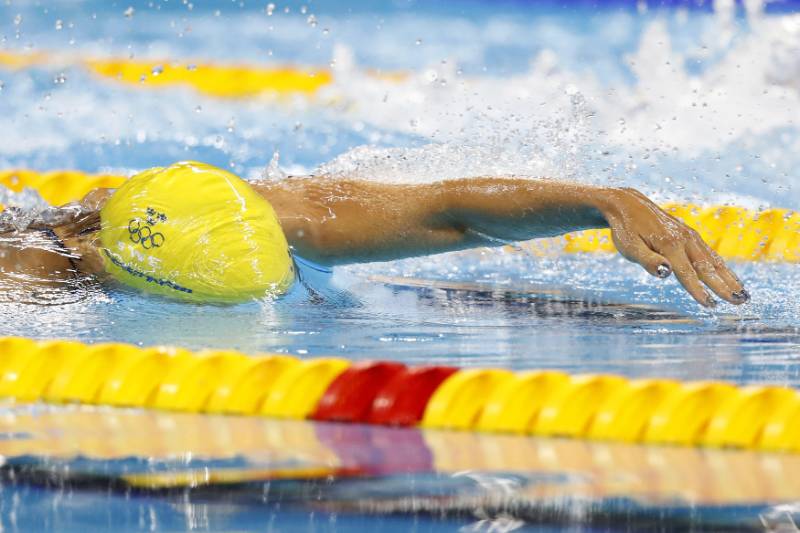
That interaction generates a lot of vertical lift, pushing the upper body toward the surface. Research by Samson et al. (2015) showed that sprint swimmers average around 40 N of upward lift, compared to about 21 N in middle-distance swimmers. That’s a lot of added lift!
This elevated position is perfect for sprinters. Riding higher frees the shoulders to rotate faster and with more power, enabling higher stroke rates and more aggressive arm actions.
The Kick
Fast freestyle sprinters have an absolute motor behind them—a white-water rooster tail that supports the stroke and creates propulsion.
In regular freestyle, the kick primarily stabilizes body position, assists rhythm, and contributes only marginally to direct propulsion—just ~6% at slower swimming speeds (Silveira et al., 2016).
But as swimmers engage sprint mode, kick contribution increases sharply. The kick becomes faster, tighter, and significantly more forceful.
Elite sprinters reach extremely high kick frequencies—often around 150 kicks per minute (Gatta et al., 2012).
At these speeds, kick mechanics also change. Amplitude narrows by roughly 10%, creating a tight, controlled motion that reduces drag while demanding exceptional hip and core control.
Counterintuitively, the amount of power swimmers can generate with the legs actually decreases as speed approaches sprint velocity.
This is largely a mechanical constraint: faster arm turnover leaves less time to complete multiple kicks per stroke cycle, while the naturally narrower kick amplitude at high speeds limits how much force can be applied with each kick (Gatta et al., 2012).
Breathing
Breathing has one of the biggest technical impacts on sprint freestyle—not because oxygen suddenly stops mattering, but because breathing changes technique.
Turning the head increases drag, alters body alignment, and disrupts timing at the exact moment swimmers are trying to maintain peak velocity.
McCabe et al. (2015) showed that when elite swimmers did a 25m freestyle sprint, they swam 2.8% slower when taking just one breath.
Stroke rate and length remained similar, but stroke mechanics changed:
- Hand entry velocity decreased by 3.3%
- Shoulder flexion dropped by 8%
- Pull phase duration increased by 14%
Breathing also increases shoulder and hip roll toward the breathing side, destabilizing body position and increasing frontal drag (Psycharakis & McCabe, 2011).
Elite 50 freestylers endeavor to eliminate breathing whenever possible. Obviously easier said than done for beginner and non-elite sprinters, but it’s technical effects on your stroke are important to be aware of.
Sprint Technique is Fast Technique
Just about every swimmer dreams of mastering sprint freestyle—it gets a lot of attention at swim meets, you’ve always got a couple of relay anchor legs locked up, and it’s the purest expression of speed in the pool.
But while it’s short and fast, it doesn’t come from blind effort or trying to 3x your regular freestyle stroke.
It comes from working the specific technical constraints—higher stroke rates, overlapping coordination, narrower kick, tighter rotation, controlled breathing—and putting them together on race day.
Master these elements of sprint free technique, and it stops feeling chaotic and uncontrolled and starts feeling powerful and fast.