
Swimmers looking to improve their kick tend to look down at their feet and ankles.
For good reason: a majority of the propulsion that happens when kicking takes place in the neighborhood of your toes, feet, and ankles.
Which then means—more ankle mobility!
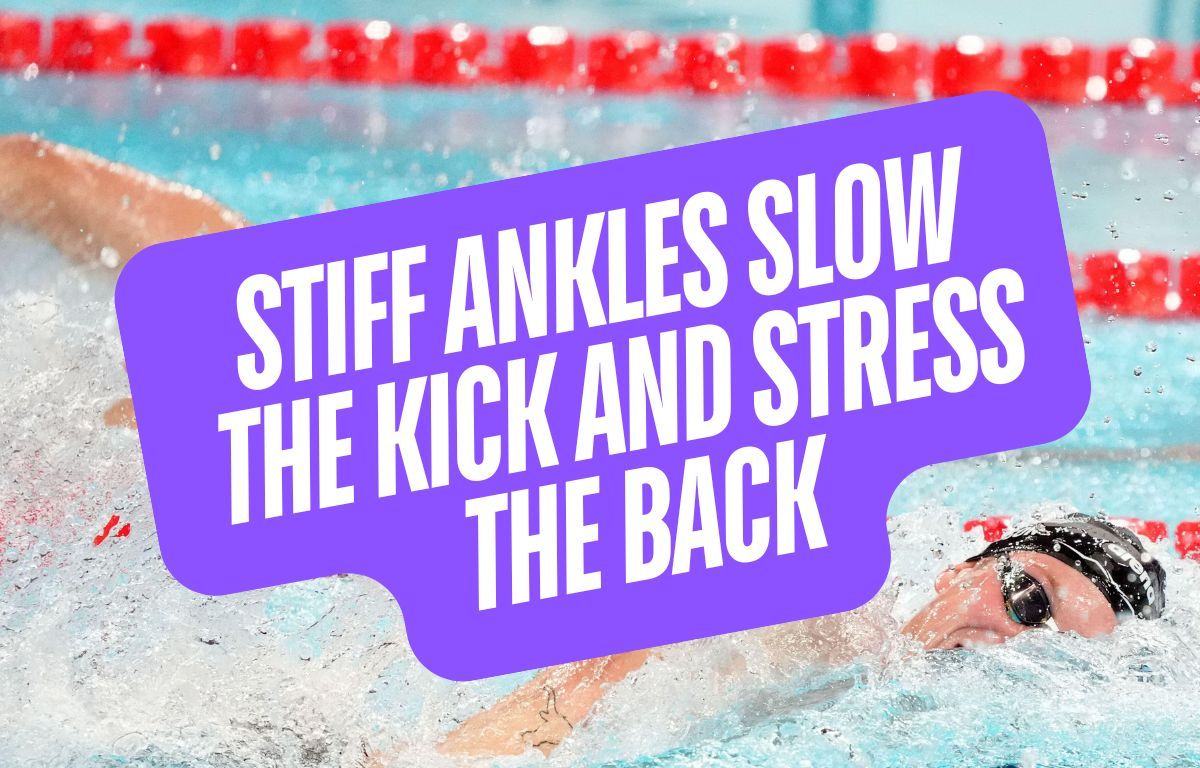
With flexible ankles, swimmers “catch” more water with each kick, the legs stay in a more hydrodynamic position (the knees don’t have to bend as much), and the feet travel further vertically, creating a stronger whip.
There is also one other potential benefit.
Less pain in your lower back.
Stiff Ankles Are Linked to Back Pain in Swimmers
Swimmer’s shoulder tends to get all the attention when we are talking about injuries in the water. And it earns that title, with one survey (McMaster and Troup, 1993) with USA Swimming members showing a staggering number of swimmers experiencing shoulder pain when asked—including 26% of the national team.
But the back pulls some pretty big numbers, too.
Back injuries are the second most common injury in swimmers. They are often the result of bad technique, excess load on the spine, and tons of training leading to fatigue in the supporting trunk muscles (Hsu et al., 2024).
But stiff ankles play a role, too.
A recent study out of the University of Seville examined a group of 157 swimmers, including 42% who were experiencing lower back discomfort.
The thing that stood out?
Swimmers with ouchie backs had measurably less dorsiflexion (flexing the toes “up”) in both legs, along with reduced hip internal rotation and tighter hamstrings.
The gaps in the ankle weren’t dramatic, but they showed up consistently, on both sides of the body.
The ankles are probably the last place you’d look when sorting out why your lower back hurts. But it makes sense when we break down how stiff ankles change the way you kick, and by extension, the way the back has to move to compensate.
Why the Ankles End Up Bugging Your Back
The feet and ankles are at the bottom of the chain. When they are restricted or can’t flex the way they should, your body still needs that range to finish the kick.
So it does what the body does best and it goes hunting for that range somewhere else. That “somewhere else” is often your lower back, which is forced to arch more to cover the difference.
Every push-off, dive, and kick politely asks the ankle for dorsiflexion. When the ankle can’t deliver, the shin can’t move forward as freely, the knee loses some range, and the hips and lower back step in to make up the difference.
Do that rep after rep, set after set, and it adds up. Especially for breaststrokers, butterflyers, and underwater dolphin kick nerds, who spend a lot of time, laps, and repetitions undulating and loading the lower back.
(And wouldn’t ya know it—it was butterflyers and breaststrokers who reported the most back trouble in the study.)
Checking Dorsiflexion in the Ankles
Plantarflexion—pointing the toes—is easy to see as we spend so much time in that position in the water. Point the toes like you are pressing the gas pedal and you get a strong sense of how well you can plantarflex the foot.
For dorsiflexion, it’s as straightforward to check with the knee-to-wall test.
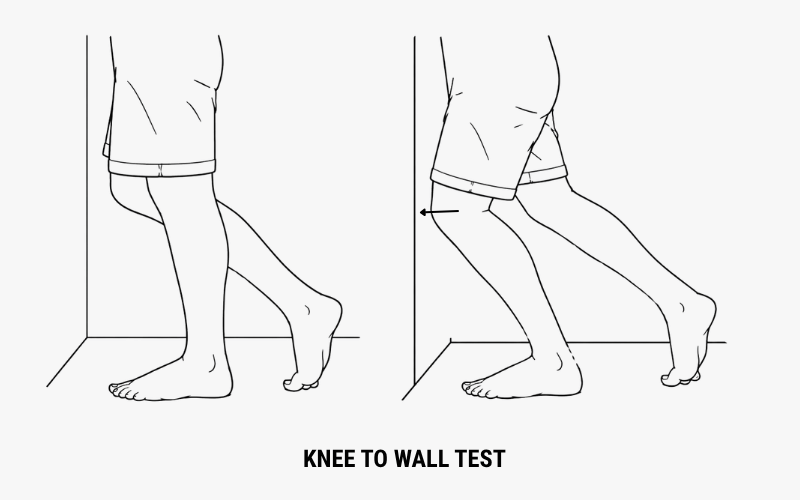
Here’s how to do it:
- Facing the wall, place your foot a few inches back
- Push the knee straight forward to touch the wall
- Keep your heel flat on the floor the whole time.
- Slide the foot back until your knee can just barely still reach the wall with the heel down.
Boom—that distance is your dorsiflexion. Do both sides and compare—a side-to-side difference is common and worth noting.
Drilling Down on the Calf
Want to know which muscle is the holdup? The study measured dorsiflexion with the knee straight and bent and were able to further nail down which calf muscle was causing the restriction.
A straight-leg calf stretch loads the upper calf (the gastrocnemius), while a bent-knee version targets the deeper soleus underneath. If the straight-leg one feels brutal compared to the bent-knee one, your gastroc is the main culprit—which is the same muscle the researchers flagged.
From there, it’s the usual suspects to improve ankle mobility:
- Regular calf and ankle mobility stretching
- Foam rolling the calves
- Full posterior-chain stretching before and after sessions (especially hips and hamstrings)
Add more time on these stretches if you’ve got a history of back soreness/injury or you simply want to open up more range of movement with your ankles and increase kicking speed.
Even just a few minutes of dynamic stretches before swimming and some static stretches after swimming will go a long way to increasing your foot’s range of motion and protect your back from all the work you do in the pool.
The Bottom Line
Injuries are a frustrating reality of our sport. All the yardage and main sets and Saturday mornings kind of make it inevitable.
But there are some key things you can do to mitigate injury risk, and when it comes to back pain, loosening up the ankles may just be one way to reduce low back pain and increase kicking speed. True double-whammy.
The good news is that ankle flexibility is very trainable. Research shows that athletes increased dorsiflexion by over 25% with just two short stretching sessions per week over six weeks.
So the next time your kick feels sluggish—or your back is starting to feel a little cranky—don’t just look at your spine and hips.
Give your ankles a look.