
Swim paddles are one of the most popular training tools in competitive swimming.
Strap on a set of paddles, use that increased surface area to get more speed from your stroke, and off we go.
But it’s worth asking: how does paddle size change the way we move through the water?
Research with swimmers gives us some answers—and some actionable insights for choosing the right swim paddle to support our goals in the water.
Bigger Swim Paddles Aren’t Always Better
Swimmers love their paddles and they love their big paddles. Big = faster. At least that’s the thinking.
But the bigger the paddles get, the more the returns diminish.
A study (Crocker et al., 2021) had a group of swimmers test five different paddle sizes (201-391 cm2) and compared to regular swimming.
Swimmers churned up and down the pool at steady-state speeds while researchers measured stroke mechanics, energy cost, and swimming efficiency.
The sharpest improvements came just from putting on a set of swim paddles. As paddle size crept into dinner plate territory, stroke length kept climbing and stroke rate kept going down, but the numbers progressively narrowed.
By the time swimmers got to the two largest paddle sizes, there were barely any performance differences between them.
| Paddle Size | Stroke Length (m/stroke) | Stroke Rate (strokes/min) |
| No paddles | 2.13 | 29.4 |
| 201 cm² | 2.40 | 26.0 |
| 256 cm² | 2.52 | 24.5 |
| 310 cm² | 2.64 | 23.5 |
| 358 cm² | 2.76 | 22.5 |
| 391 cm² | 2.82 | 22.0 |
Instead of “bigger is always better,” the findings from this study tell us something that should be more obvious—that there is a point of diminishing returns and an optimal range for paddle size.
Do Bigger Paddles Make You Faster?
We’ve seen how paddles change tweak the length and tempo of our stroke with increasing size—but what about speed?
Another study (Lopez-Plaza et al., 2012) published in the Journal of Human Kinetics looked at how paddle size impacted the performance of elite swimmers when doing a 100m freestyle fast:
- Without paddles
- With small paddles
- With large paddles
Researchers measured stroke rate, stroke length, and velocity. Conventional thinking is that the large paddles would create a supercharger effect of sorts, sending swimmers hurtling down the pool much faster than with smaller or no paddles.
But that’s not what happened. Instead, paddles adjusted how swimmers used stroke rate and stroke length to generate speed, while actual swimming velocity changed little.
Here’s how the paddles performed compared to swimming without paddles:
| Small Paddles | Large Paddles | Notes | |
| Swimming velocity | ↑ ~1–3% | ↑ ~1–4% | Same-same |
| Stroke length | ↑ ~7–8% | ↑ ~9–11% | Large paddles generated a small increase in distance per stroke |
| Stroke rate | ↓ ~4–7% | ↓ ~6–8% | Large paddles slowed down stroke tempo slightly |
The assumption that loading the hands with the biggest paddles possible will uncork tons of speed isn’t totally true.
There is a point of diminishing returns, where adding more plastic doesn’t really increase swimming speed.
Paddle vs No-Paddle Swimming
The more interesting comparison wasn’t even between the two paddle sizes but between swimming with and without paddles.
Across both paddle conditions, swimmers consistently took longer strokes. Stroke length increased by roughly 8-11%, while stroke rate decreased as swimmers covered more distance with each pull.
And those longer strokes only translated into very modest improvements in swimming speed.
That is the biggest takeaway swimmers should pull (ha) when it comes to using paddles…
Paddles change how you swim far more than how fast you swim.
Why Paddles Change Our Stroke
An older study (Gourgoulis et al., 2006) gives us a peek under the hood at how stroke technique changes with paddles. We know that stroke length goes up, stroke rate goes down—but what’s the mechanism behind this?
Researchers compared swimmers without paddles, with fingertip paddles, and regular swim paddles. Stroke rate was kept constant to provide a clear comparison.
When swimmers used the larger paddles, peak hand velocity crashed during the propulsive phases of the pull.
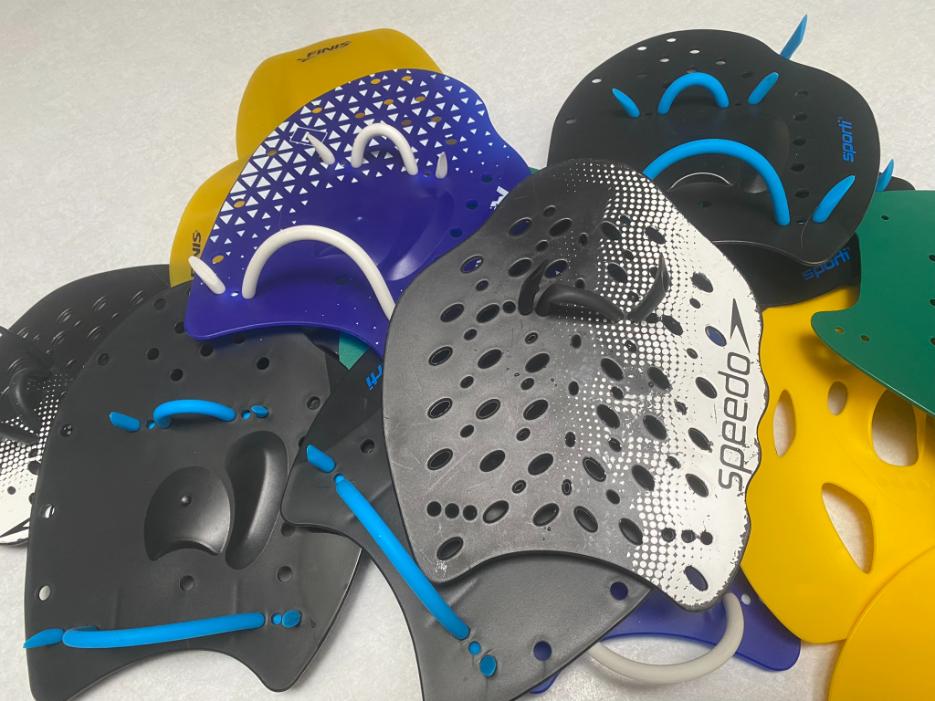
Swimmers were moving faster, but the hands had to move more slowly through the pull because it was working hard to push against a much larger mass of water.
Why does this matter?
Well, for starters hand speed is sneaky important for the freestyle pull. One of the hallmarks of an elite freestyle is being able to accelerate the hand through the pull (van Houwelingen et al., 2016).
Oversized paddles may help you grab more water and increase stroke length, but if they slow your hands to a standstill, they also end up moving the stroke away from the mechanics you’re trying to improve.
How Paddle Size Holds Up Under Fatigue
There’s one more interesting way that paddles influence how we swim: they can actually help us hold onto speed as fatigue sets in.
In the 100m freestyle time trials by Lopez-Plaza et al., every swimmer slowed down on the second 50, paddles or no paddles. But they slowed down significantly less when they did have paddles on.
Without paddles, velocity dropped by 6.6% on the second 50. With the small paddles, the speed decay narrowed to 4.6% with the small paddles and 4.5% with the large paddles.
Rather than fighting fatigue with a faster turnover, swimmers maintained speed by preserving stroke length:
| Condition | First 50 Velocity (m/s) | 2nd 50 Velocity (m/s) | Speed Loss | Stroke Length (1st → 2nd) |
| No paddles | 1.52 | 1.42 | −6.6% | 2.10 → 2.03 m (−3.3%) |
| Small paddles | 1.53 | 1.46 | −4.6% | 2.25 → 2.20 m (−2.2%) |
| Large paddles | 1.54 | 1.47 | −4.5% | 2.29 → 2.25 m (−1.7%) |
Both paddle sizes produced almost identical results. The larger paddles offered a comparatively meaningless advantage over the smaller ones.
This reinforces what we’ve seen so far—once paddle size reaches a certain point, you are changing the stroke more than you are improving performance.
How to Size Your Paddles for Faster Swimming
The main reason for using swimming equipment is to improve how you swim without it. No different with paddles—they should support your optimal stroke, not replace it or mess with stroke kinematics.
Here are a few guidelines for getting the most of your swim paddles:
Choose a paddle size that supports the right adaptations. All the studies referenced above showed that most performance benefits came just from wearing the paddles and not reaching for the largest pair available. Massive paddles don’t necessarily produce more force and they slow down your stroke tempo to the point that you are basically training a different stroke. Bigger isn’t always better.
Stay close to your normal stroke rhythm. Paddles work best when they support your regular stroke tempo. Avoid turning paddle sets into slow, grinding reps in the pool.
Alternate paddle and non-paddle swimming. Build sets that alternate paddles and no-paddles to get better at applying force in the right direction. One of the reasons that paddles can help boost stroke performance is that it’s much better at directing force compared to your hands. Learn what that feels like and try and get it to land into your regular stroke.
The Bottom Line
Swim paddles are one of the most enjoyable tools to use in the pool. They lengthen the stroke, improve your feel for the water, and make every pull hit a little bit harder.
But bigger paddles don’t automagically produce better swimming. Once paddle sizes reaches a certain point, benefits level off while your stroke coordination changes to adjust to the bigger surface area.
So:
Choose a paddle size that reinforces the mechanics you want to race with. The goal isn’t to swim with the biggest, baddest paddles you can find—it’s to use them to build a stronger and more effective stroke without paddles.