

The Elite Way to Unleash Resisted Swimming for Power, Force, Speed... and New PB's.
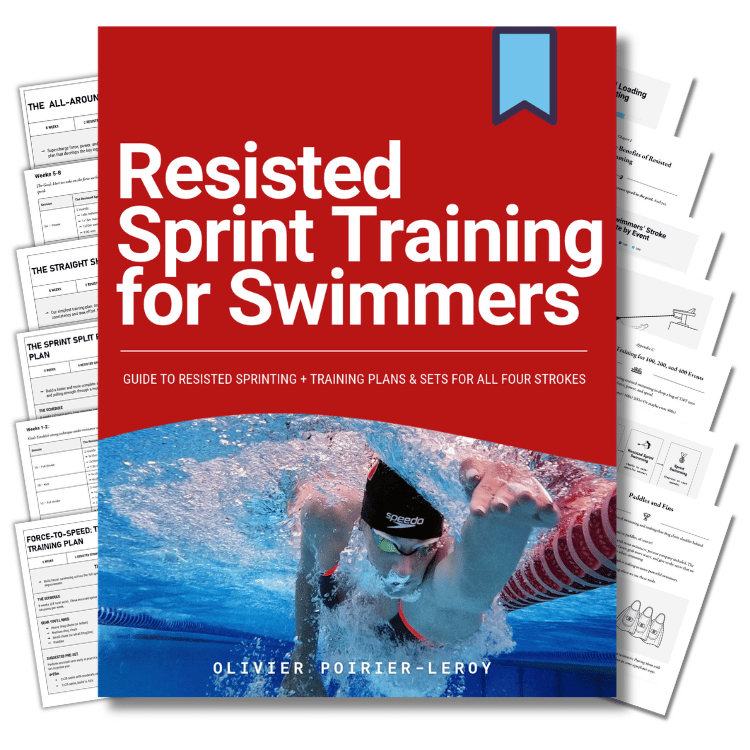
Resisted Sprint Training for Swimmers is your complete, research-backed guide for using drag chutes, swim tethers, power towers, and other resistance tools to become a faster, more powerful swimmer.
You’ll learn the right way to choose the amount of resistance to use, structure PB-breaking sprint sets, improve stroke mechanics, and turn hard work against resistance into speed on race day.
Includes 40+ sets and 8 ready-to-use resisted sprint training programs for all four strokes.
Buckle up, lock in, and unleash speed.
Complete Training Guide
40+ Sets & 8 Bonus Training Plans
Instant Download
Why Your Drag Chute Isn't Making You Faster...
Drag chutes. Swim tethers. Power towers. DragSox. Wearing five XXL drag suits at the same time.
Resistance tools are everywhere on pool decks, littering the end of the lane like a yard sale.
And for good reason. When used the right way, they unlock explosive force, develop more power, improve stroke mechanics, and shoot swimmers across the pool like a Formula 1 car.
But that’s not what most swimmers experience with resistance in the water.
Instead, they are:
- Leaving speed on the table. You know resisted swimming works, but you aren’t getting the full force, power, and speed benefits that other swimmers seem to be getting.
- Guessing instead of progressing. Random sets, random resistance levels, and a whole lot of inconsistent results.
- Stuck at a speed plateau. You’re absolutely sending it with effort each day at practice, but speed has flatlined. All that work should be paying off.
- Getting stronger without getting faster. You can make the chute and power tower creak and groan, or lift a ton of weight in the gym, but the clock doesn’t show improvement when you take the tools off.
- Not knowing where to start. Heavy resistance? Light resistance? Short sprints? Longer sets? There are a million ways to train against resistance, but which will actually make you faster?
The problem most certainly isn’t that resisted swimming doesn’t work.
It’s that making swimming hard and getting a good sweat at the pool is vastly different from getting faster.
For the swimmer who is ready to stop guessing, break through speed plateaus, and finally get the most out of every resisted sprint, introducing Resisted Sprint Training for Swimmers.
How Resisted Sprint Training for Swimmers Will Help You Light the Pool on Fire This Season...
Resisted Sprint Training for Swimmers takes the science, strategies, and proven training methods behind resisted swimming and turns them into a practical, step-by-step system for building explosive speed in the water.
From choosing the right resistance to plug-and-play sets to stroke-specific strategies, you’ll learn everything you need to know about how to get the most of every rep you do under load.
And most importantly…. turn that hard work into speed when the bright lights are on at the Big Meet.

Here’s a look at some of the chlorinated goodness waiting for you inside:
✅ Unlock the Explosive Benefits of Resisted Swimming
Resisted swimming isn’t just about making your arms and legs stronger.
That’s a fun outcome, but doesn’t necessarily help us swim faster.
Done right, resistance builds explosive force, develop more power, improve stroke coordination, sharpen technique, and ultimately swim faster.
Pretty sweet, right?
Inside the book, we’ll break down what the research actually says about resisted swimming, including how it changes the way swimmers move through the water and how those changes can be used to light a fire under your race-day swims.
You’ll get a full behind-the-scenes look at how resistance can help clean up dead spots in your stroke, develop more effective propulsion, and improve the coordination required for high-speed swimming.
Because the real goal isn’t just to get stronger against resistance. It’s to become a faster, more powerful swimmer when the resistance comes off.

✅ Turn Strength into Race-day Speed
One of the biggest struggles of the training we do, whether it’s in the gym, using a pull buoy, or in this case, using resistance, is making that work transfer into swimming speed.
After all, you can be a total beast on a swim tether, but if that doesn’t result in faster, well, results, than what are we doing here?
Resisted Sprint Training for Swimmers is built on a foundation of transfer–turning as much of the force and power you build with resistance into your actual swimming.
You’ll learn how to:
- Match race-day stroke rate to develop force at the tempo you actually swim with
- Use contrast training to funnel more of your force and power into unresisted swimming
- Improve sprint-specific coordination by recreating race-speed arm timing under resistance
- Learn the exact technique breakdowns for all four strokes that can limit gains and improvement
We’ll also look at tethered vs semi-tethered swimming, and why swimming forward with resistance is your ticket for developing race-day speed.
The goal of this book is to help you crush it on race day, and that requires a clear bridge between the training you are doing and the results you want.
✅ Build a More Complete Sprint Performance
Awesome race-day performances require more than brute strength. Or just top end speed. Or relentless speed endurance.
When you look at elite sprinters, they can do it all.
They produce force, produce it quickly, and apply it effectively to move through the water at blistering speeds.
Resisted sprint training is the best weapon you have for building that complete sprint performance.
Inside, we’ll break down the force–velocity relationship for swimmers and show you how to train across the full spectrum—from heavy force work to explosive power training to lighter, race-speed sprinting.
You’ll discover how to:
- Build more force against heavier resistance to develop stronger propulsion.
- Develop explosive power by finding the sweet spot between force and swimming speed.
- Improve sprint-specific speed by training at higher velocities and race-relevant stroke rates.
- Strengthen your kick and pull with targeted resistance methods.
- Sharpen stroke mechanics to apply your newfound power more effectively.
We’ll also explore how resistance affects stroke length, stroke rate, body position, and coordination.
Most swimmers can do one or two of these things well. With this book, you’ll be the swimmer that can do it all.

✅ Find the Sweet Spot for Resistance
How much resistance should you actually use?
A small chute? A medium chute? A power tower loaded up like you’re trying to tow a metric ton of sopping-wet swim towels?
The answer depends on what you’re trying to improve.
Heavy resistance emphasizes force. Moderate resistance can help swimmers produce more power. Lighter resistance allows swimmers to maintain higher speeds and more race-specific stroke mechanics.
And there’s a whole lot more to it than simply choosing between small, medium, and large.
Inside, you’ll learn:
- How to choose the right resistance for developing force, power, or sprint-specific speed.
- How to use velocity loss to measure how much resistance is slowing you down and find your ideal training zones.
- Why the same resistance affects swimmers differently, depending on their speed, strength, body size, and technique.
- How heavy is too heavy, including the “check engine” lights for when resistance is doing more harm than good.
No more randomly grabbing whichever chute happens to be sitting at the end of the lane.
✅ Get Faster Across All Four Strokes (and Beyond the 50)
Resisted sprint training works across all four strokes. (And your underwaters, too.)
Butterfly. Backstroke. Breaststroke. Freestyle.
Each stroke has its own demands, and resistance changes the way swimmers move through the water in different ways.
Inside, you’ll learn how to use resisted swimming across all four strokes, including stroke-specific technical considerations, opportunities for developing force and power, and common mistakes to avoid.
We’ll also dig into:
- Underwater dolphin kicking: How to overload your kick without sacrificing the rhythm, timing, and undulation that make it fast.
- Breaststroke: How to target the powerful kick and coordinate the arms and legs under resistance.
- Butterfly: How resistance affects stroke timing and coordination.
- Freestyle and backstroke: How to develop more propulsion while protecting the stroke mechanics needed for high-speed swimming.
And if you’re racing the 100, 200, or even 400?
Well, it turns out resisted sprint training has something to offer those events, as well.
The book explores how resisted training can support performance in longer events, how training priorities change with race distance, and how to incorporate resistance alongside the endurance demands of those races.

✅ Train with Resistance Like a Legend
There is no shortage of ways to train with resistance in the water.
Some sets are all about “rackmaxxing” with heavy loads and short, explosive efforts. Others use lighter resistance to target high-speed technique and coordination.
Some pair resisted and unresisted swimming. Others use clusters, changing loads, or carefully timed recovery to keep power output high.
And each leads to very different outcomes.
Inside the book, we’ll explore the different ways to organize resisted sprint training, including:
- Traditional resisted sets for developing targeted force, power, and speed qualities.
- Cluster sets that break up efforts with short recovery periods to help maintain higher-quality output.
- Potentiation clusters that combine resisted efforts with unresisted sprinting.
- Post-activation potentiation (PAP) strategies that use heavy resisted efforts to prepare for explosive swimming.
- Contrast and complex sets that combine different resistance levels and swimming speeds.
- Force–velocity training that develops the full range of qualities needed for sprint performance.
- Stroke-rate training that uses tempo as a constraint to train around and build a performance with.
Sets work best when you have a razor-sharp understanding of what it’s improving.
No more guesstimating on whether a set is leading to the outcomes you want on race day.
✅ 40+ Resisted Sprint Sets for Explosive Force, Power, and Speed
Now for the fun stuff.
Time to put all that science, strategy, and know-how into action.
Resisted Sprint Training for Swimmers includes 40+ ready-to-use resisted swimming sets designed to help you develop the qualities that matter most for sprint performance.
We’re talking:
- Force-focused sets to develop bulkhead-rattling propulsion.
- Power-focused sets to combine force and velocity for explosive swimming.
- Sprint-specific sets to develop speed and race-relevant stroke mechanics.
- Stroke-rate and coordination sets to improve the timing and tempo of your sprint stroke.
- Contrast, cluster, and potentiation sets to combine different loads, recovery periods, and unresisted swimming for targeted training effects.
Each set includes practical instructions, resistance recommendations, rest periods, and a clear explanation of what you’re trying to improve.
From simple, traditional resisted sprints to more advanced training combinations, you’ll have a whole arsenal of workouts ready to unleash in the pool.
No more standing at the end of the lane, staring at a pile of drag chutes and wondering what to do.
Built for the Questions I Couldn't Stop Asking...
I have always loved the concept of resisted swimming.
As a two-time Olympic Trials qualifier, former national-level swimmer, and lifelong student of the sport, there’s something incredibly satisfying about loading up with a drag chute, pushing off, and trying to make the cord snap from sheer power and ferocity.
But the deeper I went into resisted sprint training, the more questions appeared.
How heavy should swimmers actually go?
How well does all this extra strength transfer to regular sprint swimming?
Does resistance affect all four strokes the same way?
Where does this type of training fit best during the season?
How do we choose the right amount of resistance for each swimmer?

I’ve pored over hundreds of studies on resisted swimming, force–velocity profiling, active drag, stroke coordination, potentiation, and sprint performance.
Then organized everything into a practical guide that answers the most important question of all:
What’s the best way to use resistance to swim faster on race day?
The result is Resisted Sprint Training for Swimmers.
If you’re just looking for a bunch of brutal drag chute sets, that’s not what this is.
It’s a complete guide for turning resistance into more force, explosive power, and swimming so fast that the clock will melt.
⚡ EXCLUSIVE BONUS: 8 Complete Resisted Sprint Training Plans
Want an even more guided approach?
Along with Resisted Sprint Training for Swimmers, you’ll get a bonus collection of 8 structured training plans that turn everything in the main guide into weeks of ready-to-use resisted sprint training.
These aren’t just random sets thrown together.

Each plan has a specific goal, a clear progression, and a different approach to building more force, explosive power, better stroke mechanics, and faster swimming.
Some target force, power, and speed from day one. Others gradually build intensity, focus on specific parts of the stroke, or use velocity loss to dial in the perfect amount of resistance.
Here’s what you get inside:
- The Day One Training Plan. A 2- or 4-week introduction to resisted swimming that builds your foundation before progressing to more intense training.
- The Straight Shooter. A simple, no-nonsense program that covers the major ingredients of faster sprinting. Nothing fancy. Just the stuff that works.
- The All-Around Training Plan. A progressive approach that develops force, power, and speed in sequence, building one quality before emphasizing the next.
- The Sprint Split. Inspired by the classic bodybuilding split, with dedicated full-stroke, pulling, and kicking sessions to build a more complete swimmer.
- The Sprint Breaststroke Training Plan. A specialized program targeting the unique force, kicking power, and timing demands of breaststroke.
- The Force–Power–Speed Training Plan. Three distinct training emphases each week, developing the entire speed curve from heavy force to explosive sprint speed.
- The Stroke Rate Focus. Build the ability to maintain higher stroke rates without sacrificing stroke length, across all four strokes.
- The Velocity-Based Plan. Use velocity loss to individualize resistance, choose the right training loads, and develop force, power, and speed with greater precision.

Pick a plan, choose your resistance, and get to work today.
These programs are designed to plug into the training you’re already doing, adding targeted force, power, and speed development without replacing your regular swimming.
You don’t need to do all eight programs, either. (Love the enthusiasm, though.)
This complete collection of resisted sprint training plans is included FREE when you order Resisted Sprint Training for Swimmers today.
Who Is Resisted Sprint Training for Swimmers For?
Resisted Sprint Training for Swimmers is for competitive swimmers and coaches who want to stop guessing with resistance and start using it to build serious speed in the water.
Whether you’ve got a fully loaded power tower, a collection of drag chutes, or just some resistance tubing and a healthy appetite for sprinting, this book gives you the tools to train with excellence.
It’s especially useful for:
Competitive sprint swimmers who want to build more force, explosive power, and race-day speed without sacrificing stroke mechanics and coordination.
Swim coaches who want a research-backed framework for choosing resistance levels, designing better sprint sets, and progressing training throughout the season.
Swimmers stuck at a speed plateau who are putting in the work but aren’t seeing the improvements they want on the stopwatch.
100, 200, and 400 swimmers who want to use resisted training to develop more speed and power while continuing to train for the demands of their events.
Strength and conditioning coaches who want to better understand how force and power development transfers into faster swimming.
One important note: Resisted Sprint Training for Swimmers is intended for swimmers with an established foundation of swimming technique. It’s not a learn-to-swim manual or a beginner swimming program.
👇 Grab Your Copy of Resisted Sprint Training for Swimmers Today 👇
- Format: Digital PDF (instant download) – mobile friendly and printable
- Price: $59 USD
- Delivery: Immediate access plus download links sent to your email
- Full training guide + 8 bonus training programs.
Elite Resisted Sprinting Made Simple.

Complete Training Guide + Over 40 Sets + 8 Bonus Training Plans
$59 — Instant PDF download
Lifetime Access
Secure Payment
Built for Speed

Frequently Asked Questions
What kind of equipment will I need?
You don’t need a fancy power tower, 1080 Sprint Machine, or an equipment bag that requires its own zip code.
The book covers a wide range of resisted swimming tools, including:
- Drag chutes. One of the most accessible and versatile ways to add resistance to your swimming.
- Swim tethers and resistance tubing (“cordz”). Great for stationary and semi-tethered resisted swimming.
- Power towers and resistance racks. Allow for adjustable, measurable resistance during swimming.
- DragSox. Useful for adding resistance to full-stroke swimming but mainly for resisted kicking.
You don’t need to own all of these.
A drag chute and a swim tether are a great starting point.
The book explains how to choose resistance levels, adapt training methods to different equipment, and get the most out of the tools you already have.
The bonus training plans also include equipment requirements and alternatives, so you can choose a program that fits your setup.
Is this book only for freestyle sprinters?
Nope!
Resisted Sprint Training for Swimmers covers all four competitive strokes: freestyle, backstroke, breaststroke, and butterfly.
You’ll learn how resistance affects each stroke differently, which qualities to target, and the technical mistakes to watch out for.
There’s also dedicated content on resisted underwater dolphin kicking.
Will this help swimmers racing the 100, 200, or 400?
Absolutely. While the main focus is building force, power, and sprint speed, those qualities aren’t exclusive to the 50.
The book includes a dedicated discussion of how resisted training can benefit swimmers racing the 100, 200, and 400, and how to adjust your training priorities for longer events.
You’ll learn how to incorporate resisted work alongside your existing aerobic, technical, and race-specific training.
Is this book suitable for beginner swimmers?
This guide is designed for competitive swimmers who already have a solid foundation of swimming technique.
Adding resistance increases the demands on your body and can change the way you move through the water. It’s important to have good mechanics before loading up.
If you’re new to resisted training but already an experienced swimmer, you’re in the right place.
One of the eight bonus programs is The Day One Training Plan, designed specifically to introduce swimmers to resisted sprinting.
Do I need to follow all eight bonus training plans?
Not unless you’re planning to spend the next several months living in the pool.
The eight programs offer different approaches to improving speed, from force–power–speed development to stroke-rate training, velocity-based loading, and stroke-specific work.
Choose the plan that best matches your current ability, training goals, and available equipment.
Each includes its own schedule, progression, and recovery recommendations.
Is the book based on scientific research?
You bet your anti-fog goggles it is.
Resisted Sprint Training for Swimmers draws on a substantial body of sports science research covering resisted swimming, force and power production, stroke mechanics, coordination, velocity-based loading, and sprint performance.

But this isn’t a textbook that simply throws research findings at you.
The goal is to turn the science into clear, practical training recommendations you can use in the pool starting today.
How many times per week should I do resisted sprint training?
That depends on your experience, training goals, and the type of resisted work you’re doing.
The bonus programs generally prescribe 2–4 resisted sprint sessions per week, with recovery recommendations and progressions built into each plan.
The main guide also explains how to adjust training frequency, volume, intensity, and rest to get the most out of your sessions.
Will the training plans replace my regular swim workouts?
No. And they’re not supposed to.
The bonus programs consist of resisted sprint sets designed to fit into your existing swim training.
Think of them as a targeted addition to the work you’re already doing.
You’ll still perform your regular aerobic, technical, race-specific, and dryland training.
The book explains where resisted sprint sets fit best within a workout and how to manage recovery between sessions.
But this isn’t a textbook that simply throws research findings at you.
The goal is to turn the science into clear, practical training recommendations you can use in the pool.
When do I get it after ordering?
Right away.
You will get redirected a download page after completing your order. You’ll also get an email with additional download links.
The PDFs are searchable and printable, so you can read them on your computer, pull them up on your phone, or keep a printed copy handy on deck.
Do you offer refunds?
Because this is a digital product with immediate access, all sales are generally final.
That said, if you have questions about your purchase or genuinely feel the book isn’t right for you, reach out through this contact form and we’ll see what we can do.
Elite Resisted Sprinting Made Simple.
Complete Training Guide + Over 40 Sets + 8 Bonus Training Plans
$59 — Instant PDF download
Lifetime Access
Secure Payment
Built for Speed