
Strength training can improve swim performance when done properly—which means lifting smart and progressively both in terms of resistance and frequency. Here’s what swimmers need to know.
Strength training can boost swim performance by improving stroke power, body alignment, and help keep your stroke together under fatigue.
But here’s the chlorinated challenge: For most swimmers (and coaches), the hard part isn’t choosing strength training exercises or dealing with the inevitable uptick in muscle soreness or calf cramps (ouch).
It’s figuring out how often to strength train to see results in the water.
Swimmers—being the workaholics that we are—often assume lifting weights should be programmed with the same kind of frequency and volume as their swim training. That’s a recipe for crashing and burning. Fatigue, injury, and slower swimming.
The good news is that swimmers don’t need to hit the gym 7x per week to see real results.
How often should swimmers lift weights?
A systematic review (Fone and van den Tillaar, 2022) analyzed studies looking at how strength training impacts times in the pool.
Studies that used your traditional weight lifting exercises (squats, bench press, pull-ups, etc) showed that lifting weights 2-3 sessions per week was enough to lead to significant improvements in the water.
Interventions lasted anywhere from 6-12 weeks, with significant improvement happening around ~6 weeks. Strength training led to performance boosts of 2-2.5% faster than control groups who stuck to swim-only training.
Age-group swimmers and beginners may need less frequency (1–2x/week) to adapt safely, while collegiate and elite swimmers can handle 2–4x/week depending on workload and recovery.
How long does it take for strength training to improve swim performance?
This is the burning question behind the frequency question: how many times do I have to hit the gym to see results from lifting weights reflected on the clock?
Again, some good news. Swimmers and coaches can expect to see improvements sooner than they may expect.
A 2025 study by Yang et al compared three types of dryland training over six weeks with a group of national-level swimmers:
- Maximal strength training (lifting at weights of ~85-95% of 1RM and lower reps)
- Plyometric training (explosive bodyweight movements)
- Muscular endurance training (lighter resistance lifting, higher reps)
After just three weeks, the maximal strength training group saw jumps in 25 freestyle kick, 25 and 50 freestyle sprint times. The plyometric training group eventually caught up, but it took six weeks to get to where the maximal strength training group got to in three weeks. The maximal endurance group lagged behind (pew).
While every swimmer is unique in terms of training and experience, lifting weights provides a viable path towards faster swimming that is also relatively swift when done properly.
The Importance of Balance with Lifting and Swim Training
While there are some golden-colored improvements with strength training for swimmers, it can be a tightrope walking act ensuring that you are lifting weights the right amount of times per week so that:
Promote the right improvement
Putting up bigger numbers in the gym is great for the ego, but ultimately it should be supporting what you are doing in the water.
More arm power. Better body position. Stronger push-offs.
Scheduling gym sessions appropriately means that you are always keeping an eye on progress, recovery, and adaptations.
Have a clear idea of what you are trying to improve in the gym so that it lands in your stroke in the pool.
Reduce injury with proper form
Swimmers get hurt a lot over the miles and miles of swimming. They also get hurt a lot in the gym.
One study by Wolf et al. (2009) with NCAA division I swimmers found that nearly 40% of injuries incurred by swimmers happened during dryland activities, including strength training.
But here was the key finding in that sea of injuries: A majority of the swimmers injured in the gym were freshman, not used to the lifting rigors of an NCAA team.
This is yet another reminder to focus on awesome technique and progress smartly when in the gym.
Aim for max transfer
You hear a lot about “swim specific” dryland. Swimmers holding dumbbells and doing butterfly strokes while bent over at the hip, for example. (Not ideal.)
Strength training works best when you are trying to build maximal stability, strength, and power and then having those characteristics spill into the water.
And one way to increase that transfer is pairing lifting weights with in-water resisted swim training.
A study with competitive swimmers (Amara et al., 2022) combined heavy squats in the gym with kick work with a drag chute in the pool. After 9 weeks, the national-level swimmers saw kick velocity jump (+5.8%) and 100m freestyle time trial times dropping by ~4.4%. Giddyup!
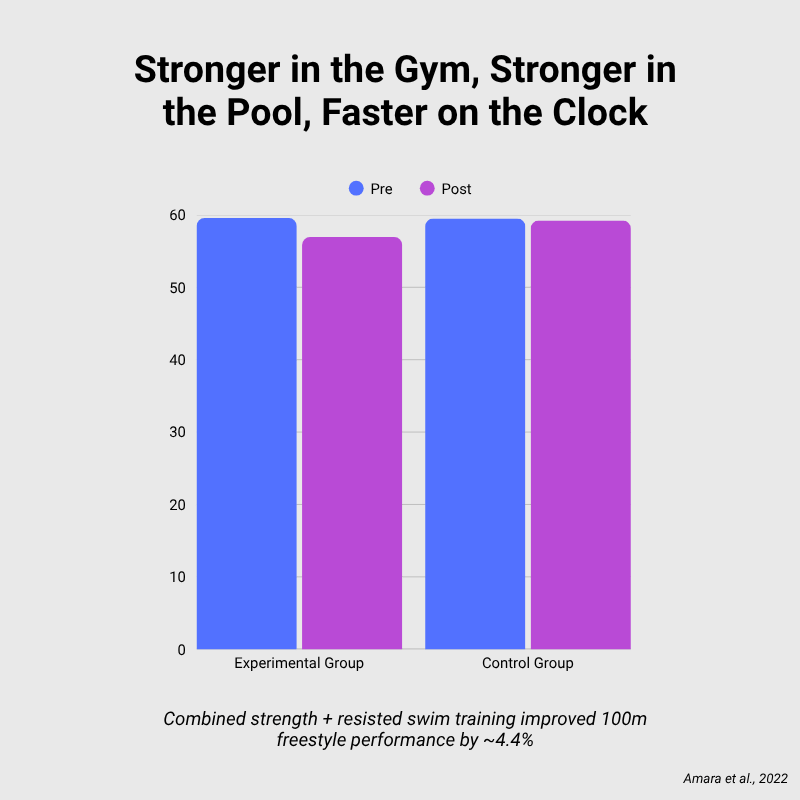
Build strength in the gym, build strength in the water, knock down PBs.
Recovery is essential
Strength training can feel easier than swimming in a lot of senses. The workouts are shorter, you can listen to tunes and chitty chat with teammates between sets, and you get that satisfying sensation of seeing yourself develop strength and muscle in the mirror.
But even though they are short, they are high in intensity. Strength training workouts can take anywhere from 24 to 72 hours to recover from depending on the intensity of the session and total volume/weight.
Given that swimmers are also going to Poundtown with meters between lifting sessions, spread them out to give yourself a better chance to recover.
Seasonal cycling for recovery
Figuring out your weekly frequency for weightlifting is one thing, but swimmers and coaches should also keep an eye on seasonal/cyclic breaks from the gym.
A study (Garrido et al., 2010) with swimmers found that after 8 weeks of strength training along with regular swim training, a 6-week strength detraining period maintained strength gains on land while swimming performance improved even further.
Like that!
Which means: Include periodic recovery blocks. Balance isn’t just weekly frequency (2 lifts per week again worked great with this study) but seasonal cycling to prioritize recovery and maintain gains.
The Bottom Line
When trying to determine how often should you lift weights per week to get faster in the water, keep these takeaways front-of-mind:
- 2-3 strength training sessions per week is the money spot for lifting frequency
- Beginners and age groupers should start with 1-2 sessions to build proper form and build a strong foundation
- Elite swimmers can graduate to 2-4 sessions depending on training load
- Improvement can start to roll in with 4-6 weeks (and sometimes faster) when lifting progressively and emphasizing strength and power work
- Pair with in-water resisted swimming—don’t just get strong in the gym, get strong in the pool with a drag chute, resistance tubing, power racks, etc.
- Prioritize recovery by allowing for 24-72 hours between big lifts
- Train smart through the season and deload periodically (you won’t lose all your strength overnight, promise!)
One of the best parts about improving in the water is seeing how things work together to drive improvement. The gym, swim training, recovery. When you understand how each supports the other, your strength sessions stop being random “swole” sessions and become pure performance for your swimming goals.
With the guidance and insights above, hit the gym like a pro, get stronger in the water, and lay waste to your goals in the pool!