
Curious what muscles the underwater dolphin kick works? Your first and chlorinated instinct would be the legs and the core, right?
Five points (and potentially a new PB) for you.
More specifically, the muscles worked during the underwater dolphin kick include the gluteus maximus, rectus abdominis, erector spinae, quadriceps, tibialis anterior, and the calves.
Many stabilizer muscles, particularly in the ankles and deep core, also play key roles in keeping the motion of the dolphin kick smooth as butter.
In this little guide on the muscles that are most active during the underwater dolphin kick, we will look a little more closely at how and when those muscles are most active, so that you can:
- Better understand when each muscle fires so that you can engage them more effectively (for faster kicking)
- Smarten up your dryland training and strengthen the primary movers so that you can develop a faster underwater dolphin kick
Let’s take a look at what muscles power the fifth stroke, better known as the underwater dolphin kick.
Muscles Worked in the Underwater Dolphin Kick
Before getting into individual muscles, it’s worth remembering that the underwater dolphin kick is a full chain movement.
From the trunk to the hips to lower legs, your body fires in a coordinated sequence to generate the undulation that makes those all-important vortices that push you forward.
Let’s start at the top and move our way down.
Core muscles
Your rectus abdominis (the six pack muscles) and erector spinae (the long muscles along the spine) are very active during much of the dolphin kick. They keep your body rigid and balanced so the hips can snap like a whip through the water.
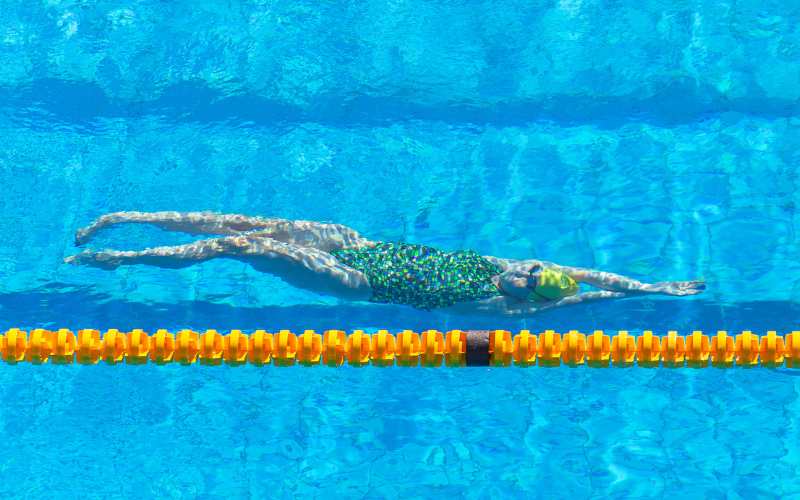
The rectus abdominis helps “catch” the feet at the top of the upkick and transition smoothly into the next downkick, while the erector spinae extends the trunk to drive the hips forward.
A strong core is very important as it sets up the undulation that travels down the legs. Tanaka et al (2022) saw that faster dolphin kickers also had faster angular velocities in the trunk when kicking, creating a sharper, more powerful whip.
Core stabilizers like the transverse abdominis and multifidus also help by controlling pelvic tilt, moving the body wave cleanly down the torso without breaking vortices or causing stiff/staggered sequencing.
Core training is essential for swimmers regardless, whether you are trying to improve sprint swim speeds or get off the blocks faster, but it’s extra essential for the dolphin kick.
Hips
Next stop on the undulation train: the hips.
This is where body movement turns into propulsion. The hips act as the bridge between the trunk and the legs, transferring force from the core to the legs, and eventually, the feet.
The rectus femoris (one of your quad muscles) helps with hip flexion and knee extension, sending the feet and toes hurtling towards the end of the downkick phase.
The gluteus maximus—those big sacks of meat under the back end of your Speedos—come online as intensity goes up, increasing power with the kick. Strong glutes also reduce excessive low back arching, which is a speed killer in the water and just generally bad news for posture.
Together, these two create a push-pull system around the pelvis. The rectus femoris kicks it off, and the glutes finish it off with gusto at the point of hip extension, increasing the strength of the vortices rolling down the body.
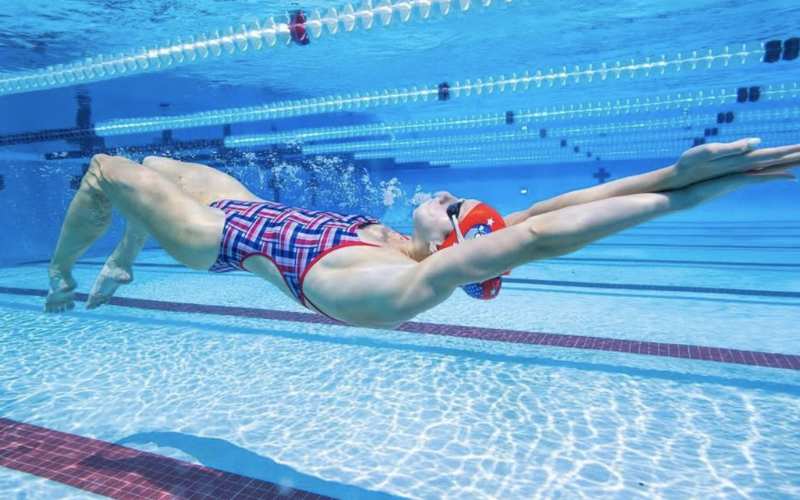
Lower legs
The calves and the tibialis anterior (shin) are the unsung heroes of the dolphin kick.
- The tibialis anterior is highly active, constantly adjusting the angle of your feet to catch and move the water more effectively.
- The gastrocnemius (calf) provides plantarflexion power (pointing the toes)
Because your feet travel the furthest during each kick (more than the knees, hips, or core), these muscles are also active the longest and experience the most torque as speed increases (Chen et al., 2022).
In other words, the faster and awesomer you get at dolphin kicking, the more important these muscles are.
Muscles Worked in Each Phase of the Underwater Dolphin Kick
To get more of a sense of how your muscles work during the dolphin kick, let’s compartmentalize each phase:
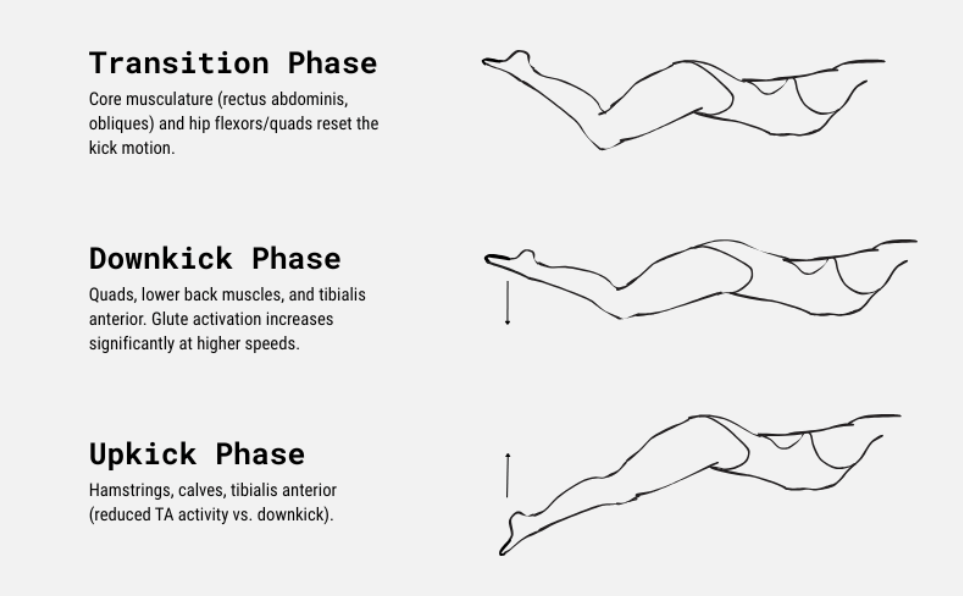
Transition phase
This is the set-up, when the feet are primed and ready to unleash the thunder.
The core (rectus abdominis and internal obliques) works with the rectus femoris and hip flexors to tilt the pelvis backward and start the downkick. Think of this phase as loading the spring for the rest of the kick.
Sample exercises that target muscles used during this phase:
- Toe raises (ankle coordination and control)
- Planks (core and pelvis control)
- Kettlebell swings (hip hinge and transitory explosive drive)
Downkick Phase
This is where the majority of the propulsion in dolphin kick happens. The big kaboom.
Quads, lower back (erector spinae and multifidus), tibialis anterior. The glutes (gluteus maximus) also become active at higher intensities.
The tibialis anterior controls ankle position and supports a pointed toe position so that you can catch as much water as possible with your feet for added propulsion.
At higher speeds/intensities, the glutes and hip extensors become more dominant (Yamakawa et al., 2022), amplifying the power of the downkick.
Sample dryland exercises include:
- Back extensions (trunk and hip extension)
- Calf raises (ankle strength and dorsiflexion)
- Hip thrusts (glute strength and pelvic control)
Upkick phase
Downkick complete, the feet return to sender during the upkick phase.
The biceps femoris, gastrocnemius (calf muscles) and tibialis anterior do work. The hamstrings and calves extend the hip and plantarflex the ankle, sweeping the legs up (like you are doing a hamstring curl underwater). The tibialis anterior, ever the busy bee, continues to fine-tune foot position and angle.
Although the upkick doesn’t provide the same amount of direct propulsion as the downkick, it’s important for a variety of other reasons, including shorter deceleration periods, vortex recapturing, and more (Sano et al., 2019).
- Hamstring curls
- Glute bridges
- Jump rope/calf extensions
The Bottom Line
The underwater dolphin kick is one of the more maddening skills to master because it isn’t just a brute strength skill—it requires exceptional coordination, timing and control to make it work.
Swimmers need to be able to sequence the right set of muscles, at the right time, in the right order, to move quickly under the surface.
To sum it up:
- The core gets the party started
- The lower back and hips drive the downkick
- And the hamstrings and calves balance out the upkick
Strengthen the individual muscles involved in the gym, but make sure to put a heavier focus on sequencing those muscles smoothly for a dolphin kick that undulates with a golden shimmer.
Happy kicking!