
The 100 breaststroke is won at the surface, on the start, on the turns. (So basically, like all swim races ?).
But breaststroke adds a twist. More than other strokes, it punishes propulsion gaps, sloppy timing, and weak acceleration.
A fast 100 breaststroke means winning the start and turns, building lower power body power, increasing stroke rate, and using smarter stroke coordination.
In this article, we are going to look at what actually matters most for swimming a faster 100 breaststroke. Using evidence-based insights from biomechanical and performance research, we will look at how elite breaststrokers generate podium-topping speed.
Faster swimming is made simpler when we know what to work on. So let’s get to breaststrokin’.
How to Build a Faster 100 Breaststroke
Not all improvements are created equal. A big mistake that breaststrokers—and swimmers in general—make is tackling the low-impact details while ignoring the things that actually move the needle in the water.
Here’s what matters most for a faster 100 breaststroke:
- Win the start and turns
- Build lower body power
- Increase stroke rate
- Less glide, more overlap
- Ditch the stroke length
- Pace the race properly
- Fix the list in your stroke
Work through them, and the race starts to make a lot more sense.
Win the starts and turns
The start and turns are huge in the 100 breaststroke, especially short course. These technically non-swimming elements can add up to more than 50% of a short course race depending on how long you can hit those pull-outs.
At the international level, Thompson et al. (2010) quantified just how big of a role the start and turns play, soaking up~35% of a 100m breaststroke race.
The study, which looked at twelve world, international, and national championship swim meets, saw a strong relationship between turning time and final result, meaning that elite breaststrokers charge into the wall and get off of it in a flurry.
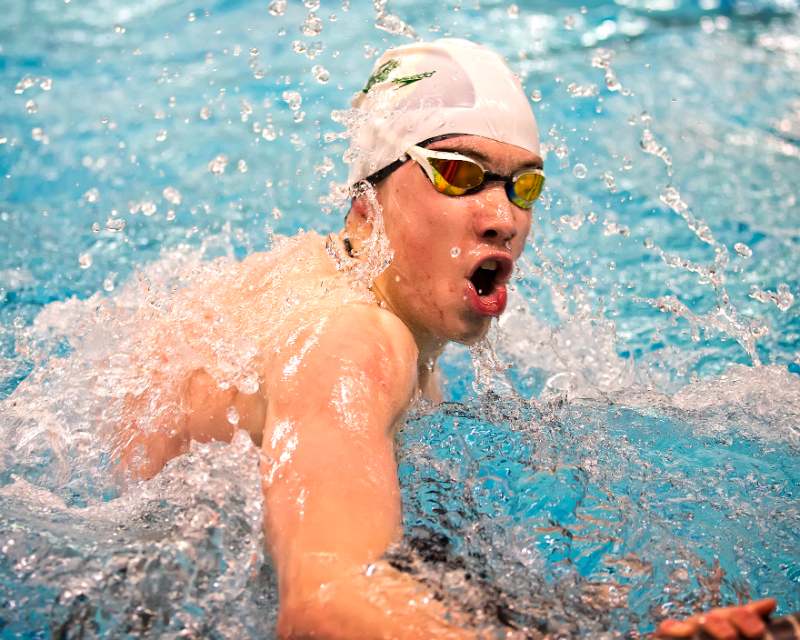
Olstad et al. (2020) also saw a nearly perfect correlation (r=0.979) between 15m start time and 100m time. Reaction time wasn’t the big needle-mover, but longer flight distance and clean, fast speed going into the first stroke.
Launch off the block, accelerate into the wall, and cleanly explode to the surface for those powerful first strokes.
Build lower body power
Breaststroke speed is driven by the kick. More than any other stroke, breaststroke relies on leg-generated propulsion, making lower-body power a must-have for breaststrokers looking to dominate the 100.
By increasing lower body power, swimmers crank up the amount of force they can generate with each kick, leading to more explosive push-offs and more boom-boom off the block.
A study (Karadenizli et al., 2025) with youth breaststrokers, aged 9-14 years, tested a variety of physical and motor qualities, including:
- Balance
- Agility
- Grip strength
- Sprint speed
- Lower body power.
Of all variables measured, lower body explosive power—tested via vertical jump height—had the strongest link to breaststroke speed.
This finding maps right on the demands of the 100 breaststroke. A higher vertical jump reflects a swimmer’s ability to produce large amounts of force quickly through the hips, knees, and ankles. These are the same joints responsible for breaststroke propulsion and wall push-offs.
In the water, and on the clock, this shows up as faster push-offs, more powerful breast kicks, and stronger acceleration after each wall.
Because the 100 breaststroke requires repeated cycles of deceleration and re-acceleration, swimmers who can generate more force regain speed faster and spend more of the race swimming at race velocity.
Increase stroke rate
The 100 breaststroke is swum at a much higher stroke rate than the 200—credit goes to the explosive stroke rate of Adam Peaty who really took tempo to new heights— and elite swimmers consistently raise tempo to meet the event’s speed demands.
At the ultra-elite level (Olympic finalists at the Paris Games), 100 breaststrokers used a stroke rate that ~30-35% higher compared to the finalists in the 200 breaststroke.
Here’s the stroke rates of both events:
| Event | Women | Men |
| 100 breaststroke | ~49.2 cpm | ~51.3 cpm |
| 200 breaststroke | ~36.9 cpm | ~39.7 cpm |
Higher tempo is not optional in the 100 breaststroke. While there isn’t a single perfect tempo—even Olympic finalists vary widely in turnover/stroke length blends—the common denominator is that they crank it up when it’s go time.
Pro Tip: Want to boost tempo today? Add some assisted sprints to your workout. A study (Lee et al., 2025) found that a warm-up with sprint assists increased breaststroke tempo (+6 stroke cycles per minute) and sprint speed (~3%).
Less glide, more overlap
Higher stroke rate is one thing, but what does that look like in terms of technique? What actually changes at 100 pace is how the arms and legs are coordinated.
Elite sprint breaststrokers reduce glide and shift ward a “superposition” coordination pattern in the stroke, which means there is less glide and more time spent in propulsive phases
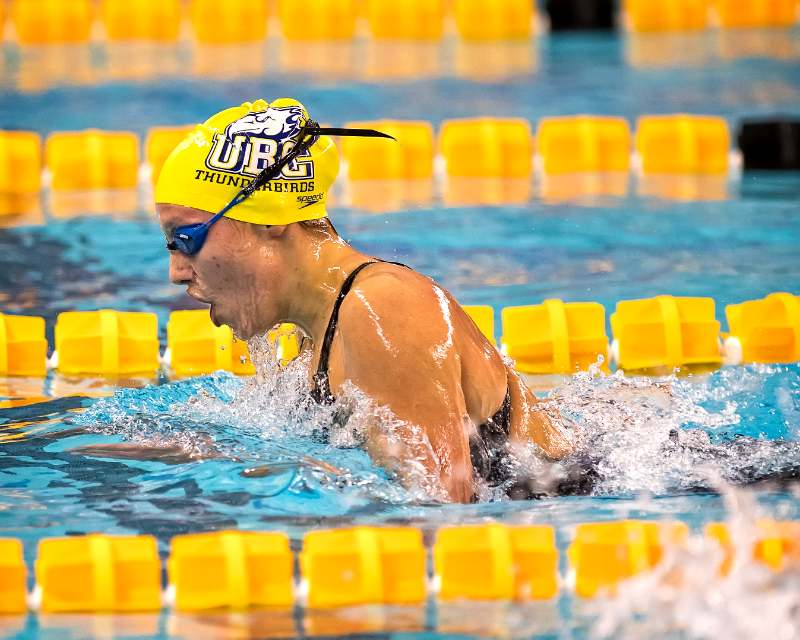
Seifert & Chollet (2005) showed that the fastest breaststrokers consistently used this overlap pattern at high speed and framed temporal gaps (time spent between propulsions) as a key coaching metric.
Another study by Oxford et al. (2016) reinforced what happens in a real 100. As the race goes on, most swimmers change coordination, and many shift toward more overlap (less “wait time” between propulsive actions). In their sample, 96% changed coordination across the 100, and 68% moved closer to overlap / increased overlap.
During the short glides that do happen in sprint breaststroke, it’s not used for times of reflection and relaxation—elite breaststrokers maintain shape with light, continuous activation to preserve alignment and speed (Olstad et al., 2017). At this stroke rate and speed, the glide is shape, velocity maintenance, and reloading the next stroke.
Most swimmers naturally do this as pace/speed increases, but it’s important to note that less glide and more overlap is the optimal breaststroke coordination for increased speed.
Ditch the stroke length
Elite breaststroke gets noticeably faster by increasing stroke rate (SR) as you move from 200 to 100 to 50 pace. Trying to maximize stroke length while also trying to sprint means we are perpetually stuck in first gear.
From Seifert & Chollet’s elite sample, SR climbs while stroke length (SL) drops as pace increases:
| Pace condition | Men SR (cycles/min) | Women SR (cycles/min) | Men SL (m/cycle) | Women SL (m/cycle) |
| 200m pace | 35.10 | 34.67 | 1.94 | 1.74 |
| 100m pace | 42.40 | 40.55 | 1.90 | 1.70 |
| 50m pace | 47.02 | 44.34 | 1.80 | 1.63 |
The stroke rate and stroke length for each event differs significantly. If you are trying to race the 100 with the same tempo as the 200 you are never going to hit those higher velocities.
This pattern is reinforced across the broader breaststroke literature: as speed increases, elite swimmers accept shorter strokes in exchange for more frequent and more continuous propulsion.
Trying to “hold length” at sprint pace usually means inserting glide—and glide is not helpful for speed in the 100. At 100-pace velocities, even small drops in speed during glide require disproportionate power to regain, making long glides mechanically expensive.
Pace the race properly
Even though the 100 breaststroke is short and furious, there is still a pacing element to it. Instead of going out like a maniac, keep something in reserve so that you can maintain stroke length coming down the home stretch (that can’t be saved by increasing stroke rate).
In a large competition analysis of twelve world, international and national championships, Thompson et al. (2010) showed that swimmers often go out too hard and then fade. An overly aggressive first length often leads to a collapse in stroke length on subsequent laps.
Here’s the key 100-specific problem: once stroke length drops, many swimmers cannot raise stroke rate enough to compensate, and speed falls anyway.

Fast 100s aren’t just about maxing out turnover—they’re about controlling the first 50 so you can still apply high turnover on the way home.
At the Paris Olympics, the pacing profile among the finalists was very consistent across swimmers and sexes. All swimmers positive-split by roughly 4-5 seconds. Below is a table with pacing profiles from Paris alongside goal times that follow the same pacing styles.
| Category | Total Time (S) | 1st 50 (time) | 1st 50 (%) | 2nd 50 (time) | 2nd 50 (%) |
| Paris – Men (F) | ~59.5 | ~27.46 | 46.3% | ~31.83 | 53.7% |
| Paris – Women (F) | ~65.3 | ~30.65 | 46.9% | ~35.29 | 53.1% |
| Goal: 1:10 | 70.0 | 32.6 | 46.5% | 37.4 | 53.5% |
| Goal: 1:20 | 80.0 | 37.2 | 46.5% | 42.8 | 53.5% |
| Goal: 1:30 | 90.0 | 41.9 | 46.5% | 48.1 | 53.5% |
Fast 100s aren’t just maxing out hard on turnover, but controlling that first 50 so that you can still apply that high turnover on the way home.
Fix the list in your stroke
Breaststrokers use both arms and both legs at the same time. Obvious? Sure—but how often have you considered the possibility that you’ve injected asymmetry into a stroke that works best when it’s symmetrical?
If there is yaw in the stroke (when right/left limb torques don’t balance), uneven and inefficient propulsion can result.
I’ve seen this lots over the years—a swimmer that tilts their head when they breathe, raise a shoulder higher than the other, or using uneven hand and foot paths.
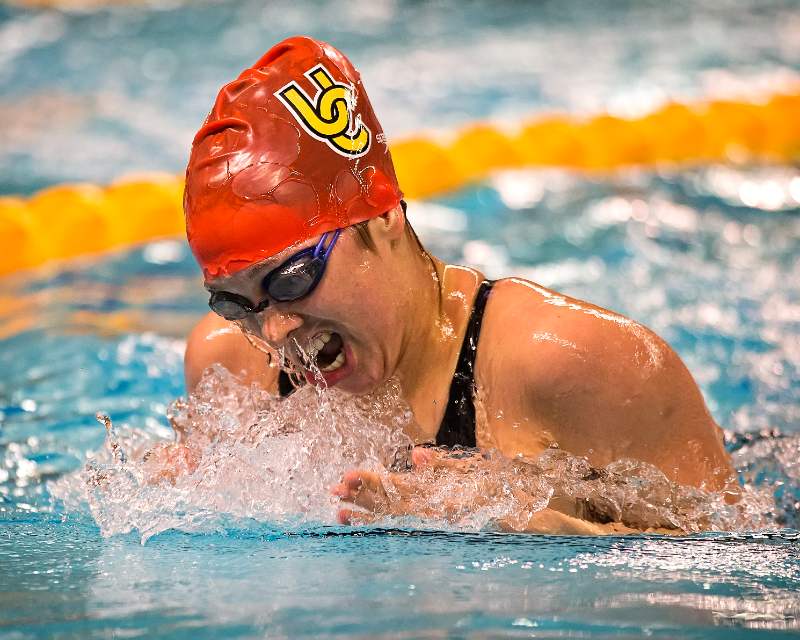
This is not even remotely an effective way of maximizing propulsion (even though some elite breaststrokers make this work, it’s precisely because they’ve used this motor pattern for years and years and honed it–they are successful despite this asymmetry).
In a detailed case study (Sanders et al., 2015) of an elite female international breaststroker, they identified five episodes of yaw-producing torques per stroke cycle sample, linked to bilateral differences: during out-sweep, in-sweep, arm recovery, leg recovery, and the kick.
If you snake, drift, or your feet/hand paths look different side-to-side under speed, you’re likely paying a drag tax that shows up brutally across the race.
The Bottom Line
Breaststroke is one of the more infuriating strokes to master, especially for long-axis swimmers who struggle to master the kick/pull timing, nevermind all of the other intricacies of what makes a fast breaststroke go.
Ultimately, a fast 100 breaststroke is a mix of high stroke rates, compressed stroke timing, clean symmetry, lower body power, and excellent walls and starts.
To crush with it with this race, avoid swimming it like a faster 200 breaststroke, chase those higher stroke tempos, and find velocity in those smaller gaps between strokes.
More Breaststroke Resources
6 Breaststroke Drills for a Faster and More Efficient Breaststroke. Breaststroke looks easy but it is difficult to master. Here are six breaststroke drills that will help you build a faster and more efficient breaststroke.
How to Improve Your Breaststroke Pull. Want to up your pull? Here’s a guest post by two-time Olympic breaststroker, Mike Alexandrov with a drill progression for a stronger breaststroke pull.