
Short step vs long step relay start—what elite swimmers use and why it matters for early race speed.
Relay starts are the only time swimmers are able to generate momentum prior to leaving the block.
Instead of diving into the water from your set position—an isometric hold—relay starts mean swimmers can move, step, and swing the arms aggressively. This turns the block into a short runway.
Done and timed well, relay starts are free speed—but maybe not the way that swimmers think.
Why Relay Starts are Faster
Before comparing the two relay starts, it’s worth understanding why relay starts are faster. Sure, they feel faster—but not usually for the reason swimmers assume.
Compared to regular starts, the biggest advantage with relay starts is that you are already moving when your teammate touches the wall.
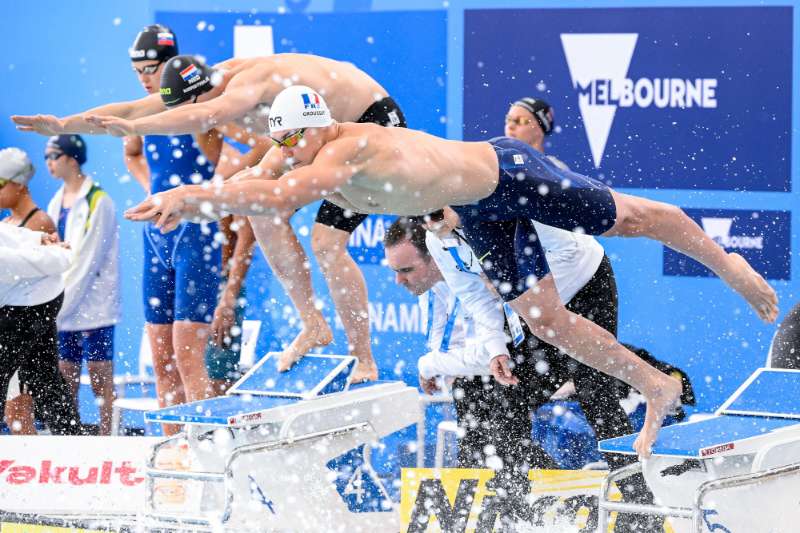
Researchers analyzed short step relay changeovers and compared them to regular starts. The flying head start accounted for times that are ~30% faster to the 5m mark (Qiu et al., 2021).
Timing is one part of it—body position and flight path are another.
Relay starts change the way you move through the air and enter the water.
While the step and arm swing don’t create more force on the starting block, swimmers still fly further, use a cleaner entry angle, and burst out of the breakout at speeds significantly faster than when using regular starts (2.5m/s vs 2.0m/s).
So while the “head start” advantage of a relay start is fixed, the real opportunity for improvement is using a relay start technique that maximizes how you fly through the air and enter the water.
Relay Start Step Techniques
Elite swimmers primarily use either a short step or long step (also known as the “step over”) relay start.
Short step relay start
The short step technique is the classic relay start. Swimmers have one foot at the back of the block, the other at the front.
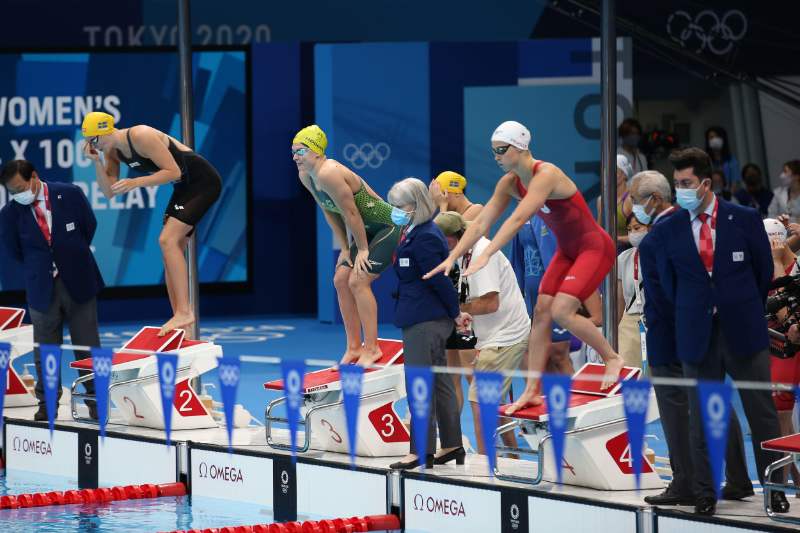
The swimmer takes a relatively small step forward, with both feet at the edge of the block, while doing an aggressive double arm back swing to shoot them off the block.
This start:
- Smaller stepping distance
- More controlled
- Both feet are parallel at take-off
- Simpler and more stable
The reduced stepping distance also means it’s easier to time your teammate’s approach to the wall.
Long step relay start
The long step start, popularized by NCAA swimmers and now popular at international competition, is the new kid on the block (ha). Swimmers set up with one foot on the back of the block (behind the wedge), the other on the wedge.
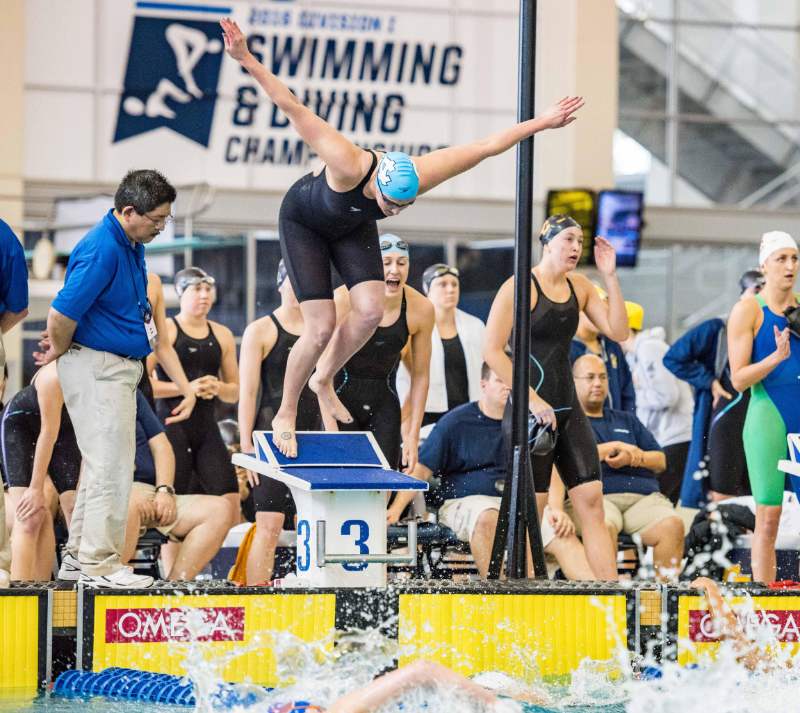
During the takeover, swimmers take a longer, more aggressive step forward—the foot furthest back takes the step—and they depart the block with a double arm swing and in a track-style position.
The long step:
- Larger stepping distance
- Track style take off
- Increased momentum from a longer runway
- Increased risk of extra rotation with the split-stance take-off
This technique is high reward and harder to time with precision.
Long Step vs Short Step
A study by Veiga et al. (2025) published in the Journal of Sports Science and Medicine tested the two starts.
Researchers had 20 international-level male and female swimmers and had them do a series of 25m sprints using their preferred relay start.
Times were recorded at take-off to 5m and 10m to see what type of relay start performed best.
Here’s how the two techniques compared:
| Variable | Result |
| Time to 5 m | Long step — ~0.09s faster |
| Time to 10 m | Long step — ~0.09s faster |
| Block time | Long step — ~0.11s longer |
| Horizontal velocity during step | Long step — ~17% faster |
| Peak horizontal force at take-off | Long step — ~24% more |
| Peak vertical force at take-off | Long step — ~15% more |
| Take-off velocity | Long step — ~18% faster |
The long step wins in a variety of ways, the most important being that it’s faster. The longer block time generates more momentum, a faster take-off, and increased velocity to 10m.
Long Step Relay Starts are King
If choosing purely on performance, the long step relay start is the easy choice.
It produces greater horizontal velocity during the step, higher force at take-off, and faster times to 5 and 10m. It gives swimmers a longer runway, more momentum, and a burst of speed down the pool.
It’s definitely harder to master and presents some risks, whether we are talking about improperly timing your teammate’s touch, spending too long on the block, or twisting in the air from the split-stance take-off.
Try both in practice, get some reps under your belt before you go to competition, and maximize the flying head start to swim your relay team to glory.