
Tapering for swimmers is a balancing act.
How long should it last? How much should you reduce training volume? How much fast swimming? What about dryland?
Tapering is basically a series of Goldilocks challenges stacked like kickboards.
Then there’s another question that comes up:
Should men and women taper differently?
Here’s what the research says and what swimmers and coaches should be paying more attention on instead.
Male and Female Swimmers Show Similar Taper Responses
It’s a reasonable assumption that men and women should taper differently. Yet the studies on swimmers tell a more nuanced story.
The Longhorns Study
A thesis by Joel Trinity (2004) followed swimmers from the University of Texas men’s and women’s teams as they tapered for their championship meets.
The swimmers were divided into four groups. Men and women competing only at the conference championships and men and women advancing to NCAA Championships. Across all four groups, power, torque, and swimming performance improved.
The taper worked across the board, with performance gains of 4% to 5.5%. Nice.
More importantly (for our present purposes), the taper response was consistent across all four groups. The biggest increases in power happened in the first 7-10 days of taper, with the remainder accumulating over the next two weeks.
If being male or female were the primary factor determining taper response, you would expect those curves to look very different. They didn’t.
Taper Response in Youth Swimmers
More recently, a study (Arruda et al., 2021) out of Brazil ran a three-week taper with male and female swimmers—older teenage swimmers—and saw that post-taper responses were the same.
This is important because the two groups had much different baseline measures like propulsive force and stroke parameters, but response was the same.
Age, Dryland, and Stroke
This is the study that often gets pointed at to support sex-based differences when tapering.
Avalos et al. (2003) followed 13 elite French swimmers over three seasons and found that there was a group that needed a longer taper—the older male sprinters. And the group that needed a shorter taper was made up of younger female swimmers.
So, case closed, right? But the authors were pretty explicit about why.
The young women had done the least amount of dryland training leading into taper, which meant they were carrying less muscle damage and fatigue. They were also adolescents, and at that age swimmers lean less on the anaerobic system during hard training than adults do. Less anaerobic stress means a shorter taper.
The older male sprinters had piled up years of high volumes of hard swimming and heavy strength work. And recovery capacity declines with age.
Whether you are a girl or a guy, if you are training like a hard core sprinter—endless speed and power sets, tons of speed endurance, heavy, heavy lifting in the gym—you’re going to need the longer taper, especially as age creeps up on us.
See also: 6 Taper Sprint Sets for Maximum Readiness
The Things That Should Drive Your Taper Design
When you’re deciding how long to taper, there are the classic variables that include taper length, reducing volume, maintaining intensity, and the shape of the taper.
Those are the pillars.
But as the research with tapering athletes continues to grow, we are seeing that there are other things that play a huge role in whether your taper succeeds, including:
Pre-taper Training Volume
As the saying goes, taper has to be earned. You have to taper down from something in order for it to really work. And this volume is what dictates a lot of what happens during the taper, especially reductions in training load.
The swimmer that shows up to every practice and every dryland and works hard is going to need a fundamentally different taper than the teammate that shows up to half the practices and sandbags the main sets when he does show up.
The harder the training that precedes it, the more taper you are going to need to properly clear fatigue.
The Overload Peak
Big, heavy training is one thing, but where do the biggest weeks of training land in relation to when your taper starts and when competition begins?
This is a subtle but huge mistake that swimmers and coaches make with tapering. Because they are natural workhorses, swimmers will drop their hardest training of the season or block right before the taper starts.
This decision may be well-intentioned—you’re trying to squeeze in some final hard work and really earn the rest and recovery of tapering—but hammering yourself in the final week doesn’t work.
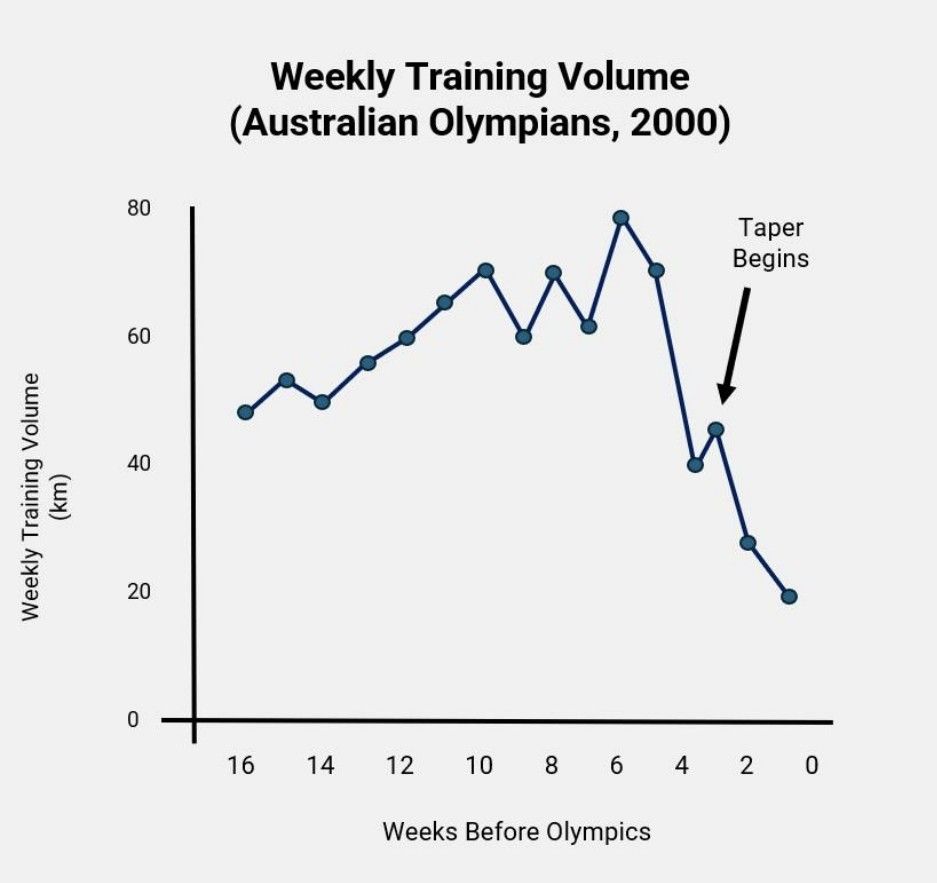
Hellard et al. (2013) tracked a group of more than 30 elite swimmers over multiple seasons and found that the best tapers had an overload block that peaked around 4-6 weeks before competition.
In other words, swimmers hit their hardest training of the season, eased off slightly for 1-2 weeks, and then tapered.
And what happens when we do collapse across the finish line into taper?
Hooper et al. (1998) tried this approach, with swimmers doing their biggest training weeks right up against a two-week taper. It wasn’t enough to pull swimmers out of the hole and none matched their PBs in competition.
Smart tapering begins before the taper with a controlled and subtle step-down from your hardest training of the block or season.
Level of Fatigue
On top of pre-taper training, you’ve also got pre-taper fatigue to consider. Swimmers in the same group can be going through the same training, show up to the same workouts, but show up to taper in totally different states.
A study (Bretonneau et al., 2024) followed a group of 26 elite swimmers at 10 weeks and 3 weeks out from a big meet. All did the same training, but the way they responded was night-and-day in competition:
- One group was in a state of functional overreaching, which meant that they were so wrecked that even tapering wasn’t enough to recover. They swam slower (-0.49%)in competition.
- The second group had manageable fatigue—tired, not wrecked—when they entered taper. The taper did its thing, and they improved on race day by 1.8%. Textbook taper response.
Training History
Taper design also changes as you progress in your career. The taper you need to excel as a plucky 14-year old is going to be different from the one that carries you to finals at Nationals when you are 23 years old.
Hellard et al. (2013) did a cool study where swimmers were tracked for up to nine years of their swimming careers—all while swimmers were at the elite level—for 85 different overload/taper periods.
As swimmers got older, and their training histories stacked up behind them, they needed a bigger training stimulus and a more aggressive taper drop to get the same pop in performance on race day.
In earlier years, better results came from maintaining a medium training load into taper.
The Bottom Line
While there are certainly physiological differences between male and female swimmers, the research to date suggests that sex alone isn’t a strong enough reason to prescribe fundamentally different tapers for swimmers doing the same training.
Which is good news for swimmers and coaches—one less thing to agonize over when designing your taper.
Instead, build the taper around the things that really matter.
- Training load.
- Peak overload timing.
- Recovery during hard training.
- Age and training history.
- The strength and high-intensity work they’ve done in the months leading up to the Big Meet.
Coaches often note that tapering is part science and part art, and they are right in the sense that there’s no universal formula for every swimmer on the planet to follow.
Just what works best for the swimmer in front of you.
Happy tapering!