
A strong core is essential for swimmers looking to go faster. But it’s only one piece of the puzzle for a well-rounded core that produces results in the pool.
Core training is one of the best things that swimmers can do to improve in the pool.
The core touches just about every aspect of what you do in the water:
A more powerful pull. A faster start. Cleaner stroke timing. Reduced injury risk.
And yes, core training can lead to faster swimming.
So swimmers do what swimmers will do and unlock Brute Force RepetitionTM on their core.
Planks. Rollouts. Crunches. Pallof presses. Slamming med balls through the floor.
But there’s an important distinction when talking about what makes a core “strong” and what makes it useful for fast swimming.
Core Strength ≠ Core Stability
One of the common frustrations with core training (and dryland training, really) is that it doesn’t always transfer to the pool.
In the case of the core, it’s countless planks, crunches, cable rotations and so on—but the moment we hit the water the hips keep fish-tailing, body roll is all over the place, and our bodyline feels saggier than an overcooked asparagus.
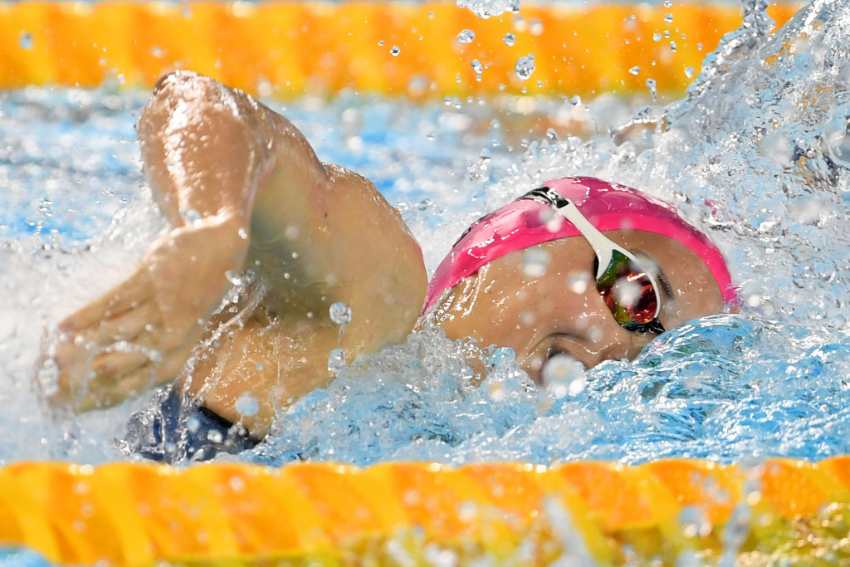
A study (Dai et al., 2025) with 32 elite competitive swimmers gives us a great example of how isolated core strength doesn’t automagically turn into faster swimming.
Researchers measured maximum core strength—across flexion, extension, and rotation—and compared it with sprint swimming performance.
The big finding?
Having a stronger trunk did not predict swimming speed.
See also: Why Swimmers Should Stop Prioritizing Crunches
Which seems upside down and backwards until we consider what the core’s job in the water really is.
It’s not—as most swimmers assume—to create movement. But rather to control movement and to transfer force.
For example, a study by Andersen et al. (2021) measured core activity in a group of elite freestylers and found that the main trunk muscles—rectus abdominis, obliques—didn’t fire until after shoulder roll had already started.
The core was acting more like a brake than a gas pedal.
This changes the usual way that swimmers view core training.
Instead of:
Stronger obliques > More powerful rotation > Faster swimming
Think:
Stronger, better-coordinated obliques > Better control of rotation and force transfer > Faster swimming
I know that this feels like we are splitting chlorinated hairs a little bit, but the Dai study was on top of this. They measured trunk torque during rotational movements precisely because they resemble the high-velocity demands of sprint freestyle.
And even then, more rotational torque didn’t predict faster sprint swimming.
The missing ingredient isn’t more force but how well that force is coordinated.
And it gives us a model of two different types of swimmers:
- A swimmer with a strong core, but limited stability = Lots of explosive firepower, but not much control
- A swimmer with good stability, but limited strength = Plenty of control, not a lot of horsepower
The goal with awesome core training is to have both stability and strength.
Why Swimmers Need Core Stability, Too
Before you swing an arm, kick a leg, rotate through a stroke, or leave the block, the deep muscles of the trunk activate to stabilize the spine.
You don’t think about this muscle activation to make it happen.
It’s like when a friend gives you a light shove and your trunk stiffens. It’s automatic and (usually) anticipatory.
But when that stabilization is late, untrained, or it breaks down with fatigue, you get leaks.
The hips swing out when you get tired. The lower back sags. Rotation gets sloppy.
The strength is still there, but it needs the firm footing of stability so that it can be actually used.
For some ready-made core workouts for improved performance in the pool, check out this collection of dryland core workouts for swimmers.
Stability > Strength > Power
Core stability and core strength are related qualities but they are not the same. Research with athletes tells us that there is a surprisingly weak relationship between the two (Schulte et al., 2025).
That sounds confusing, but it actually clears the water in terms of how to train the core properly:
- Start with core stability. Use anti-movement core exercises like Pallof presses and planks, along with breath work to teach the deep stabilizers to do their job. Build the control and get better at resisting movement.
- Add core strength second. With the foundation in place, layer in the roll-outs, long lever planks, pot stirrers.
- Express it with some thunder. Where we climb the stability and strength we’ve built to unleash power. Med ball slams, throws.
Skip the stability and control part and you end up with strength and power that you can’t channel and control.
Focus exclusively on control all season long, and you miss out on the increased force transfer that comes with strength and power training.
Isolated Core Strength Is Only One Signal
The Dai study also highlights why isolated core strength can only tell us so much.
During their testing, the hips were restricted so that trunk torque could be isolated. That is fun and useful for measuring pure trunk strength, but it also strips away almost everything about what makes the core valuable for our goals in the water.
To move across the pool, we use the shoulders, trunk, pelvis, arms, and legs to move and transfer force together.
The trunk is rarely hitting peak muscle contraction numbers during this effort. And it’s role is more as a conduit and a brake versus flexing hard and causing movement.
So while the study gives us one of those counterintuitive nuggets that sounds spicey—stronger trunks don’t predict faster swimming speeds—it also points towards the most important lesson…
Swimming doesn’t reward force for its own sake.
You can be the strongest swimmer in the gym, but if you can’t direct that force through a stable platform and efficient technique, you’ll continue to underperform in the water.
So create a foundation of stability. Slather on some strength. And let it rip with power. Faster swimming will follow.