
Resisted sprint swim training is one of the best ways to improve performance in the water. Here’s what swimmers should know about tethered and semi-tethered sprint training.
Resisted swim training is one of the most effective ways to improve performance in the water (especially for sprinters).
Upon learning this, we do what swimmers do: head down to the pool and crank resistance up to 11. Max out the power rack. Strap into an industrial-grade tether and sprint in place. Clip on every drag chute we can find to our waist.
But, as with most things in the pool, the chlorinated gains are in the details. And that includes resisted sprint swim training.
In this guide, we are going to look at two common types of resisted sprint swimming–tethered and semi-tethered–and show swimmers how they differ and how they can be programmed for maximum awesomeness.
Let’s get our resistance on.
Tethered vs Semi-Tethered Sprint Swim Training
A study (Keating et al., 2025) tested 20 Olympic-level and national-level sprinters, recruited from two high-performance centers and compared how two types of resisted sprinting relate to actual race performance:
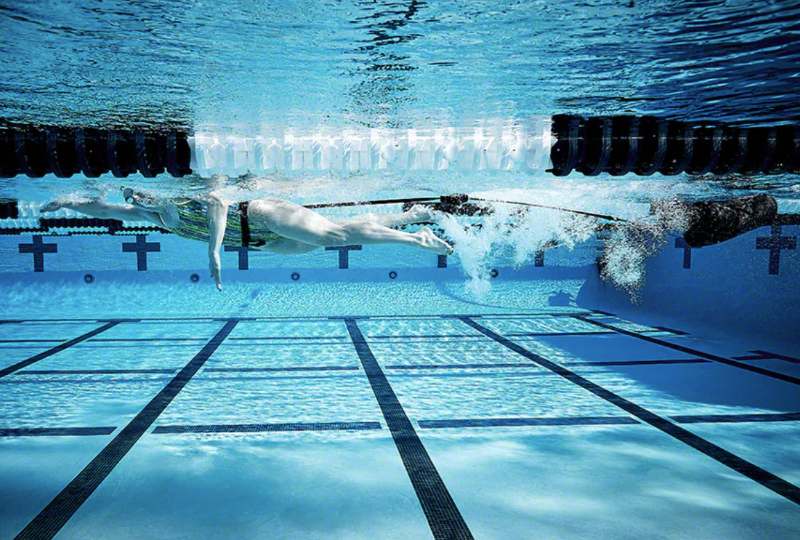
- Fully-tethered swimming – Swimmers were hooked up to a fixed swim tether and sprinted in place for 20 seconds. There was no forward motion at all.
- Semi-tethered – Swimmers sprinted 10m while using a resistance device (1080 Sprint) under different loads.
Separately, swimmers did a 50m all-out sprint to compare tethered results with actual sprint performance.
Two big things stood out:
Semi-tethered sprints much better predicted sprint performance
The strongest indicators of elite 50m speed came from resisted forward swimming, not stationary tethered sprints.
Which makes sense:
- Semi-tethered sprints preserve forward motion
- Swimmers interact with drag, like in a race
- Technique remains far closer to normal sprint mechanics
We are moving forward through the water like we would when swimming normally. This leads to swimmers navigating drag forces, using more natural swim technique, and better mimicking the “real thing.”
Tethered sprinting keeps us in place, which ignores drag and changes technique and form. Also makes it a less accurate predictor of race performance.
Tethered sprints saw way more peak force
Although tethered sprints were less effective for predicting sprint performance, they created a ton of peak force.
Tethered sprints saw significantly larger peak force numbers compared to semi-tethered. Men increased peak force by 25% and the women’s peak force jumped by a whopping 51% compared to semi-tethered.
Why? Because:
- Slack in the tether causes spikes in force
- Technique changes without flow/drag
- No forward motion = no drag
So while tethered sprints don’t reflect many of the environmental characteristics of sprint swimming, the larger force numbers indicate that tethered sprints can be used as a tool for increased strength in the water.
Training Force and Power for Sprint Swimming Success
So does this mean swimmers should go all in on semi-tethered resistance training? Ditch the tether?
That’s one option—but a smarter and more effective approach would be to take advantage of both types of resistance for a more complete approach that maximizes strength and power.
Think of it like the gym:
- Tethered sprints are like doing a heavy strength lift (i.e. 3×3 bench press at 95% of 1RM). Lower velocity, higher force, pure strength capacity.
- Semi-tethered sprints are your speed squats or bench press at lighter loads with a focus on explosive bar velocity. More velocity, more power, and closer to race-specific mechanics.
Elite swimmers work at both ends of that equation.
Sample Week of Resisted Sprint Swim Training
Here’s an example of how this could be programmed over the course of a week of swim workouts so that you can structure resisted sprinting sets like a pro:
Tuesday – Max Force (Heavy Resistance)
- 6×20 seconds all out
- Fully tethered
- 2 minutes of rest between repetitions
- Builds raw strength and force.
Thursday – Power (Moderate Resistance)
- 6×10 seconds all out
- Semi-tethered with a large drag chute
- 2 minutes of rest between repetitions
- Trains high amounts of force with enough speed to build power
Saturday – Speed (Light Power)
- 6×10 seconds all out
- Semi-tethered with a small drag chute or DragSox
- 2 minutes of rest between repetitions
- Targets max velocity and fast-twitch recruitment.
I love this approach as you are training different parts of the force-velocity curve, developing a more complete sprint engine.
The Bottom Line
Sprint success comes down to a lot of things working together, including dryland work, starts, turns, stroke mechanics, and so on.
Resisted swim training is another piece of the puzzle, and seeing how different forms of resistance creates different responses can be handy in getting the most of these types of sets.
So instead of just hammering everything at max load…
Or doing only power work…
Or relying solely on high-velocity sprints…
Blend tethered and semi-tethered sprinting and build a total sprint performance that rocks out on race day.
Happy sprinting!