
A dolphin kick count is one of the sneaky weapons top swimmers rely on. Here’s why training it in practice makes you faster and more confident in competition.
Fast swimmers, and by extension, fast dolphin kickers, use a kick count.
There’s next-to-no guesswork about how many dolphin kicks they are going to do when they dive into the water or push off the wall.
Four kicks? Three? Errm, maybe five? Nope, no “let’s just wing it and dolphin kick by the seat of my Speedos.”
They know it, they train it relentlessly in practice, and deploy it on race day, giving them allowing them to turn their brains off and execute the underwaters they’ve done a million times in training.
Here’s why adding a kick count to your UDK training is essential for executing the race of your dreams at the Big Meet.
For more proven strategies and tips for improving your underwaters, check out our detailed blueprint on building a faster underwater dolphin kick.
Elite Swimmers Use Kick Counts
Look at some of the best underwater swimmers on the planet:
- Gretchen Walsh: “I am constantly counting in practice.” It’s no accident her breakouts and underwater dolphin kicks are so explosive, she’s training her kick count every day, every rep, until it’s automatic.
- Leon Marchand: “He never doesn’t do seven dolphin kicks… on every set,” says his coach Bob Bowman. That level of consistency is part of what helped him kick out to 14m on the final lap of a golden 400m individual medley at the Paris Olympics.
- Ryan Murphy: “If you don’t apply it [the kick count] every time, it won’t pay off in a race.” That’s from an Olympic champion who has built his backstroke dominance on some of the best underwaters in the game.
And then we have Australia’s Cam McEvoy, the defending Olympic champion in the 50m freestyle, the sport’s splash and dash. A race where there is less than zero room for error.
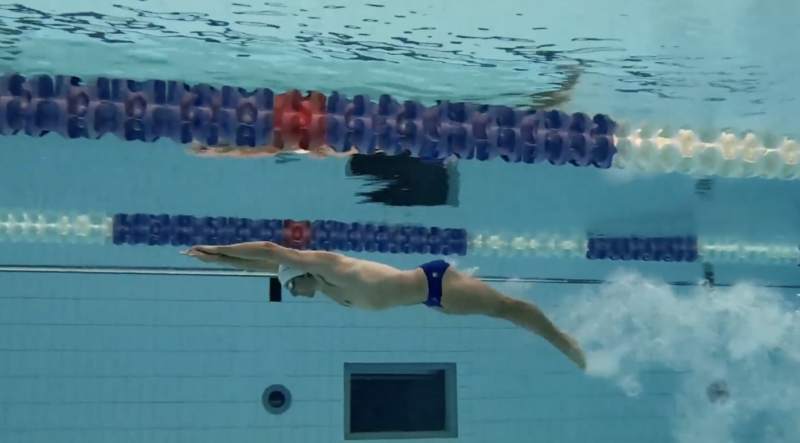
McEvoy does five dolphin kicks every single time he dives into the water.
Whether he’s racing in the prelims at the Olympics, a low-key timed final at an invitational in Tokyo, or banging out countless reps in practice, it’s always the same:
Five kicks. Every time.
Why Does a Kick Count Matter?
When it comes to competition, there’s a lot of stuff going on. The warm-up pool is buzzing. Competitors are putting up blazing times. The eternal “hurry up and wait” as your heat approaches.
But there’s also the mental battle of competition. The internal and external expectations. Managing nerves. Trying to stay focused and not get distracted.
And there’s overthinking. The moment you start trying to tweak or second-guessing technique and performance, the wheels start to fall off.
A kick count helps to automate this part of your performance. You’ve already done the thinking and stockpiled the repetitions in practice. Now it’s time to “let go” of the wheel and let your body execute what is second-nature.
A kick count:
- Creates consistency
- Keeps your breakout timing sharp
- Reduces panic or hesitation under pressure
- Allows you to get into flow more easily
- Helps you “turn off” your brain and let your body do what it’s trained to do
Building Out Your Kick Count
Every swimmer will have a different kick count that works for them. And every swimmer will have a different kick count for different distances in the pool.
There’s lots that go into developing a high-performance kick count, from body position, lung capacity, CO2 tolerance, power and so on. That’s why elite dolphin kickers spend so much time figuring it out in practice.
Here are some tips to master the UDK kick count:
Pick a base kick count.
Pick a starting kick count that is realistic and repeatable. Start easy, start “doable.” Two kicks per wall. Every wall. Or one kick, if necessary. Whatever kick count you need to start with to sustain consistency in the first few days.
Use it in warm-up, warm-down, the main set, when doing drills, when going all-out. Don’t just save the kick count for “important” meters/yards.
You make it automatic by using it all the time and not just when you get a random hankering to improve your underwater dolphin kick.
Slowly increase the distance/kicks.
Build out your kick count progressively. Michael Phelps’ developed his legendary underwater dolphin kick doing exactly this starting in 2002.
Phelps and his coach, Bob Bowman, recognized the impact of the UDK as a weapon and progressively expanded his ability to handle the extended underwaters:
“During the summer of 2002, Bob and I resolved to work that dolphin kick into my training, into my IM sets. If we did ten 400 IMs, for instance, I would dolphin kick [to 15m] on the last two, from breast to free; then work my way up to four, six, eight, and finally, ten.” –Michael Phelps
Stack the reps.
One of the big benefits of a kick count is that you will very quickly stack a ton kick repetitions in training without having to overthink it.
For example, if you bump your count from 2 à 3 kicks, that’s an extra kick on every turn. Over a 3,000m short course swim workout, we are talking about 120 fresh new dolphin kicks.
Do that day after day, week after week, over the course of a full season, and you are looking at an eye-popping number of dolphin kicks, along with serious underwater strength and endurance to go with it.
The Bottom Line
A strong, dependable kick count doesn’t magically show up on race day. It’s built steadily over the weeks and months of training.
Whether you’re a sprinter like Cam McEvoy or Gretchen Walsh, a powerhouse IMer like Leon Marchand, or a backstroke dynamo like Ryan Murphy, the principle of a kick count is the same:
Under pressure, swimmers don’t want to think—they want to do.
So:
Be patient. Start where you are. And get back on the proverbial horse when you miss a kick count.
Happy kicking!