
Struggling to sprint fast under pressure? Here’s a mindset strategy sprinters can use to hit top speeds when it matters most.
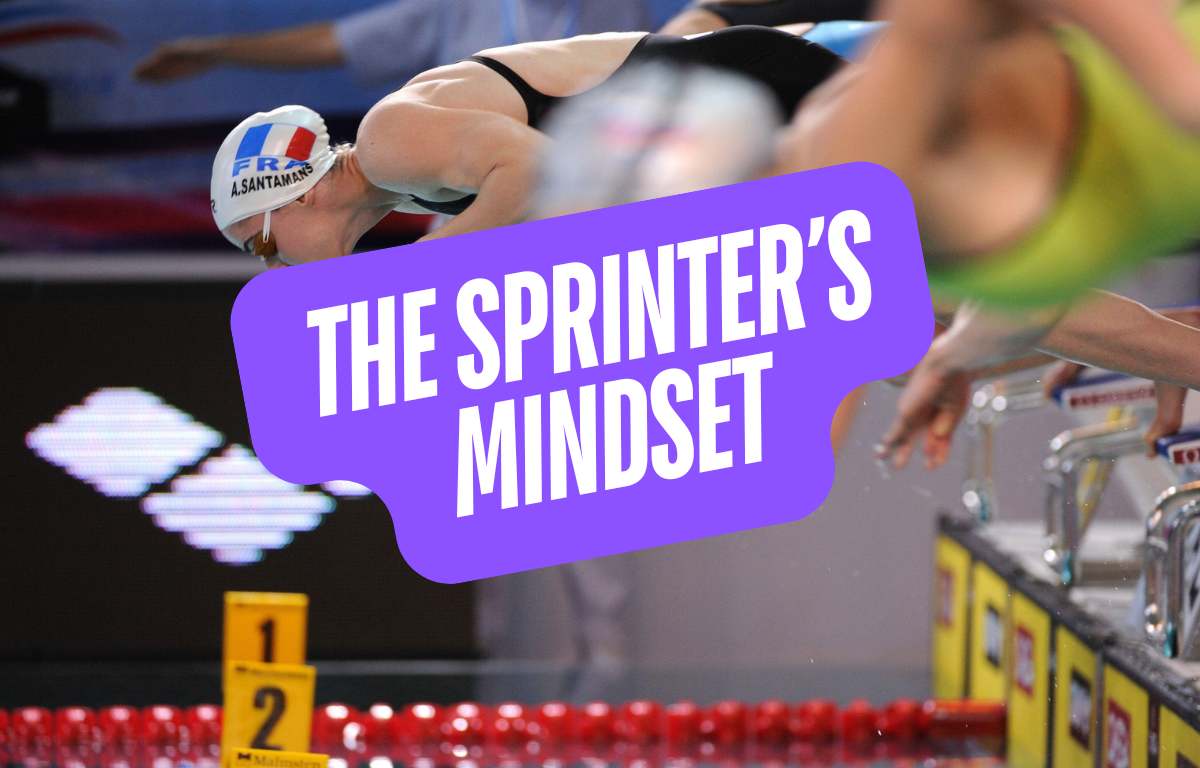
Swimming is full of paradoxes, and one of the most frustrating is that the harder you try and force a sprint performance, the more likely it is to crumble under pressure.
More often than not, overthinking a sprint performance causes a crash in speed and results.
Standing on the blocks, we over-analyze every last detail:
- Should I change the foot placement on the start?
- Should I use a straight-arm recovery today?
- More dolphin kicks?
- Am I getting enough hip roll?
The truth is the more you try to micromanage technique when you’re already race-ready, the slower you are going to swim.
This is one of those classic reasons that swimmers struggle to perform under pressure.
These last-minute adjustments, while good intentioned, disrupt your automatic control, the muscle memory you painstakingly spent thousands of reps and miles building in practice.
The solution is simple but hard for the overthinker: learn to let go when it’s time to go fast.
Here’s how.
“People who tend to be cerebral, who are thinking: Don’t forget to breathe; remember to kick; am I ahead? are not going to excel in the 50. The more people hold onto those thoughts, the slower they’ll end up going.” — Matt Biondi
Why Performance Cues > Overthinking
Performance cues are short, simple, and external. They direct your mind to the effect you want to create and not the how.
Instead of obsessing about finger angles or hip rotation, you’re telling your brain: “Explode!” off the blocks, “Accelerate!” underwater. This helps you swim instinctively and move powerfully instead of feeling stiff and hesitant.
See also: Sprint Freestyle: Technique, Training, and Race Strategy
In one study done by Bull et al. (2023), researchers showed that skilled athletes performed about 20% better and made almost 50% fewer mistakes when they focused on the effect of their movement instead of micromanaging body parts.
Internal cues trigger overthinking. External cues drive performance.
Here’s a comparison of how this looks on race day:
| Performance Cues | Overthinking Mechanics | |
| What you focus on | The effect or outcome you want. Simple, external, action-focused | The how. Body parts, angles, and technique details |
| Mental state | Automatic, instinctive, confident | Self-conscious, hesitant, stiff |
| On the block | Cue: “Explode!” | Thinking: “Push hips up, straighten knees, swing arms back…” |
| Underwater | Cue: “Accelerate!” | Thinking: “Kick bigger, toes pointed, core tight, don’t bend the knees too much…” |
| When it helps most | High-speed, high-pressure moments | Useful for technical swimming and drills |
| Performance impact | Promotes fluid, powerful, instinctive execution | Disrupts rhythm, slows reaction time, adds tension |
| Key takeaway | Trust your training. Cue the outcome. | Don’t micromanage your mechanics when racing full speed |
Race-Ready – A Cue Plan for Fast Sprinting
For swimmers looking to construct a farm-to-table performance cue plan for a fast 50 freestyle, here is an example from which to draw inspiration:
| PHASE | CUE |
| Behind the blocks | “Loosey goosey.” |
| Start | “Explode!” |
| Underwaters | “Accelerate!” |
| 25m mark | “Now!” |
| 40m mark | “Hulk smash!” |
| 45m | “Win!” |
That’s it! Seriously. No long-winded conversations with yourself about how important the race is, what kind of technique you should use, or what swimmers in the next lane are doing.
The cues should be very short and simple. Purposely vague. And purely external and effect-driven. And swimmers should absolutely use them in high-intensity efforts during training so that they become second nature in competition.
The Bottom Line
“Letting go” can be maddening for elite-minded sprinters looking to maximize their performance on race day.
I was this swimmer on occasion, thinking that if I just forced a swim, or over-analyzed my technique/feel for the water/performance to death, that an elite swim would pop out of my ears.
But that’s not how speed works.
You need to be able to swim instinctively on race day, and this happens when we do the work in training (can’t skip that step!) and get out of the way of our hard work when we step up on the block.
Set some cues for your sprint efforts, hone them in training, and let your hard work shine the next time you put on a tech suit in competition.
Happy sprinting!