
Plyometrics are one of the best forms of dryland for swimmers looking to up performance in the pool. Here’s a look at the benefits of plyos for swimmers looking to get faster.
When it comes to dryland workouts for swimmers, there’s a lot of options to choose from. Lifting weights, core training, mobility work, conditioning, and yessir—plyometrics!
Plyometric exercises are short, powerful movements like jumps and hops that can build boom-boom power without lifting or fancy gym equipment.
The benefits of plyometric training for swimmers include faster starts, turns, and swim speeds. Plyos can also improve kick speed, bone health, and improve neuromuscular efficiency.
Below, we will examine each of these benefits in more detail, back it up with some recent research and studies, and show you why plyo training may just be the thing to spice up your performances in competition.
Let’s jump in.
Faster starts
The most obvious application of plyos to faster swimming is right at the start. Standing on the block, perched, ready to launch yourself into the air, you tense and coil the body to dive explosively in the water, mimicking the action of a plyometric jump.
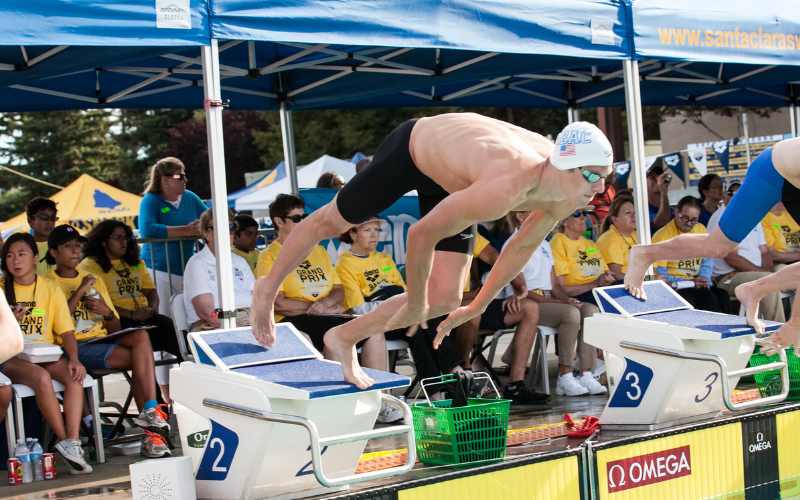
Plyos train the specific explosiveness for faster starts, giving you more horizontal velocity (Rebutini et al., 2016) and faster times to 15m. Another study by Rejman et al., 2017 showed that just six weeks of plyometric training with national-level swimmers saw big gains in take off velocity, entry angle, and flight velocity.
Plyos are one of the best tools at swimmers’ disposal for blasting off the starting block like a rocket.
Faster swim speeds
Plyometric training can improve swimming speed. And ultimately that’s what we are looking to do each time we dive into the water—straight-up swim faster.
In a 2025 study comparing plyos to strength and endurance training in university swimmers, the plyo group cut 50m times significantly more than the muscle endurance group. Another study (Sammoud et al., 2019) with young age groupers did eight weeks of plyos (ankle hops and CMJs) shaved time off their 50 free times.
Plyometric training builds the explosiveness and power for faster top-end velocities in the water, making it an essential part of prep for sprinters looking to improve 50 freestyle times.
Quicker turns and push-offs
When looking at the similarities between plyometric turns and turns/push-offs, this form of training makes sense.
After all, when swimming into the wall and flip turning, the legs absorb energy, load the legs, and explode with a squat jump. Tightly mimicking the muscle and movement patterns of plyo jumps.
See also: 5 Best Dryland Exercises for Faster Swim Turns
A study with a group of age group swimmers (Potdevin et al., 2011) did six weeks of plyo exercises in addition to regular swim training and saw faster glide speed off the wall (5.7% faster) and a massive improvement in acceleration through the push-off—41%!
Fast turns are critical for success on race day, particularly for short course swimmers who spend a lot of time going in and out of the walls, and plyos can be a way to get more oomph from each turn.
Stronger kick
The kick is key for fast swimming, especially at higher velocities, where it becomes uniformly important. Plyometric exercises build the fast-twitch responsiveness to move the legs quickly and crisply when kicking your chlorinated brains out.
A pair of studies (Sammoud et al., 2019; 2021) with age group swimmers doing plyometric training for eight weeks saw modest improvements in kicking speed. Swimmers covered 25m when sprint freestyle kicking at speeds that were 6.2% faster.
See also: 3 Dryland Workouts for a Faster Freestyle Kick
Plyos are mostly leg-driven, and the quicker force production carries over into a stronger kick that can help you explode out of your breakouts and close your races strongly.
Better body control during the start
Plyos help you get off the block faster. Awesome. But they also improve body control during the flight phase of the start. While soaring through the air, we are positioning the body, rotating the arms, and tensing the body for a clean entry.
Plyos can help here, too, improving body control and entry angle.
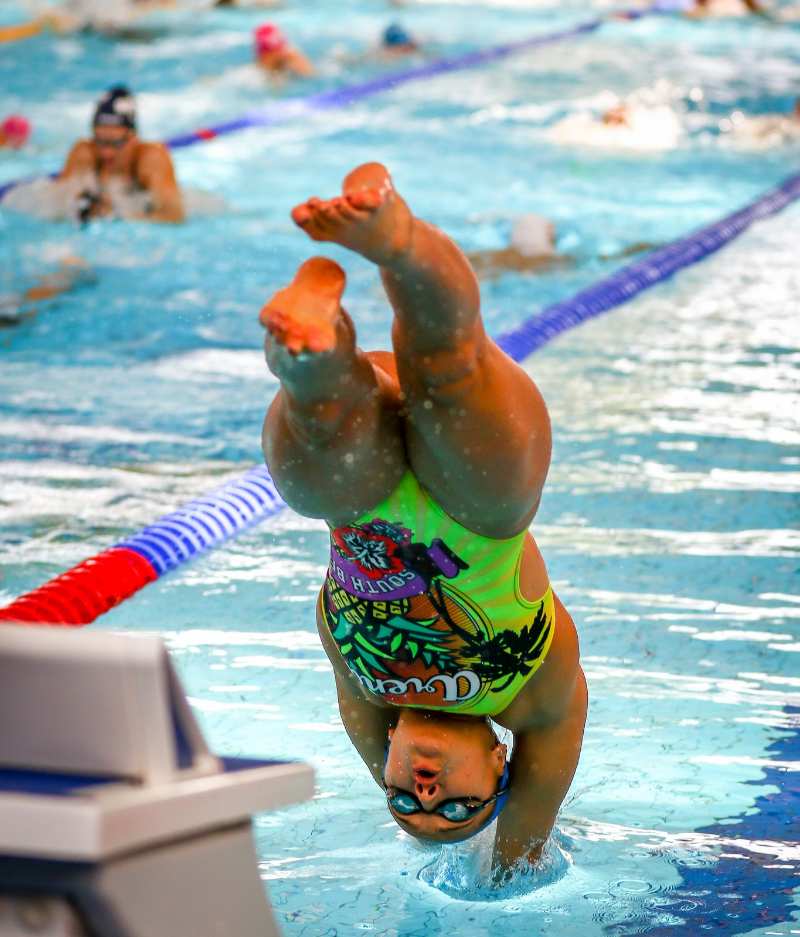
National-level swimmers in a 2017 study by Rejman et al. improved entry angle by 45.5% after 6 weeks of plyos, boosting glide velocity by 29%.
The improved entry angle means we are cutting down on wasted drag and resistance at the precise moment when we are moving fastest over the course of our race.
Improved bone health
Swimmers spend a lot of their time training in the water, which is a low bone loading environment. The buoyancy of the water can lead to lower bone density compared to athletes on the dry side of the pool (Lee and Kim, 2015).
Plyometric training can be one of the ways to improve bone mass and stiffness.
A study with athletes, including competitive swimmers, had them do a 9-month plyometric training program in addition to their regular swim training. Bone mass improved by 4-6% and bone stiffness increased by 12% with the swimmers, helping build stronger, more resilient bones.
Neuromuscular efficiency
Plyometric training fine-tunes how quickly your nervous system fires, improving the stretch-shortening cycle (SSC) so that you can store and release lots of energy faster (Kons et al., 2023).
This neural upgrade boosts timing and coordination in the water, which is important for everything from switching kick phases when dolphin kicking all-out to better timing the arm and leg coordination when sprinting freestyle.
Plyos are a proven form of training that can give swimmers the neuromuscular efficiency to sprint, jump, and change direction crisply.
The Bottom Line
Plyometric training is one of the simplest ways swimmers can level up swim performance while outside of the pool. No fancy gym or weight equipment required, either.
With nothing more than a plyo box, swimmers can build explosive power that converts into faster starts, turns, kick, and swim speeds. Benefits creep beyond the pool too, with stronger bones, body control, and a faster-firing nervous system.
Get your jump on, build that explosiveness, and dive into faster starts and swimming.