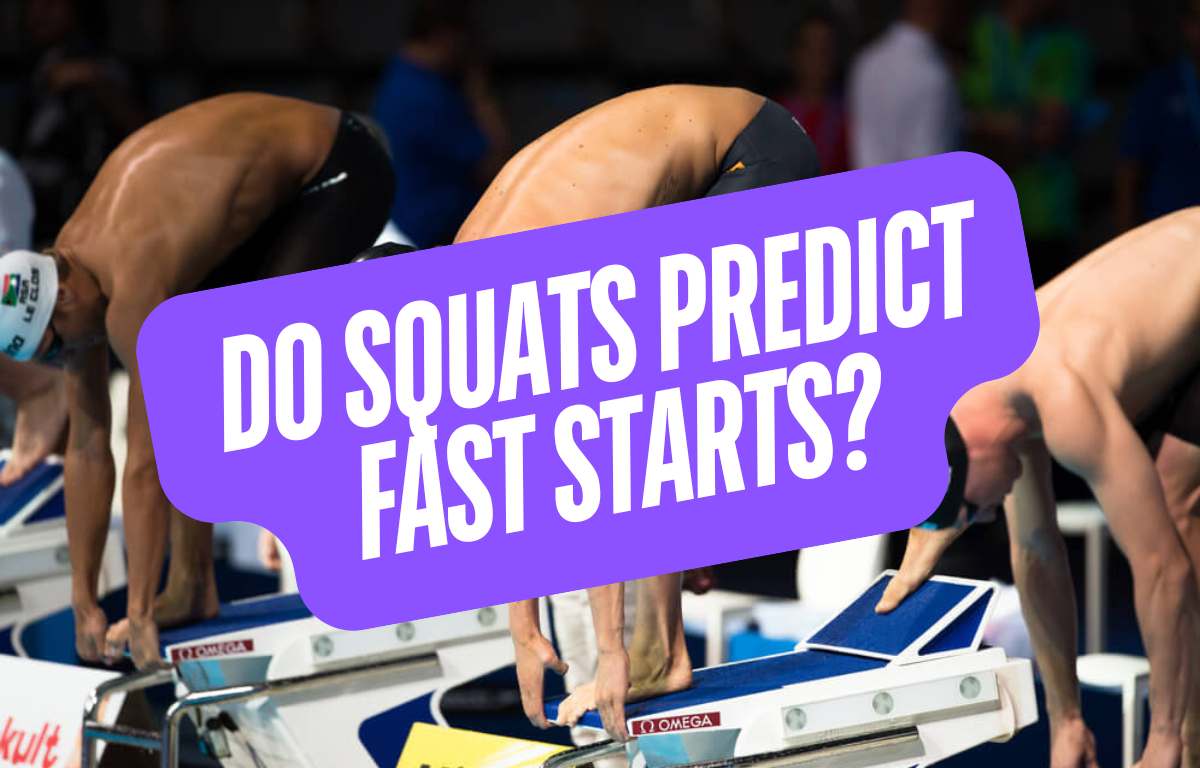

Barbell back squat strength is a strong predictor of swim start performance, with stronger swimmers reaching 15m significantly faster.
A lot goes into developing a fast start. Block set up. Reaction time. Horizontal force. Using the arms. And building the quick-burst power to catapult yourself off the starting block.
Focusing on back squats in the gym should be on that list, too. If you’re serious about getting to 15m with lots of speed, it’s time to step under that barbell.
Back Squats Predict Start Performance
A study (West et al., 2011) tested a group of eleven British international sprint swimmers in the gym and off the blocks.
They were all 50-100 specialists, all within 15% of the world record in their events, and all had been doing structured weight training for at least two years.
Researchers measured:
- Estimated 1RM back squat
- Countermovement jump height and peak power
- Two all-out starts timed to 15m
Start time in this case was defined as the time from the starter’s signal to the swimmer’s head crossing the 15m mark, and not as the more common “reaction time” that swimmers often focus on.
Here’s what they found:
- Squat strength correlated with 15m start time at r = -0.74.
- Peak power correlated even stronger at r = -0.85.
That’s a strong relationship. In non-stats speak: swimmers with an elite start could squat a lot and they could express that strength explosively.
Squats Predict Key Start Factors
Squat strength predicted more than just time-to-15m (which is already a pretty good result).
Swimmers with a strong squat also produced more force into the block itself—both horizontally (very important) and vertically. Horizontal force is one of the leading factors in what makes a start fast, and squat strength was a champ here, too.
Squats predicted:
- Peak vertical force on the block
- Peak horizontal force on the block
- Jump height
- Lower body power
Squat strength was strongly associated with many of the defining characteristics of an explosive start. It gives swimmers the raw force capacity that underpins those outputs.
Another study (Garcia-Ramos et al., 2016) with international-level female swimmers supports this pattern. Swimmers who could move quickly while doing loaded squat jumps (25-100% of bodyweight) had faster 5m, 10m, and 15m start times.
Stronger legs > Greater force into the block > More velocity into flight and underwater phases
How Much Should a Sprinter Squat?
The international sprint swimmers in this study were strong:
- 129kg (284lb) estimated 1RM back squat
- 78kg (171lbs) average bodyweight
- Roughly 1.7x bodyweight
That’s a useful benchmark for sprinters.
Developing higher absolute squat strength raises your ceiling for force and power production, which supports fast block performance.
And for weaker swimmers, the priority should be heavy-load strength training before jumping into high-velocity power work (Stone et al., 2022).
Squats build the strength that opens the door for more power, which leads to faster time-to-15m.
Squats Matter for Starts
These weren’t novice swimmers benefitting from beginner gains. They were international-level sprint specialists already doing structured strength training.
Even in a highly trained group, squat strength still parsed out the high-performance starts from the (relatively) slow ones.
That’s significant.
The start is a bit funny in the sense that it’s part of swimming but it’s not trained in the pool. It’s fundamentally a loaded horizontal jump. And jumping movements reward force production.
You don’t build that in the water. You build it by squatting heavy in the gym.