
Struggling to stay focused in the pool? This guide to focus for swimmers shows how to control attention, avoid distractions, and perform better in practice and at swim meets.
Focus is hugely important for swimmers in both training and competition.
You know the feeling.
You’re three reps into a best-average set of 200s and your brain has already taken a field trip—replaying a race from last month, worrying about the meet coming up next week, or thinking about dinner.
The same thing happens on race day. Instead of executing the race plan, attention shifts to what other swimmers are doing, fears that we aren’t going fast enough, or the people in the stands.
In both cases, performance ends up suffering.
Focus is the difference between swimming with intention and simply going through the motions. It’s what turns practice laps into performance gains and helps you execute under the bright lights at swim meets.
The good news is that focus is a trainable skill, not a personality trait you either have or don’t. Learn how to direct your attention, and you’ll get more from every practice, race with greater control, and ultimately swim faster.
In This Guide
Why Focus Matters for Swimmers
Swimming is a sport with lots of repetition. Lap after lap, stroke after stroke, we rack up thousands of repetitions each week. And this stockpile either builds good technique and faster swimming or leads to sloppy and inefficient technique.
When your attention drifts:
- Stroke mechanics deteriorate
- Pacing becomes inconsistent
- Boredom seeps in
- Things feel harder
Focus determines whether practice builds performance or simply lights a whole bunch of yardage on fire.
Research on elite athletes (Jackson and Roberts, 1992) shows that peak performances are characterized by complete focus on the task itself. The most commonly reported feature of athletes’ best performances was total concentration on what they were doing in the moment.
The swimmer who can focus on the task at hand and avoid distractions has the best chance of success in the water.
What is Focus, Exactly?
Focus refers to your ability to direct and sustain attention on what matters for performance while filtering out what doesn’t.
This allows swimmers to direct attention to the things that matter for fast swimming—technique, feel for the water, performance cues, race strategy—and box out the distractions that do not improve swim performance,
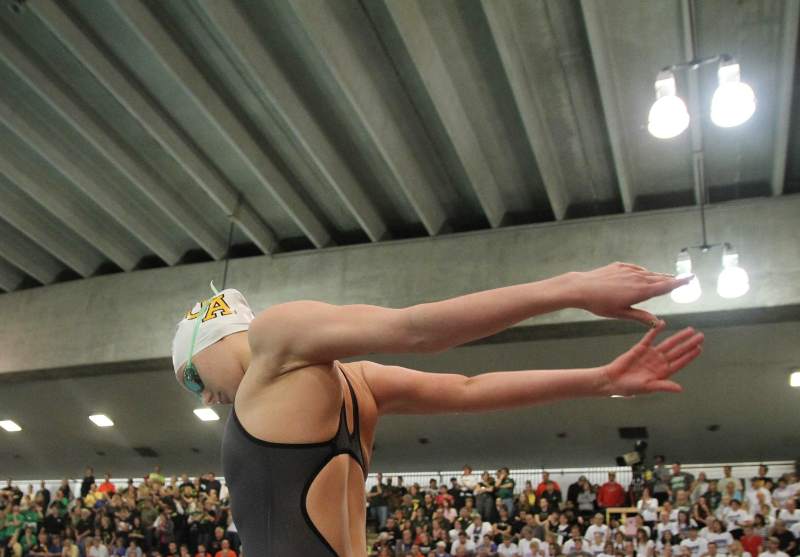
That sounds simple enough—just squish your eyebrows together and think real hard—but focus is a little more complicated and interesting than that.
What you focus on matters and how you focus matters. Attention has a limited capacity, so making the most of your focusing bandwidth is essential.
“When I’ve had my best performances it’s when I’m really just locked into the race plan and nothing’s going to distract me from that.” — Ryan Murphy
The Different Types of Focus
Controlling your focus can feel a bit abstract at first, but it becomes clearer when you understand that attention varies along two simple dimensions: direction and width.
Once you understand these two dimensions, it becomes easier to notice where your attention is going—and to redirect it when focus inevitably drifts.
Focus Direction — Internal vs. External
Attention can be directed in two ways: internally or externally.
- Internal focus directs attention to your body and its movements. Things like stroke mechanics, breathing rhythm, or how your kick feels.
- External focus directs attention toward the effects of your movement on the environment. The pressure of the water on your hands, driving your body toward the wall, or displacing water with your hands and feet.
In practice, swimmers constantly shift between these two modes:
| Internal cue | External cue |
| “Keep your elbow high” | “Push water backward” |
| “Kick from your hips” | “Drive water toward the wall” |
| “Rotate your hips” | “Slice through the water” |
Although the cues look similar, external cues typically produce better performances. Motor learning research (Ericksen et al., 2024) shows that focusing on the effects of a movement tends to produce smoother and more efficient coordination than focusing on individual body parts.
Why?
When swimmers think about pushing water backward or driving toward the wall, the nervous system organizes the movement better and more automatically.
Focusing on specific body parts can interrupt this natural coordination by introducing too much conscious control.
“As soon as you start looking around, you have lost. I’m concentrating on my own race, my own lane, my own pace, stroke rate—that’s the key.” – Alex Popov
Focus Width — Broad vs. Narrow
Attention also varies by width—how much information you’re trying to process at once.
Are you thinking about every aspect of your stroke when swimming freestyle—from finger position to hip rotation to tension in the trunk? Or are you dialed in on a single cue, like your catch or driving the hand out the back of the stroke?
- Broad focus takes in multiple pieces of information at once—such as awareness of your body position, the pace clock, and the rhythm of the set.
- Narrow focus locks onto a single cue or detail, such as your catch, kick timing, or a cue word.
Research suggests that narrowing attention too much on specific body movements can actually disrupt performance.
In one study (Becker et al., 2015) examining jumping performance, athletes who focused on a specific body movement (extending the knees as fast as possible) performed worse than athletes who focused externally on the result of the movement (jumping as far as possible).
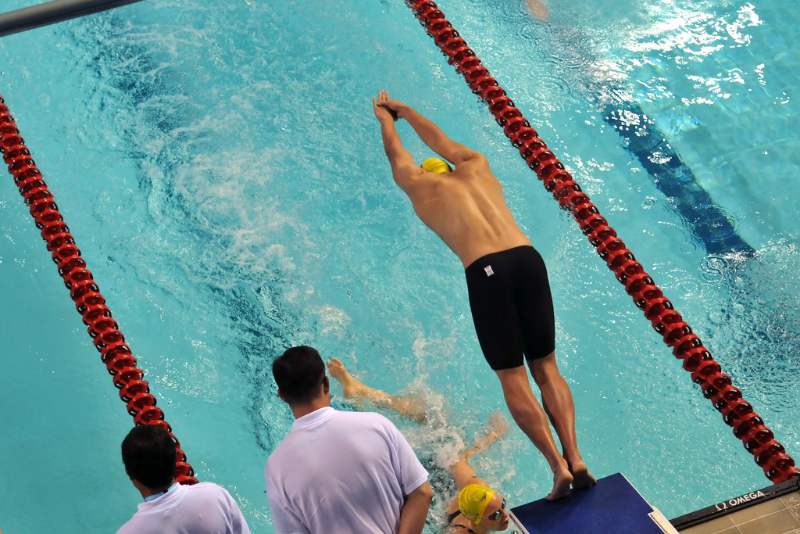
Both broad and narrow internal cues were less effective than an external focus, likely because consciously controlling individual body movements interferes with the body’s natural coordination.
For swimmers, this means attention width should match the task. Long aerobic sets often benefit from a broader awareness of pace and rhythm, while sprint efforts or technical drills may require a narrow focus on a specific cue.
The key insight: focus isn’t about trying harder to concentrate. It’s about knowing where your attention should go, and gently steering it back when it wanders.
Which brings us to the most important thing to understand before we get into strategies.
Focus Naturally Drifts
A lot of swimmers treat focus like it’s an on/off switch. The expectation is that once they hop into the water, they flick on that high-powered focus telescope for two hours straight.
But that’s not how attention works.
Research on sustained attention (Langner and Eickhoff, 2013) shows that peak levels of attentional readiness can only be maintained for a few seconds before the brain has to refresh the focus again. Over longer tasks, attention naturally fluctuates and must be repeatedly re-engaged.
Because when focus does drift—and it will—the mind tends to wander towards internally generated thoughts. Things like replaying past events, imagining future scenarios, or unrelated stuff, like thinking about something you saw on social media that morning.
Peak levels of attentional readiness can only be maintained for a few seconds before the brain has to refresh the focus again.
Focus drift happens to every swimmer at every level. The skill isn’t preventing your focus from wandering.
It’s noticing when it has wandered, not beating yourself up about it, and steering it back.
That redirection—done calmly and repeatedly—is the actual training.
How to Improve Focus Skills
Focus is a skill, and like any skill, whether we are talking about your underwater dolphin kick, stroke coordination, sliding into that early vertical forearm like a pro—it’s trainable!
Focus improves when you use it intentionally in training and racing in a way that matches the circumstances. Give your attention something specific to anchor to and repeatedly bring it back when it wanders.
Here’s how:
Use Self-Talk as a Focus Tool
Self-talk is a crucial skill for swimmers that can motivate and also anchor your attention in the present moment.
Using performance cues—short, simple words tied to a movement—are especially powerful for maximizing the right kind of focus and performance when swimming. They guide attention, thought, and most importantly—action.
On race day, use simple but powerful performance cues to sharpen focus:
- Push-off and breakout: “Explode!”
- Final turn: “Accelerate!”
- Maintaining stroke length: “Long and strong!”
Cue words work because they do three things at once:
- Give a physical instruction that boosts performance
- Boxes out non-essential thoughts (“hmm what’s for dinner?”)
- Pulls your attention directly to the current moment.
For longer sets where focus erosion is almost guaranteed, you can also less intense forms of self-talk:
- Counting strokes per length
- A mental rhythm (“1-2, 1-2, 1-2”)
- Periodic reset cues every 50 or 100
The reality is that your focus is going to go somewhere when swimming. It’s not like you completely turn it off—the internal monologue is going to run whether you direct it or not.
Self-talk and cues give you something to focus on instead of mentally drifting.
Use the Right Type of Focus for the Moment
One reason swimmers struggle to focus isn’t lack of effort—it’s using the wrong type of focus for the situation.
Practice is primarily a technical environment. You’re building movement patterns through repetition, which often calls for a more analytical, internal focus.
Thinking about your catch, your body line, or kick timing is exactly right during drills or moderate aerobic work.
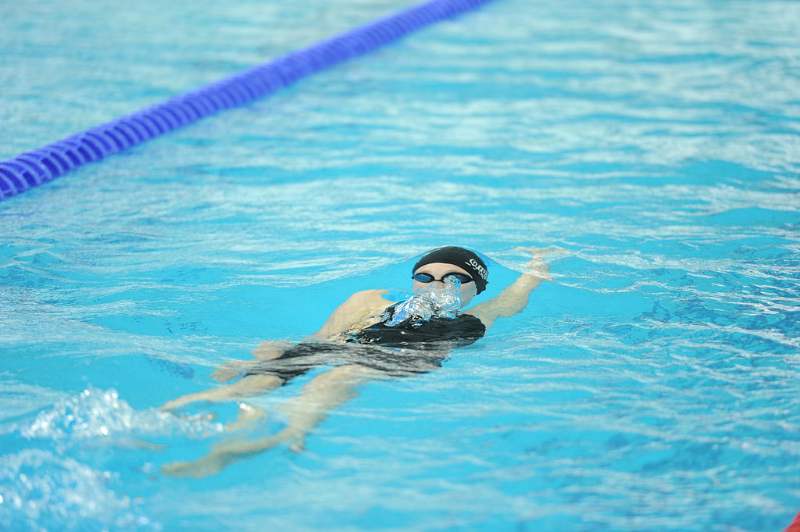
But when you’re racing—or sprinting—that same analytical focus can actually hurt performance. Overthinking mechanics at full speed interferes with the automatic execution you’ve trained.
Competition usually calls for a simpler focus: cue words, rhythm, the wall, or the next stroke cycle.
Practice is for thinking. Racing is for simplifying.
Focus on what you control
Even though we swim in our own lane, separated by two lane ropes, our brain can’t help but offer an invitation to things we don’t control:
- What the swimmer in the next lane is doing.
- Whether conditions are fast that day.
- What someone else thinks about your swimming.
Sending attention toward those things is a direct focus leak. Performance is literally rolling into the gutter when we expend mental energy on things we don’t control.
A simple exercise that I use with swimmers that I consult is maintaining a control/no control list for when they start to find their focus start to waver.
| Things I control… | Things I don’t control… |
| My effort | Other swimmers |
| My preparation | Pool conditions |
| My attitude | Expectations of others |
| My response to mistakes | What may/may not happen |
Distractions, both external (conditions, other swimmers, crowd noise) and internal (thoughts, fears) come for our focus and attention.
Focus is precious commodity. Protect it.
Use a pre-race routine to lock in
Pre-race routines—a controllable and personalized plan for preparing to race like a pro—are an excellent focus tool.
On race day, there is a lot going on:
- The warm-up pool is a bubbling gong show.
- You’ve got one eye on competitors.
- Between both ears is the stress and expectations of performing at a high level.
This soup of distractions is ready-made to dilute your focus. A pre-race routine keeps you on the straight line of high performance. As you steadily work your way through it, your focus is dialed in on the stuff that matters.
A pre-race routine doesn’t have to be super elaborate, either (it actually works best when it’s simple and easy to follow).
- A simple dryland activation routine with banded exercises, some core activation, and dynamic stretches
- A meet warm-up that steadily increases heart rate and readiness
- Performing visualization for 5 minutes after warm-up and 30 minutes before your race
- Listening to your hype playlist before your race and heading down behind the blocks two heats before your race.
There is a lot of power in a pre-race routine, including keeping your focus in line under stress so that you can prepare your best to compete.
Process Over Outcome
When you focus on the outcome—the final time, the swimmers next to you, what a poor result might mean—your attention moves toward things you can’t directly control.
But when you focus on the process, your attention stays on the steps you can execute right now.
A process-focused practice might look like this:
- Show up to practice ten minutes early
- Do pre-hab exercises and activation routine
- Give at least a 9/10 effort on the main set
- Do ten starts
- 15 minutes of core and mobility training after practice
Notice that nothing on this list mentions times or results. It’s pure action.
A study (Jackson and Roberts, 1992) with collegiate athletes found that this kind of process-oriented focus tends to lead to better performances:
- 66% reported process-focused thoughts during their best performances
- 87.5% reported outcome-focused thoughts during their worst performances
When we have our best performances in the water, we are focused on execution (“process”). Our worst results come when we focus on results.
Use visualization to sharpen focus
Visualization is often treated as a competition-only tool. But using it at practice can dramatically sharpen your focus from the first rep.
Spend five minutes mentally rehearsing how you want to move in the water. Spend those quiet moments between sets and reps in the pool rehearsing the body position, technique, and feel for the water you want to see on race day.
12-time Olympic medalist Natalie Coughlin was very keen on visualization and using it for more focused training in the pool.
“I used a lot of imagery. Focusing on how I wanted my races to progress. Visualize the lead up, the race, the post-race,” she said. “I would try to imagine as many details as possible and engage all of my senses in this visualization practice.”
But she didn’t just use visualization for competition—but in practice to focus on the performance she was building.
“In training, I always brought my attention back to how I wanted to feel in my races,” she said. “If I need to work on my body position at the end of my races, then I would push myself in practice to the point of exhaustion then work on my body position when exhausted.”
Hit reset when focus wanders
Even with preparation, some practices spiral mentally. You can’t find your stroke. The main set looks like it’s going to break you. You are falling off the pace.
In those moments, focus is begging to sneak out the back door. Thought stopping is a way to interrupt the negative mental loops that form in these moments.
Use a consistent cue:
- Clench and release your fist.
- Wipe your goggles before a rep.
- Say a reset word like “next” or “reset.”
The cue creates a break in the mental loop, giving you the space to redirect your attention to more productive cues.
Over time, the cue becomes a conditioned trigger for refocusing.
The Bottom Line
Focus can feel like one of those things that “just is” in the water. While some swimmers naturally have better attention control, it’s absolutely something you can improve—especially once you understand how focus works and how to use it at the right moments.
You build focus by:
- Redirecting attention
- Deploying self-talk
- Choosing the right type of focus for the moment
- Protecting attention from distractions
Swimmers have a finite number of opportunities to get better in the water. Being more focused means you show up mentally—rep by rep, set by set.
Personal best times… look out.
This guide on focus for swimmers is a part of series of articles on mental training and mental skills for swimmers. Read more guides below.