
The self-talk we use is in the water influences how fast we swim. Learn the two types, five proven techniques, and how to build self-talk skills that makes you faster.
Most swimmers have a coach on deck. Writing workouts, giving encouragement, offering technique feedback.
But swimmers also have a coach between their ears, offering a running stream of self-talk.
Some of it helpful, some of it critical, the self-talk that swimmers use has real effects on swimming performance, both in training and on race day.
And for most swimmers, it represents a significant opportunity for improvement on the clock.
In this guide, we’ll examine how to make the most of self-talk, how powerful it can be, some techniques to use it effectively, and how to get started.
In This Article
What is Self-Talk?
Self-talk is the ongoing internal narrative you carry on with yourself—in the water, behind the blocks, and in the moments between reps in the pool when you are working hard and breathing harder.
Some of it is obvious. The “you got this, buddy!” when stepping up on the block. The “time to accelerate!” when pushing off the final turn.
But most self-talk is more subtle than that. It’s the thoughts of disappointment that creeps in when a teammate laps you during the main set. The voice that decides whether a hard interval feels like an opportunity or a punishment.
This running commentary has a real effect on how much effort you’re actually willing to put forth in the water.
Self-talk isn’t just thinking. It’s the way you talk to yourself—the way you coach yourself. And it has a direct and measurable effect on your performance in the water.
Good news? Like other mental training skills for swimmers, it gets better when we apply some good old fashion elbow grease and deliberate practice.
Can Self-Talk Improve Swim Performance?
Self-talk has a direct and measurable impact on swimming performance. Swimmers who use positive, deliberate self-talk train harder, persist longer through tough sets, and race faster than those who don’t.
The way you perform in the pool and your mental state are inextricably linked.
Think about it this way: if you had a personal coach standing behind you every single rep, encouraging you, reminding you of your capability, and pushing you through the moments where you wanted to give up—would that make a difference?
Of course it would!
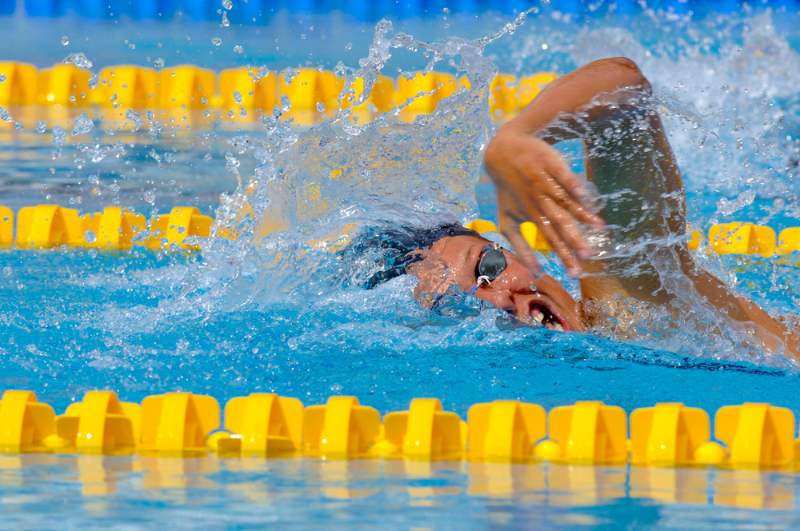
Here’s the thing: you already have that coach. After all, you are the most important person you listen to. The question is whether you’re using it to help you swim faster or letting it work against you.
Just how much so is a bit surprising when you consider the research on the subject:
- In a controlled study of youth swimmers, a 5-week self-talk intervention produced small but significant improvement in 200m freestyle performance compared to a control group—measured at a swim meet, not a lab (Meggs & Chen, 2019).
- A group of competitive swimmers who focused on self-talk for ten weeks improved ~1.5% more than their teammates—same practices, different self-talk (Hatzigeorgiadis et al., 2014)
- A group of 24 participants were asked to perform a vertical jump after verbalizing various types of self-talk. Motivational and positive self-talk significantly increased both jump velocity and height (Tod et al., 2009).
- Competitive cyclists who practiced individualized self-talk over two weeks went almost 20% further in a time trial to exhaustion than the control group — and reported feeling less tired doing it (Blanchfield et al., 2014).
- A meta-analysis of 47 different studies showed that while negative self-talk won’t make you a worse athlete, it does lead to increased anxiety, impaired attention, and reduced confidence.
The research above reveals that the cliché you have heard endlessly over the years—it really is mind over matter.
The way you swim in the pool and what’s happening between your ears—including the discussion you are having with yourself—are inextricably linked.
The Two Types of Self-Talk Every Swimmer Needs
The self-talk you use comes in two different flavors, and the type you choose depends on what you are trying to do in the pool and gym.
A meta-analysis of 47 controlled trials (Tod et al., 2023) confirmed that both types work, but they work for different reasons and for different situations.
The two types are motivational self-talk and instructional self-talk, and understanding the distinction separates you from the swimmer that just repeats random phrases and wonders why nothing stick.
Motivational self-talk
Motivational self-talk is the classic cheerleader self-talk. The coach walking up and down the pool alongside you as you swim, waving a rolled up heat sheet, belting out “hyup!” every time you breath.
It’s designed to fire you up, push you when doubt starts to creep in, and give you some motivational juice when you need it most.
Some of the hits include:
- “Let’s go!”
- “You got this!”
- “One more rep!”
- “I’m the hardest worker in this pool!”
Motivational self-talk boosts confidence, sustains effort, and cuts a path through the uncertainty and pressure of high-stakes moments in practice and competition.
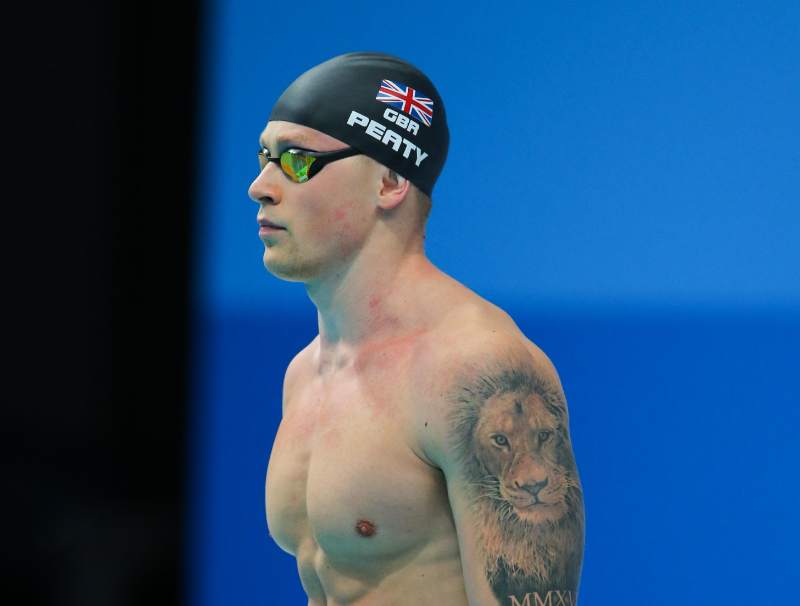
It’s most effective for strength and endurance tasks. Hard sets, hard workouts, hard lifts, hard races—motivational self-talk is the nitroglycerin for performance.
Instructional self-talk
Instructional self-talk is the technique coach, sitting at the end of the lane, demonstrating how to hit that early vertical forearm, or slide into better body position, or streamline a little bit tighter.
Instead of lighting the motivational fuse, it directs attention to technical elements of your swimming.
- “Roll with the shoulder!”
- “Grab that water in the catch!”
- “Tighten up the streamline!”
Instructional self-talk is the most effective type of talky-talky for precision and fine motor tasks. Drills, stroke correction, start mechanics, tighter tumble turns—you get the idea.
This type of self-talk is awesome for keeping you present when swimming, reducing attention drift during training.
Hard set or big race à Motivational self-talk. Technique work à instructional.
Where things get interesting is when overlap happens between the two.
On a tough main set you may start out with motivational self-talk to hype yourself up, but then resort to instructional self-talk to help keep your technique together as fatigue rolls over you.
The goal isn’t rigidity with self-talk, but knowing which one is the tool for the job when swimming.
Positive vs Negative Self-Talk
Beyond what type of self-talk you use, the tone and quality matters even more. Every piece of self-talk you use lands somewhere along the spectrum between positive and negative, and where it lands has a direct effect on how you swim.
The goal with self-talk isn’t pretending like everything is fine and hunky-dory, or that things aren’t difficult, it’s about understanding the language you choose either builds the conditions for a good performance… or not.
| Positive | Negative | |
| Tone | Positive and optimistic | Negative and pessimistic |
| Logic | Rational, productive | Irrational, unproductive |
| Confidence | Builds confidence | Deflates confidence |
| Focus/Attention | Sharpens focus on task at hand | Disperses focus, increases distractions |
| Effort | Pushes you further | Invites quitting |
| Orientation | Process oriented | Outcome oriented |
| Stress | Alleviates stress | Increases stress |
It’s hard to imagine the negative self-talk being tactically effective in any sense of the word.
It pulls attention away from what you are doing, makes things out to be harder than they are, and jump starts the negotiation to head for the exit.
One more note with positive self-talk—it should be believable! We aren’t trying to sugar coat reality. It just has to be believable and forward moving.
For example, swapping “I can’t hold this pace” with “Let’s see how long I can hold this pace” is more than enough.
You are staying in the fight, keeping the door open to the possibility of excellence, and not lying to yourself about what’s happening in the water.
Self-Talk Techniques for Swimmers
Here are some of my favorite self-talk techniques swimmers can use to swim faster in training and on race day.
The 1MR Trick
This is one of the most effective—and laughably simple—self-talk tools for getting through sets that are testing your commitment and dignity.
Let’s say you’re doing a set of 20×100 best average (ouch). Staring at this thing, you can feel the enormity of effort required already deflating you before you’ve pushed off the wall for the first rep.
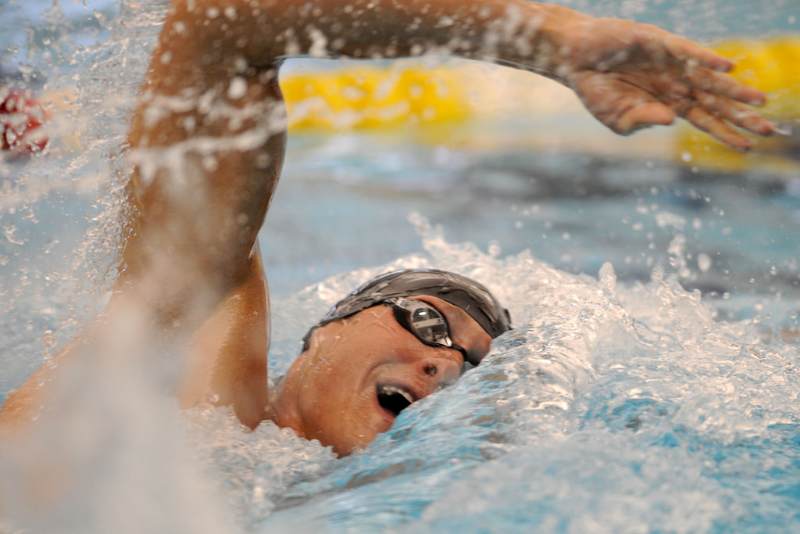
Instead of thinking about all 20 reps, or 150, or 10… just stick to this next one.
“One more rep.”
This little self-talk trick works because it removes the paralysis from thinking too far ahead. It forces you to stay in the moment and avoid hedging your effort for future reps, ensuring that you are also swimming faster.
- “I’ll do just this one.”
- “Just one more.”
- “I’ll warm up and see how I feel after that.”
Slice up the mountain into small hills.
Use “I Don’t” Instead of “I Can’t”
This is a small change in language with a surprisingly large effect.
When you’re grinding through a hard set and want to quit, there’s a temptation to say: “I can’t give up.”
Well-intentioned—but the phrase I can’t rings of desperation. It’s an escape hatch. It implies you would give up if you could, but you’re restraining yourself.
Swap it for: “I don’t give up.”
Feel the difference? One is a cage. The other is an identity.
A study (Patrick & Hagtvedt, 2011) tracked how well 30 peoples stuck to their health and fitness goals over ten days. The “I don’t” group maintained their commitment at a rate of 8 out of 10. The “I can’t” group? Just 1 out of 10.
This simple self-talk tweak instantly makes it more confident.
- “I don’t miss workouts.”
- “I don’t give up when things get hard.”
- “I don’t quit before the work is done.”
Get your coach voice on
Another subtle and sneaky self-talk technique is using your name or second/third-person pronouns during self-talk—better mimicking the same language you’d hear from a coach or teammate.
Examples:
| Instead of… | Try… |
| “I don’t think I can finish this set.” | “Olivier, you’ve done harder sets than this—keep trying!” |
| “I went out too fast. The piano is going to fall on my shoulders on the back half.” | “Olivier, you got this! You know how to finish like a boss.” |
| “I swam like hot garbage today. My goals are kaput.” | “Olivier, one bad practice doesn’t erase the work you’ve put in. Bring it hard when we go back tomorrow.” |
Using your name instantly gets you into that role of “coach” rather than the role of stressed-out swimmer.
In a series of seven studies, Kross et al. (2014) found that people who used their own name or second/third-person pronouns performed better under pressure, felt less distressed, and appraised stressful situations as challenges rather than threats.
First-person self-talk drowns you in the emotion; third-person creates just enough distance to think clearly and act more positively.
Use external self-talk
Not all self-talk stays between your ears—some of it gets verbalized. A teammate back in the day would give herself audible pep talks during hard sets:
- “Come on Jules, you’ve got this.”
- “One more, let’s go.”
This is external self-talk.
Before the final of the 100m freestyle at the 2017 FINA World Championships—a race he’d win in a blistering 47.17—Caeleb Dressel landed from his pre-race jump, and said: “let’s go!”
Not to his competitors. Not the crowd. To himself. External self-talk has some power behind it. A study had basketball players try different types of self-talk, participants played better and faster when they were talking to themselves out loud.
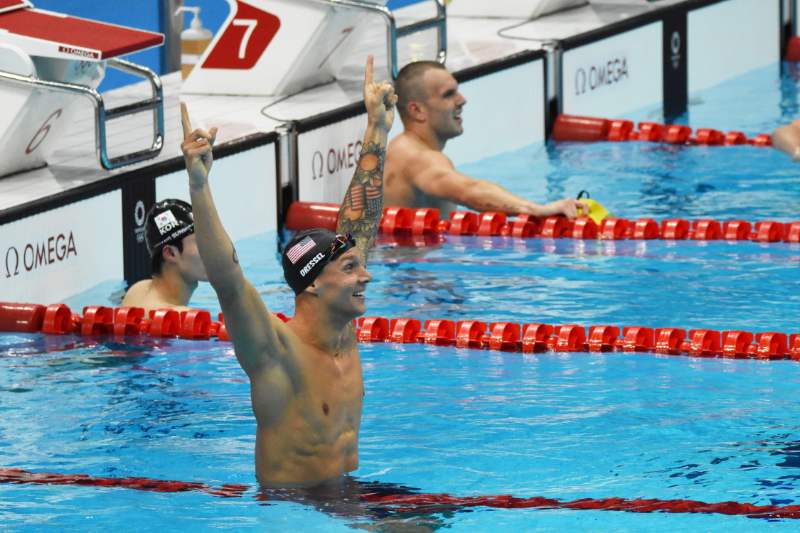
External self-talk gives you perspective you can’t get from just thinking it.
Keep it short and punchy. No Shakespeare required.
Pair with a head nod
Self-talk paired with a physical movement—in this case, nodding your head—can also power up performance.
In a study (Horcajo et al., 2018) with 150 CrossFit athletes, participants were given positive or negative self-statements and instructed to either nod their heads (simulating agreement) or shake them side to side while listening.
Then they were tested on a vertical jump, a squat test, and a 1RM deadlift.
The big finding:
Nodding while using positive self-talk led the way on every single test. By a lot.
For the vertical jump, they averaged over 33cm when nodding with positive self-talk—versus 26cm when nodding with negative self-talk. The deadlift gap was even wider: 175kg vs. 122kg (!!!).
This is a powerful reminder that your body is listening to what you are saying. The nodding signals to your brain that what you are saying is true, one of the core requirements of effective self-talk.
Nod your head and pair it with something short and positive + “Let’s do this” or “You got this” or “Let’s kick butt”
Let the physical reinforce the mental.
Self-Talk Can Boost Endurance
Distance swimming is a lonely endeavor. It’s you, the black line, the clock, and all manner of counting. The main voice in this chlorinated wilderness is the one between your ears, and yes, self-talk boost endurance, too.
In a study by Blanchfield et al. (2014), competitive cyclists who spent two weeks developing and practicing individualized self-talk went 18% further in a subsequent time trial to exhaustion compared to a control group.
Fun bonus—they also reported feeling less tired.
The self-talk group took phrases like “this is brutal” and replaced them with short, positive self-talk like “I can do this.” Simple stuff. Over the two weeks, it moved the needle dramatically.
How to Improve Your Self-Talk Skills
Self-talk is developed best when used at practice. By trying out different forms of it, deliberately, consistently, you learn what works best.
Here’s some tips for making it a real part of your training:
- Write it down. Sit down before the season and think about the moments where you crater mentally. The hard main sets. The moment a competitor surges past you. The pre-race nerves. Write out specific self-talk for each scenario. Don’t improvise under pressure—decide in advance how you’re going to respond. There are a select number of moments in practice and competition where self-talk is most valuable. Start there.
- Put it where you’ll see it. One thing that worked for the swimmers in the competitive self-talk study was writing their self-talk phrases on their swim equipment—water bottles, kickboards, pull buoys. When it’s in your line of sight between reps, it becomes a continuous signal to your brain of who you’re choosing to be today. Consistency with self-talk helps solidify the identity of the swimmer you want to become.
- Practice on easy days too. It’s tempting to only reach for self-talk when things get desperate. But like any skill, it gets sharper with regular use. Make it part of every workout, not just the hard ones. Instructional self-talk lives for drill/recovery days—use it to fine tune streamline position, stroke mechanics, body roll, and so on.
- Look back at your best performances. If you’re not sure what self-talk phrases work for you, think back to the times you swam out of your mind. What were you telling yourself? What was the internal tone? Start there—if it worked before, it’ll work again.
The Bottom Line
Self-talk is the most available mental performance tool you have. It costs nothing, requires no equipment, and works in every pool on the planet.
It’s also very high leverage—the conversation is already happening in your head. Now you get a chance to tweak it in a way that supports your goals and dreams in the pool.
So:
Use the right type of self-talk for each situation. Keep it short, believable, and positive. Say it out loud. Back it up with body language. And practice it like the skill that it is.
This guide to self-talk for swimmers is part of our series on mental training for swimmers. You can read the main guide, and other articles below.