
Struggling with pressure in competition? Learn how pressure works, why swimmers choke, and proven strategies for handing pressure when it counts.
You’ve trained hard for months. The early mornings. The brutal main sets. The taper. Everything points to a breakthrough on race day.
But then you dive into the water and things unravel.
Your stroke feels clunky. Can’t time the turns. Watch competitors pull away.
You touch the wall and look up at a time that belongs to a swimmer who didn’t do the work you did. But you did do the work. So what happened?
Pressure happened.
The pool that feels like home at 6am becomes a completely different place when the stands are full, the heats are stacked, and all your hard work comes down to a couple of minutes of swimming.
Crushingly, being a great practice swimmer offers no guarantees on race day.
That gap between practice performance and race performance isn’t a talent problem. It’s a pressure problem. And performing under pressure is something you can actively get better at.
In this guide to pressure for swimmers, we’ll break down what pressure is, why it causes swimmers to choke, how it shows up on race day, and how to train your mind to perform when it matters most.
In This Article
What is Pressure?
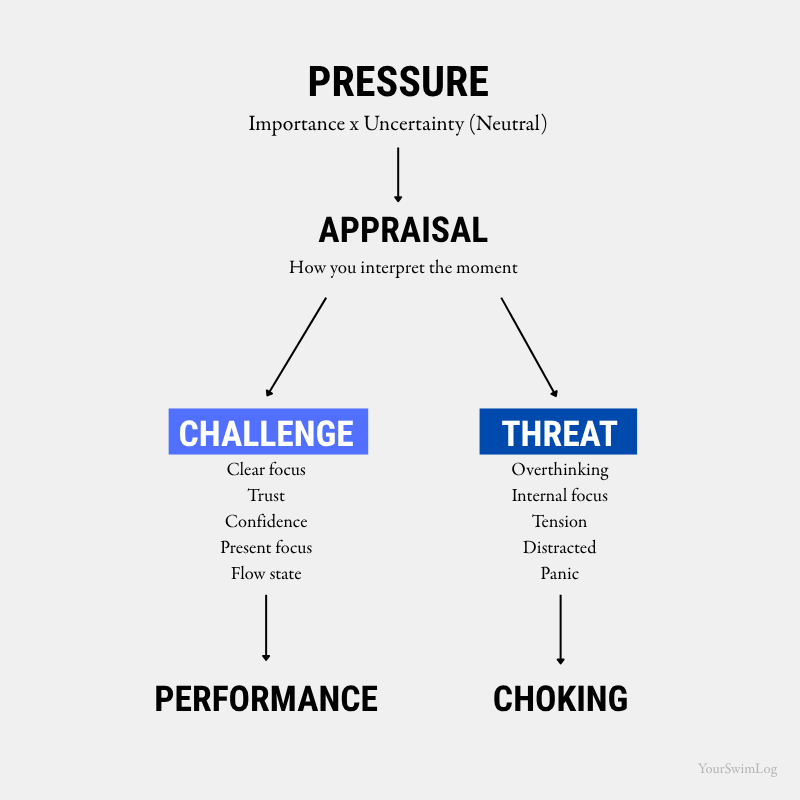
Pressure is the importance swimmers assign to an outcome combined with how uncertain they feel about achieving it.
In other words, pressure shows up when something matters—and you’re not fully sure how it will turn out.
It’s also one of the most misunderstood parts of the competitive experience. Swimmers often talk about pressure like it’s something external, something the meet, event, or moment puts on them.
But pressure isn’t built in the chlorinated air at the pool.
It comes from how you evaluate what’s at stake.
For example:
- Swimming a 200m free at a random dual meet and then again at the Big Meet involves the same pool length, race strategy, swimsuit—but one carries loaded meaning (pressure) and one doesn’t.
- Even at the same championship meet, one swimmer can see the race as an opportunity, while another sees it as a risk.
The difference comes down to how the moment is interpreted.
When pressure is seen as a challenge, it sharpens focus and elevates performance. When it’s seen as a threat, it disrupts attention, increases tension, and sets the stage for choking.
External vs. Internal Pressure
Ask most swimmers why they cracked on race day and you’ll hear some version of the same answer:
- Expectations from coaches and parents
- Big meets and championship finals
- Rankings and qualification standards
- A stacked heat or a fast competitor in the next lane
That’s external pressure. And it feels legitimate because those things are real.
The crowd is loud. The expectations are there. That rival is swimming like a monster. The stakes are real. None of it is imagined.
But external pressure doesn’t cause choking. It creates the conditions where choking is more likely.
Mesagano et al. (2012) increased pressure with athletes by adding an audience, a camera, and performance-based incentives. Every athlete faced the same conditions—but their performances didn’t break the same way.
Some handled it. Others choked. The difference was in how athletes responded to being evaluated (fear of negative evaluation).
Ultimately, the crowd doesn’t reach into your nervous system and scramble your stroke. Your competitors don’t have that power. Nor do keyboard-clacky warriors on comment threads on swimming websites.
The internal response is what disrupts exectuon, not the pool, the heat sheet, or the name on the lane next to you.
They are simply the context in which the real problem shows up. And understanding that shift, from external conditions to internal response, is where we will go next.
External pressure doesn’t directly cause choking, but it does help create the conditions for choking. Choking is fundamentally an internal response.
Why Swimmers Choke on Race Day
Choking is when swimmers underperform under pressure. The swim isn’t just bad—it falls below what the swimmer can demonstrably do.
You’ve done the training, the taper clicked, the strategy was clear… and yet, it all falls apart like a dollar store tech suit.
Most explanations of choking point to one thing: overthinking.
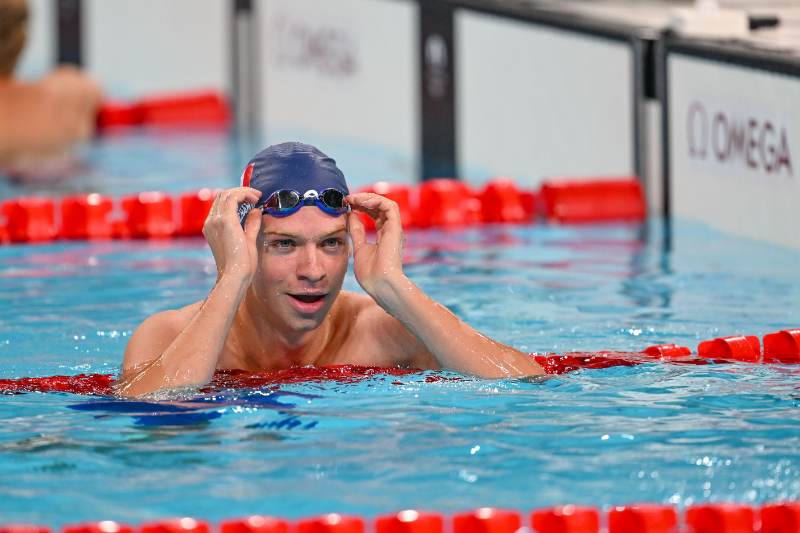
Instead of trusting their training and swimming freely, the choking swimmer tries to override the automatic patterns built up in training. This leads to a clunky stroke, missed race cues, and slower swimming.
That’s part of it—but it’s not the full picture.
Choking doesn’t happen in just one way. It can come from:
- Overthinking your stroke and trying to control every movement
- Getting distracted by outcomes, splits, or competitors
- Emotional reactions (fear, doubt, frustration) taking over
- Or losing control of your attention altogether
In many cases, it’s not one of these—it’s several happening at once (Christensen et al., 2015).
How Swimmers Choke Under Pressure
Swimmers don’t all choke the same way. And the same swimmer will even find new and creative ways to choke from race to race.
Here are the most common ways this breakdown happens under pressure:
| Pathway | What Breaks Down | What It Looks Like in the Water |
| Over-control (self-focus) | Pressure makes you consciously control movements that should be automatic | Stroke feels stiff, forced; overthinking catch, kick, breathing |
| Distraction (outcome focus) | Attention shifts to consequences, splits, competitors, or results | Looking around, rushing pace, abandoning race plan |
| Attentional breakdown | You lose control of your focus—can’t lock onto what matters | Mind feels scattered; inconsistent stroke, missed cues |
| Emotional interference | Anxiety, fear, or doubt disrupt execution and coordination | Tightness, rushed tempo, loss of feel for the water |
| Negative appraisal (threat response) | You interpret the moment as danger instead of challenge | “Don’t mess this up” mindset; hesitation, tension |
| First mistake cascade | One small error triggers emotional + cognitive spiral | One bad turn > panic > rhythm collapses > race unravels |
In most cases, choking isn’t caused by just one of these, it’s a blended cocktail of several happening at the same time.
A common example is the first mistake cascade:
- A small mistake happens. A turn that isn’t as crisp as you’d like. A warm-up that doesn’t go as well as it should. A breakout that felt messy.
- Emotional reaction. Frustration, doubt, or a quick shot of anxiety (“That’s not good…”)
- Cognitive shift. Attention shifts from racing and toward the mistake, the outcome, or fixing things mid-race.
- Breakdown spreads. Stroke timing slips, rhythm gets thrown off, decisions get rushed, and performance fragments.
That first mistake—especially in hindsight given what happens towards the end of the cascade—usually isn’t a big deal.
It’s how you appraised it and the cascade of poor focus and snowballing series of mistakes. One moment turns into two, three, then four, until the race slips out of your control and you end up wondering what just happened.
How to Reframe Pressure
Since pressure is largely the result of how you interpret what’s happening, the first step to managing it is learning how to reframe (reappraise) it.
The goal isn’t to eliminate pressure—it’s to put in the right frame so that we can stay focused, relaxed, and in control.
See pressure as a privilege
Pressure isn’t random—and it’s not a problem to eliminate. It shows up when something meaningful is on the line.
That race matters. The goals are real. And you earned the lane.
And the pressure isn’t going anywhere. Unless you completely withdraw, it will always be part of the competitive experience. That means your primary goal is reframing and interpreting pressure so that you can perform under it.
Two swimmers can stand behind the same block, feel the same pressure, and face the same field—and experience it completely differently.
- One sees a moment their training has prepared them for
- The other sees a moment that might expose them
These are challenge and threat states, and the difference comes down to how the swimmer evaluates the situation (Meijen et al., 2020).
Here is how the two compare when dealing with pressure:
| Situation | Threat | Challenge |
| Big final at a championship meet | “If I mess this up, everyone will see it.” | “This is exactly what I’ve trained for.” |
| Racing a faster competitor | “I don’t belong in this heat.” | “Perfect—let’s give this guy a run for his money.” |
| Tight race at the 100 turn | “I’m dying—I can’t hold this.” | “This is where I separate—stay on it.” |
| High expectations from coach/parents | “I can’t let them down.” | “I’ve earned this expectation—now stand up and deliver.” |
| Coming off a poor previous race | “What if it happens again?” | “I’ve learned the lesson—let’s reset and use this as motivational fuel.” |
Best of all for swimmers fed up with choking and having a lousy relationship with pressure, this interpretation is not fixed.
Reappraising the feeling of pressure can shift an athlete from one state to the other, even in the middle of competition.
“Pressure is a privilege. Pressure can be overwhelming, but you often are deserving of that pressure and can handle it if you have faith in yourself.” — Natalie Coughlin, 12-time Olympic medalist
Reframe nerves as excitement
The surge of energy you feel behind the blocks—the racing heart, adrenaline, clammy arm puts, tunnel vision—are pre-race nerves. And they don’t have to be interpreted as anxiety.
If you want a deeper breakdown of pre-race nerves, read our comprehensive guide on how swimmers can deal with pre-race nerves on race day.
Physiologically, excitement and anxiety are almost identical. The difference is the label you slap on it.
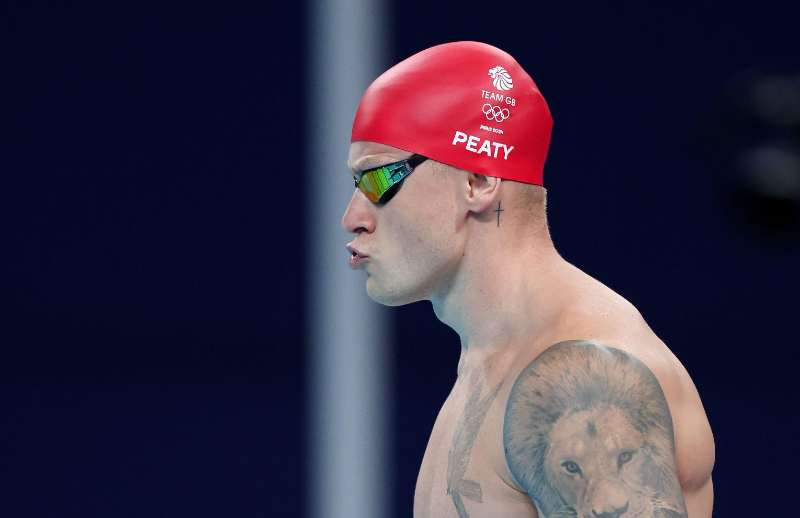
Research shows that doing something as simple as telling yourself “I’m excited” instead of “I’m nervous” leads to better performances and better responses under pressure (Brooks, 2014).
Shift to a process-oriented focus
Pressure can start to veer towards choking when we start thinking about what’s at stake when racing. What the outcome will mean, what happens if we don’t succeed—pure threat appraisal response.
To get around this type of outcome-obsessed focus, which spikes pressure, shift your attention to a controllable process.
Things like:
- The performance cues you are going to use for each lap of the race
- The rhythm you want to feel in your stroke
- The pacing strategy for your race
- A pre-race routine to give you controllable wins all the way up to the start of the race
Swimmers often buckle under pressure because they get out ahead of their proverbial skis in terms of focusing on the outcome.
Process focus narrows your attention, keeps distractions at bay, reduces uncertainty, and keeps you away from that powerful mental spiral that pulls swimmers into choking.
Anchor to identity, not outcome
When everything feels like it rides on a single swim, it’s easy to tie your identity to the result.
That’s when pressure starts to feel heavy.
Instead of hinging your identity on the outcome or placing—which you have limited control over—anchor it to how you show up.
The way you define yourself as a swimmer determines how you respond under pressure.
Here’s how different identity frames either stabilize performance—or set you up to choke:
| Process-Based Identity (Performance) | Outcome-Based Identity (Pressure/Choking) |
| “I’m a swimmer who executes my race plan.” | “I’m a swimmer who has to win.” |
| “I show up and compete with focus and effort.” | “I have to prove I’m the best.” |
| “I race aggressively and trust my training.” | “I can’t mess this up.” |
| “I stay composed and adjust when things aren’t perfect.” | “If this goes wrong, my meet is a waste of time.” |
| “I commit to my stroke, tempo, and turns.” | “I need to hit this exact time.” |
| “I compete with confidence regardless of the result.” | “My result defines how good I am.” |
| “I control what I can—execution and effort.” | “Everything has to go perfectly.” |
| “I respond, not react, when things feel off.” | “One mistake ruins everything.” |
Research with collegiate athletes found that a stronger athletic identity was linked to lower psychological distress and greater resilience.
But this was only the case when identity was built around the process of competing—commitment, discipline, execution—not outcomes. When identity becomes too wrapped up in results, vulnerability to pressure increased (Kabak & Baş, 2026).
Reframe disappointing performances
Getting better at pressure isn’t about being perfect in the water—bad swims happen despite our best intentions—but about raising your baseline performance level.
When a race goes wrong, swimmers instinctively reach for an explanation. That explanation either adds weight to the next pressure situation or reduces it. The problem is that the most available explanations are usually the most damaging ones.
- “I always choke under pressure.”
- “I can never put it together when my team counts on me.”
- “I am not a Big Meet swimmer.”
These self-assessments attribute failure to fixed, uncontrollable things—wiring, talent, identity. Every time a swimmer does this, they are pre-loading their next race with more pressure.
Attribution retraining flips this. It teaches swimmers to explain failure through a lens that points toward controllable, changeable factors—effort, strategy, preparation, execution.
| Fixed Attribution | Controllable Attribution |
| “I choke when the pressure is on.” | “I went out too fast and paid for it at the 150.” |
| “I don’t have the mental toughness for this.” | “I lost my process focus when the swimmer next to me went out hard.” |
| “I always fall apart at big meets.” | “My pre-race routine wasn’t locked in—I was distracted on the blocks.” |
| “I’m just not a finals swimmer.” | “I haven’t practiced racing when fatigued enough. That’s fixable.” |
Fixed attributions ramp up performance-killing pressure. Controllable attributions turn that same pressure into something you can direct your focus towards.
This sneaky little process works too. Using it meant that athletes saw significant reductions in fear of failure and self-criticism—two of the primary psychological mechanisms that turn pressure into choking (Huang et al., 2025).
Reframing changes how you think about pressure.
But the swimmer who looks unstoppable at practice and falls apart in competition isn’t just thinking about pressure wrong—they’ve never actually trained for it.
Next, we look at how swimmers can increase race-relevant pressure in training so that competition pressure feels as normal as a Wednesday night practice.
How to Train for Pressure
Pressure is something that swimmers can train. And like other parts of your swimming, from your start, pace times, breakouts, underwaters—the more you train it, the better you’ll execute it when it counts.
Research with national-level swimmers shows that the anxiety we feel before practice is no different from our day-to-day baseline.
But competition is a totally different situation—state anxiety jumped 32% and stress hormones spiked sharply before the meet even started (Carrasco Páez & Martínez-Díaz, 2021).
If the only exposure you have to pressure is in the moments when you step onto the pool deck at the Big Meet, you’re encountering that response for the first time exactly when you can least afford it.
The great news for swimmers is that pressure training works.
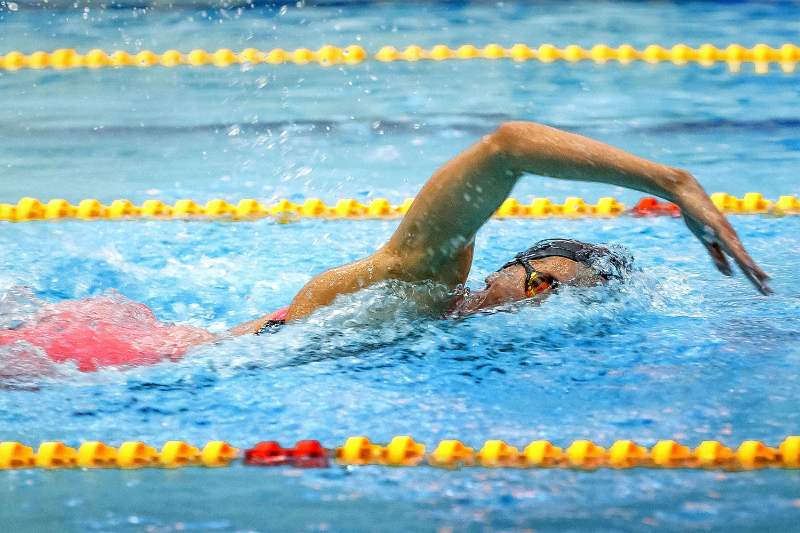
A meta-analysis (Low et al., 2020) found it produced a moderate-to-large improvement in performance under pressure, with consistent results across different sports and experience levels.
What Pressure Training Does
Pressure training does some fun things:
- Reduces choking. Under pressure, swimmers shift from automatic movement patterns to internally monitoring their stroke, which tanks performance. Pressure training teaches them to maintain goal-directed focus under elevated anxiety.
- Builds confidence. Confidence is essential for swimmers, not just for the belief that you can execute technically, but that you can do so under pressure. Pressure training teaches you to successfully manage the experience of racing ahead of competition, so when the real thing happens, the familiarity naturally promotes confidence. Been here, done this.
- Master coping skills. Pressure training is where the mental skills (self-talk, focus cues, arousal regulation) get pressure-tested. You build reps in conditions that are applicable to competition. Practice becomes more than just reps and main sets, but pressure practicing, too.
“In the months leading up to a race, practice feeling pressure. In order to be good at anything, people need reps. I want to be great at dealing with pressure, so I find time to rehearse those feelings.” — Ryan Murphy, Olympic, World, and NCAA champion
How to Use Pressure Training
There are a lot of ways to introduce pressure to practice, and coaches and swimmers can be quite creative when it comes to this stuff.
A meta-analysis of pressure training studies (Oudejans & Kegelaers, 2024) looked at different ways that coaches use it.
They included:
- Competition simulation. Scoring sets, heat-style lineups, scoreboard tracking. “Suit up Saturdays” are a common feature of elite swim teams. Slap on a tech suit, get up on the blocks, and get after it!
- Fatigue. Race pace repeats immediately following lactate work—simulates the somatic anxiety symptoms (elevated heart rate, shallow breathing) of the pressure of a real race.
- Forfeits and rewards. The swimmer-favorite—“Get out swims.” Consequence-based sets fall within this category as well.
- Distractions. Crowd noise, music, unfamiliar pool environments.
- Task restrictions. Time limitations, altered intervals, modified rules that raise the stakes.
The biggest thing about pressure training is this—mild anxiety is enough.
Swimmers and coaches don’t need to replace the thick and hair-raising pressure of US Olympic Trials.
You just need to practice the thinking and behaviors you’ll need under pressure.
This is helpful so that you don’t go too soft (no consequence) or too hard (learned helplessness territory).
“There is a difference between training to make it through practice and training to race. That specificity of training, as well as developing a racing mind-set, makes all the difference in the world.” – Dave Salo, Olympic and NCAA winning coach
Navigating Pressure on Race Day
Alrighty. You’ve done the hard work in training—including pressure training and reframing, which are the main levers swimmers have to get better at swimming fast under pressure.
But now it’s race day, and you can feel the pressure start to close in on you.
Here’s how to work with it for some high-performance swimming.
- Pre-race routine. A pre-race routine is essential for swimmers. It’s not a superstition (favorite tech suit, favorite lane, etc) but a sequence of actions before racing that gives your nervous system a familiar track to run down where things feel familiar, building confidence and reframing pressure as performance.
- Performance cues. Pressure is a distraction-machine—we start obsessing about what things mean. How fast a competitor looks. Expectations from others. Performance cues—short, impactful cue words—bring our focus back to the things we control. Assign cues for each part of your race to maintain your focus.
Performance cues are a form of self-talk. To learn more about this powerful mental skill, read our complete guide to self-talk for swimmers.
- Reset after disappointing swims. Pressure heightens what we are feeling at swim meets, making the highs really high and the lows really low. To better navigate the disappointing swims, journal it out. Doing this in a structured way can significantly reduced self-critical rumination and help you bounce back (Neumann & McInnes, 2025). Get it out of your head and onto the page, extract useful information, and redirect your focus to the next race.
- Mindfulness. Pressure is a champ at hijacking attention and focus when we need it most. Mindfulness trains you to notice that drift and redirect, keeping your focus on the controllables. Research linked higher mindfulness levels to reduced fear of failure and better self-talk regulation during competition (Kee & Wang, 2008; Zhong et al., 2025). Add some smooth, deliberate breathing to return your focus on your race day process and the things you control.
The Bottom Line
Swimmers’ first instinct with pressure is to try and get rid of it. But that doesn’t work, and you don’t want it to–swimmers that can use the stakes, expectations, and the big moments as fuel for performance are at an immediate advantage.
The difference isn’t who feels pressure and who doesn’t. It’s who knows how to handle and channel it for faster swimming.
Pressure is a skill. One you can better understand. One you can train. One that gets sharper every time you get into a high-pressure moment and handle it like a boss.
You’re doing the yards in practice, now do the training for pressure, and unleash your best performance when it matters most.
This guide on performing under pressure for swimmers is part of our series of articles on mental training. To learn more, read the articles below.