
Ready to swim more efficient and faster freestyle? Power up your freestyle with ten freestyle drills from some of the best coaches and swimmers on the planet.
Everybody wants to swim faster freestyle and to improve freestyle technique, but all too often we get hung up on particular technical and mechanical shortcomings.
Our catch isn’t strong enough, we lack proper rotation or our feel for the water isn’t quite there yet, the high elbow slips in the catch.
That’s where freestyle drills can be effective. They highlight a particular segment of your stroke, and then you transfer it to your regular stroke.
The following swimming drills for freestyle are designed to improve technique, feel for the water, apply better positioning of the hands and arms, and ultimately, boost freestyle performance.
Let’s dive in.
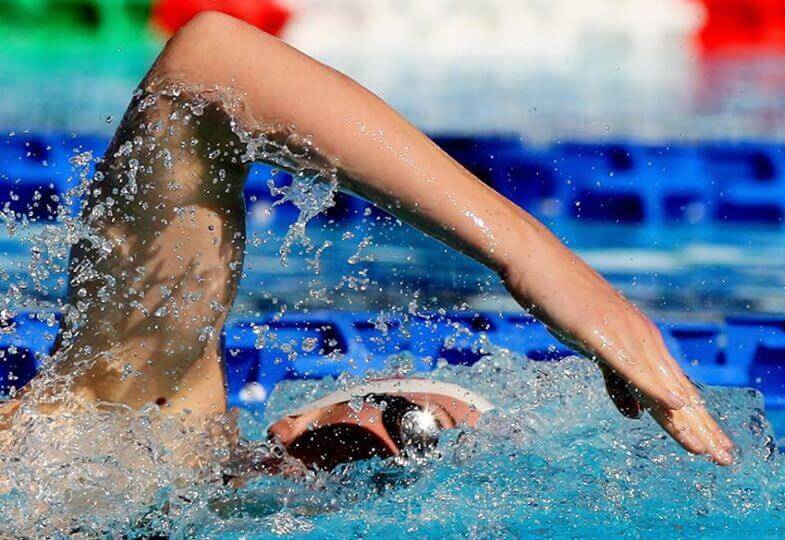
1. Closed-fist Freestyle.
One of my favorite freestyle drills, and about as simple as it gets. Closed fist freestyle.
The drill is exactly as it sounds: You ball up your hands, removing the surface area that your out-stretched fingers would usually provide for your pull, and swim freestyle as you normally would.
It reinforces the notion that when you are pulling that you should also be using your forearms and not just your hands! This added emphasis on the surface area of the forearm also pushes you towards a higher elbow recovery.
Your stroke count per length will go down a little bit, and once you unclench those hands you will get a little jolt of power, your hands now feeling like over-sized swim paddles.
Best for: Increasing feel for the water with your forearm. Positioning the arm for better mechanical leverage in the pull. Encouraging high elbow recovery.
2. Mini-Maxi
This isn’t technically a drill, but it requires your full attention and concentration. The goal is simple: to swim as fast as you can, taking as few strokes as possible. Add time and stroke count together, and you get a total number that you should strive to beat.
This kind of swimming forces you to be efficient with every part of your stroke. You look for ways to take less stroke while maintaining speed, whether it’s keeping your hips raised, your head straight, nailing that high elbow recovery, and kicking without clanging your ankles together.
In the video below, while wearing fins and paddles, I am doing reps of 25-yards taking 5 strokes in approximately :10. (Giving me a Mini-Maxi score of 15.)
Best for: Working distance per stroke. Better body position. Nailing a clean hand entry and catch.
3. Underwater Freestyle with Fins.
This is an advanced freestyle drill that helps you to really feel out every aspect of your stroke. In particular, the added resistance of the water to your recovery will help to strengthen and increase the arm speed on the recovery.
A problem many competitive swimmers have once they get to a particular level of conditioning is that their turnover is too slow. They have the distance per stroke aspect nailed down, but need to crank up the RPM.
This drill creates resistance on the arm recovery, which will have your arms flying once you return to regular freestyle.
Best for: Freestylers who want to improve hand speed in recovery. Increase thoracic roll for a more aggressive catch.
4. Head-up Freestyle.
Not my favorite (I can feel my traps tightening as I write this), but it does a couple of things for your swimming. It puts you off-balance, forcing you to kick harder to maintain a somewhat straight body line. It removes any over-glide at the front of your stroke because gliding will sink your face into the water.
I find that having your head up out of the water gives you another angle at your hand entry. The removal of the glide also forces you to maintain a continuous rhythm with your stroke, which will encourage a higher elbow recovery.
Perform the drill with fins for added leg work.
Best for: Freestylers who are prone to over-gliding. A good warm-up for sprint work later in the workout.
5. Hand-drag Drill.
Another classic for hand speed and arm recovery speed for you freestylers with a classic, and one of my old stand-by drills– the hand-drag.
How do you do it? Swim freestyle normally, but during the recovery phase drag your hand through the water. Keep your hand rigid for added resistance (i.e. don’t just drag your hand limply through the water).
When you return to normal swimming your arm recovery will feel like it’s slashing through the air. This drill isn’t for everyone–the shoulder impingement it creates can be uncomfortable.
Best for: Improving hand speed, maintaining body line.
6. Freestyle with Dolphin Kicks.
At the Sydney 2000 Olympics, Michael Klim lead of the Australian men’s 4x100m freestyle relay. In the final 15m he switched his freestyle kick over to a dolphin kick (Klim is a multiple world record holder in the butterfly) as he powered into the wall, breaking the world record in the 100m freestyle with his hybrid stroke, clocking a 48.18.
While I would not recommend using this type of freestyle in competition–the increased vertical movement of the dolphin kick and reduced hip power due to body roll means you are increasing drag and not maximizing the power benefits of the UDK–it’s very useful as a drill.
Especially for swimmers:
- Looking to get more rhythm from their stroke
- Master the dolphin kick breakout (where you dolphin kick “into” your first freestyle stroke)
- Who want to get more comfortable with higher stroke tempos
The first time trying it will be a little awkward, but once you get comfortable with it you’ll be surprised at how fast you can get going.
Best for: Improving stroke rhythm. Increasing stroke rate. Timing the “dolphin kick breakout.”
7. Sculling.
Sculling is the Swiss-army knife of swimming drills. And it’s also simple–move your hands back and forth in the water, focusing on gripping and holding as much water as possible.
The variations you can come up with are nearly endless, and they can help improve your feel for the water.
- Having trouble sticking the hand entry? Spend some time sculling back and forth (none of those half-breaststroke strokes!) with your hand or hands outstretched above you.
- Want more power and more “stick” with your catch? Angle your arm a few inches below the surface and scull your way down until your arm is perpendicular to your body.
Sculling is particularly helpful as it highlights how propulsion is truly made in freestyle–by creating pressure differences on the top (dorsum) and bottom (palm) of the hand. It’s this pressure difference that generates a lot of the propulsion in the pool and is what most swimmers refer to when discussing that mythic feel for the water.
Best for: Trouble-shooting the weak parts of your stroke. Improving feel of the water.
8. Dip & Kick.
I stumbled across this freestyle drill recently and fell in love with it right away. It comes courtesy of Mike Bottom (University of Michigan’s head coach), and one of his former swimmers Bobby Savulich who demonstrates it below.
I prefer doing it in a long course pool so that you can get a few stroke cycles in. With fins on, your arms get going and you can build up some great speed.
Here is Coach Bottom explaining how the drill works:
Best for: Exploding the shoulders out of the water. Proper hand entry. Stroke coordination.
9. Catch-Up Freestyle
One of the classic freestyle drills, Catch-Up is used with swimmers from tadpoles to experienced Olympians.
Catch-up freestyle focuses on hand entry placement, maintaining body roll, and squeezing more force from each pull of the stroke.
In the video below Lower Moreland Swimming’s head coach Karney McNear shows his swimmers performing the drill at a recent practice.
Notice how the drill encourages the swimmers to use a fuller and more balanced flutter kick in order to sustain propulsion:
Like all drills, catch-up freestyle has its trade-offs. Excessive use can lead to a more gallop stroke–not necessarily a bad thing, again, but too much stroke asymmetry kills speed and can open the door to injury risk.
Best for: Developing swimmers to isolate the pull. Increasing gallop. Arm and leg timing.
10. Freestyle Retraction Drill
Elite freestylers understand that having a strong early vertical forearm is essential to fast swimming. Having good EVF means that you get into the catch earlier, which results in a “fuller” and more powerful pulling motion.
Coley Stickels, a longtime NCAA coach who has worked with countless Olympians over the years, has used the retraction drill with his swimmers in the past, including Olympians Abbey Weitzel, Roland Schoeman and Santo Condorelli.
Some focus points on doing the drill properly:
- Strap on a swimming snorkel and one paddle.
- The paddle stays on the “catch” arm, with the opposite arm in a recovery position.
- The catch arm does a quick scoop-like motion engaging the core and forcing the torso and hips into a flattened position, while the recovery arm moves forward.
- Both arms quickly retract to the original catch and recovery position, before then taking a full cycle of a stroke.
- The swim paddle then switches to the other hand.
Best for: Advanced sprint freestylers looking to master arm timing. Swimming “downhill.”
Take The Next Step
Developing a smoother, more powerful freestyle is actually pretty simple when you start to break it down into sections.
Whether it is improving stroke rhythm, keeping your elbow from dropping, or increasing your stroke rate there is a drill to help you break it down and improve it.
Try out the above freestyle drills during your next practice and drill your way to a faster and more technically proficient freestyle.