
Workouts and races are won with superior physical and mental preparation. Here’s how swimmers can start using mental training skills to improve performance in the pool.
A huge part of our sport is mental.
Whether it’s finding ways to persevere during hard sets, bouncing back after a bad practice, or managing pre-race nerves, how we perform largely comes down to the mindset we bring with us to the pool.
And yet, how much time do you spend trying to improve your mindset?
Sure, lots of you will think about your mindset:
- I wish I was mentally tougher…
- I wish getting up early for morning practice was easier…
- I wish I could get out of my own head when at practice…
But thinking about something isn’t the same as working to improve it.
If you’re serious about building a stronger mindset in the water, start with the fundamentals. Our complete guide to mental training for swimmers breaks down every core skill—from visualization to self-talk to managing nerves—so you know exactly what you’re working with.
Getting Started with Mental Training
Most swimmers obsess and spend mental energy on the outcome of their performances on race day, and to an extent, in training, too. The problem is that placings and results can’t be perfectly predicted or controlled.
But what you can control is the mindset you bring to the water every single day. You get to choose:
- The visualizations you run through your mind before competition
- The goals and the plan you create around them to achieve big-time results
- How you channel and manage pre-race nerves when you step up on the blocks
These are things you 100% have control over.
And you know what else? Your mental habits are being shaped and trained each day whether you are paying attention to them or not. Every practice, every set, every moment you choose to push through or back off—you’re building a mindset.
Might as well be intentional about it!
And before you write this off as something only struggling swimmers need—mental skills aren’t a first aid kit or an indication that something is broken.
Think of them as fins and paddles for a mindset you already have.
Here’s where to start:
1. Build the blueprint.
A successful mental training skills program starts by looking at where you are at, where you are strong, and where you want to improve. The best way to do this is to look through your own performance history.
Look over the past week of training. Think back to the mindset you had in practice.
Were you not as focused as you could have been? Did you find your concentration wavering during the main set?
Were you able to coach yourself to a max effort during the main sets? Did you ease into the hard stuff too much? Sammy Save-Up a little?
Look at where you did things really well.
What kind of self-talk did you use? What was your mindset like?
These are the keys to your mindset. You can read all day about how other swimmers do it, but there are some big hints in your own training and racing history about what works best in your specific case.
Think of it this way: Each swimmer has their own mental configuration for best performances. Some swimmers prefer to be calm, others angry, some like to get loud and boisterous, others stare dead-eyed across the pool all day.
We each have our own little blueprint for elite swimming.
What’s yours? What emotions are you feeling? What’s your self-talk? Where is your focus?
Write these down—think of them as the default settings for you kicking all the butts in the pool.
Once you have these listed, the rest of mental training and the skills you can use are all about helping you get into those states as much as possible.
2. Set short term goals to build on your strengths.
Mental training skills are just that… skills.
They aren’t a switch that you can turn on and off at will, they aren’t an overnight solution to your performance woes, and they aren’t something that can replace the other critical parts of your performance (sleep, nutrition, going to practice).
They are skills that require time and consistency to develop. With that in mind, set yourself daily/weekly mindset goals that feed into your broader mindset goals.
- Each Sunday I am going to write out a new mantra on my water bottle that will help keep me focused and motivated in practice.
- This week I am going to spend five minutes before each practice visualizing myself swimming with perfect technique.
- Before practice I will take two minutes to imagine myself overcoming the hardest set that coach has ever thrown at me, so that when the main set does come it will seem “easy.”
And so on. Set specific and actionable goals, make a plan, and follow through with them over time.
And how do we make sure that we follow through?
Great question—
3. How to keep yourself accountable
Okay, so we know what we want to work on, and we are going to set ourselves some short-term goals to get things rolling.
But how do we make sure that we stay consistent and on track?
How do we make sure that this isn’t a half-hearted attempt at getting mentally tougher that flames out after a couple days?
We stay on track by finding ways to measure the time and effort we are putting into our mental training skill.
The reality of training—whether it’s in the pool or in the weight room—is that we focus our energy on the stuff we can measure. If you can see precisely what you are doing, where you are improving, where you can be better, you are more likely to stick with trying to improve at it.
What you measure gets focused on. That’s about as simple a piece of advice as I can give you.
The problem with mental training skills is that they are difficult to quantify. How do you measure focus? How do you measure how positive your self-talk was? Or how you did visualization after practice and before bed?
Simple—the same way that you grade any other kind of effort or work you do at the pool.
Let’s say you want to spend more time emphasizing positive self-talk, because you know doing so will help you push through hard sets and keep you from getting too down on yourself when things don’t go perfectly.
After each workout, pop open the pages of your training journal and give yourself a simple rating or grade on your self-talk that day. Rank it on a scale of 1-5. Or smiley faces. Or blue stickers.
Similarly, you can pile up the reps of times where your mental game was strong by counting up how many meters you did with total focus. Or how many minutes you spent visualizing (“I did 12 minutes of visualization each day after practice, giving me 62 total minutes for the week.”)
Having these numbers gives you something to work with and improve on week over week.
Taking the next step
A lot of times swimmers will wait until their mindset is in tatters before reaching out for assistance with their mental skills.
And even then, many will simply choose to withdraw, fearing that by admitting they aren’t as sharp mentally as they’d like that they are weak or not deserving of the success they’ve worked so hard for.
Which is flat-out wrong.
Instead of looking at mental training skills as an indication that there are loose screws between your ears, view them as a weapon for faster swimming.
In the same way that a cleaner diet, better sleeping habits, and improved technical efficiency can help you swim better, just a little attention and focus spent on improving your mental game can pay big dividends for you in the water.
Ready to take your mental game to the next level?
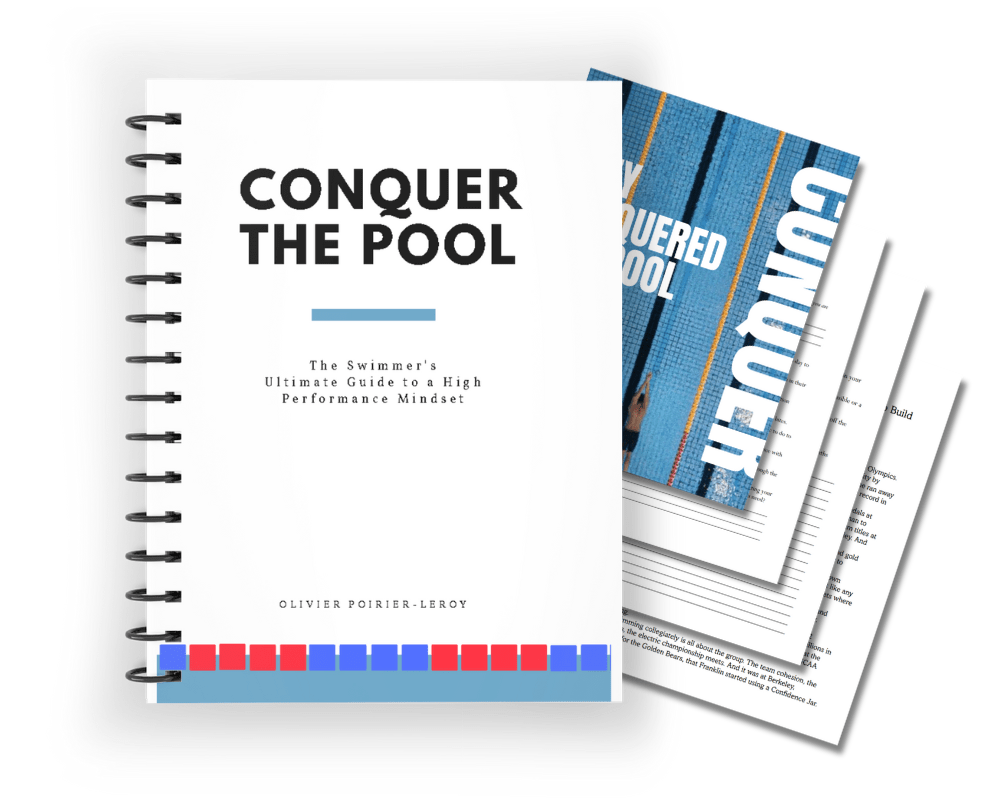
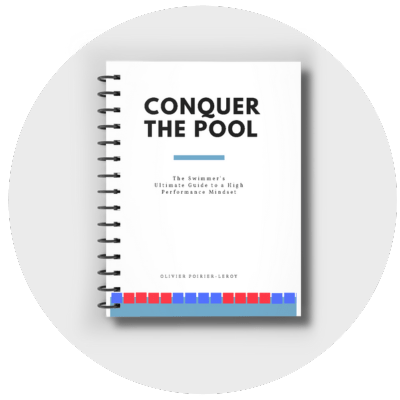
Swimmers frustrated with underwhelming performances on race day and want to conquer their mindset will love Conquer the Pool: The Swimmer’s Ultimate Guide to a High-Performance Mindset.
Written with the feedback of 200+ Olympians, NCAA champions, and head coaches, the book is the complete blueprint for an unbeatable mindset in practice and training.
From learning how to build a killer pre-race routine to everything you’ll ever need to master pre-race nerves, Conquer the Pool gives swimmers the tools to swim with total confidence on race day.