
How should you pace the 100 freestyle? Data from Olympic finalists reveals where races separate, how much elites positive split, and why the third 25 often decides the outcome.
The 100 freestyle is the blue ribbon event in the pool. It’s fast, furious, creating thunderous rolling waves that fill the gutters and make the lane ropes squeal in protest.
Which is probably why most swimmers give you a blank stare when asked about how they are going to pace it:
Go out fast and hang on. It’s a sprint—you don’t pace a sprint. White-knuckle speed and no fear!
While you certainly do go out fast (“go out fast, come back faster”), there is a subtle pacing strategy at work.
Elite 100 freestylers follow a clear pacing structure. Understanding it helps you manage energy on race day and set more accurate race-pace targets for practice.
100m Freestyle Pacing — Split the 50s
Research by Robertson et al. (2009) analyzed over 3,000 performances from nine elite international competitions, including the Olympics and World Championships.
They found that elite 100m freestylers used a positive splitting strategy. No big shock there—hard to even or negative split the 100 free. Swimmers went out fast on the first 50, followed by a second 50 that was roughly two seconds slower.
In Robertson’s data set, men averaged a 2.06 second difference between the two laps, while the women were a tad more even with their 50s at 1.95 seconds.
The Paris 2024 finalists replicated this almost exactly:
| Men | Women | |
| Paris 100m Finalists | 2.07 | 1.99 |
| Robertson et al | 2.06 | 1.95 |
But those are averages, and the individual splits from Paris tell a more interesting story.
The top three finishers all closed the race under the field average:
- Zhanle Pan – 22.28/24.12 (1.84s)
- Kyle Chalmers – 23.03/24.45 (1.42s)
- David Popovici – 22.94/24.55 (1.61s)
Meanwhile, the swimmers with the largest split differentials tended to finish lower. Maxime Grousset had the fastest first 50 of anyone not named Pan (22.61) but came back in 25.10, a 2.49-second gap, finishing fifth.
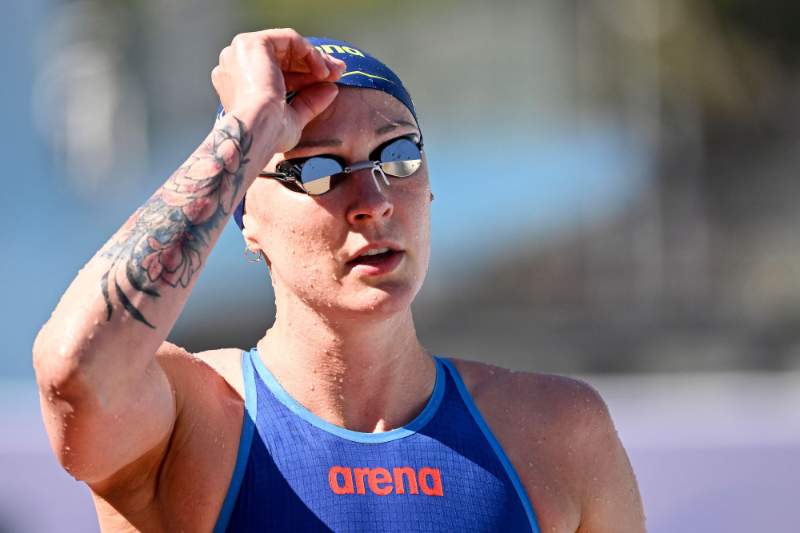
The women’s final was less clean—split differentials were all over the place despite the average holding—but the lesson remained.
Sarah Sjöström won with a controlled 1.64s split differential, while Gretchen Walsh took it out fast but paid for it on the second lap, coming home 2.60 seconds slower and placing eighth.
The broader pattern is consistent across placings, too. Robertson noted that swimmers finishing 1st through 16th all used the same pacing shape, but winners were faster across both parts of the race.
Go out fast, come back faster.
Where the 100 Freestyle Often Separates
A general pacing strategy is one thing, but knowing where 100m freestyle races are actually won is another.
A 2025 study by Gao et al. tracked 59 elite swimmers (including two Olympic champions and eight medalists) and found some clear patterns in where races separate.
- For male swimmers, velocity between the 65–75m mark was the strongest predictor of final race time—more predictive than the start, the turn, or any segment of the opening 50.
- For women, the picture was different—first lap speed, especially the 15-25m portion, was the strongest predictor of final time.
In other words: for men, races tend to break open in the third 25. For women, they may be won or lost earlier than that.
Why the third 25 for men—and why does it increasingly matter for women too as fatigue sets in? Because at that point of the race, your body is hitting a wall.
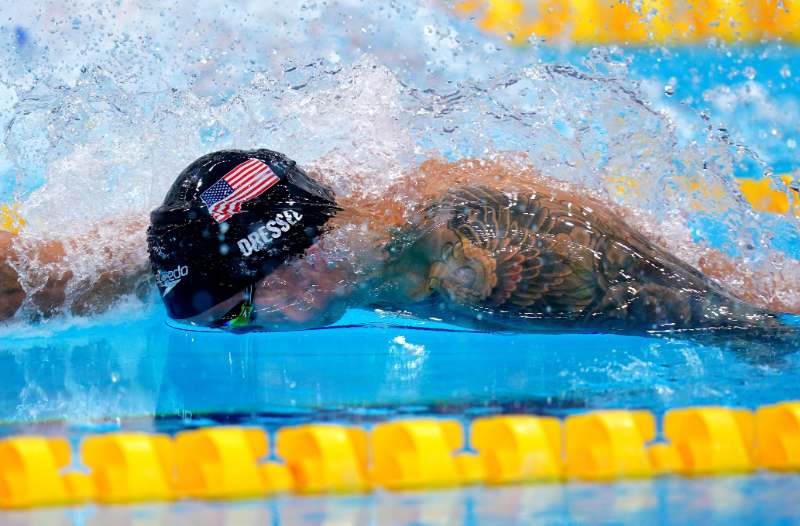
Several of them, actually.
Research by Hellard et al. (2018) shows what’s happening under the hood at this point of the race:
- Phosphocreatine is nearly gone. The energy system we rely on for explosive power is running on fumes.
- Lactate is climbing fast. Lactate is churning, hitting 8-10 mmol/L by the third 25m.
- The aerobic system has already peaked. Oxygen uptake maxed out around 50m and can’t climb any higher. It’s carrying more and more of the load, but it has hit its ceiling.
The third 25 is crucial as this part of the race becomes a negotiation between what your brain wants—personal best time, baby!—versus the physiological reality of what’s happening in your body.
The swimmers who train and pace their race to hold their stroke together at this point are the ones who get their hand on the wall first.
Training to Master 100 Freestyle Pace
So what does this mean for training? Well, the race follows a clear pacing pattern, the third 25m is important, and for women, opening speed is a must.
Here are some training ideas to incorporate into your training to improve your 100m freestyle:
- Use accurate race-pace splits – Don’t divide your goal time evenly. You don’t swim a :50 100 free with two :25s. Instead, target real race time splits, using a realistic 1.5–2.0 second differential (e.g., 24.0/26.0 or 24.2/25.8), so both the front half and back half are properly conditioned.
- Raise your V02max – At the third 25m point of the race, aerobic capacity is redlined. A higher VO2max means more aerobic horsepower available when you need it most.
- Resisted sprints – Resisted sprinting is awesome for building top end speed, which raises your velocity ceiling on the first lap, especially crucial for women looking to swim more explosively in the first 15-25m.
- Swim fast 75s – Work that third 25 in practice with fast 75s, focusing specifically on maxing out on that third 25m of each rep.
- Better underwaters – A fast third 25m starts off the wall. Develop a powerful underwater dolphin kick and a clean breakout to surface with velocity instead of scrambling to rebuild speed.
- Lock in stroke length under fatigue – Learn to hold more water under fatigue with stroke counts under mounting fatigue (i.e. 100s at ~80% effort with matching stroke counts on all four 25s).
The Bottom Line
The 100 freestyle is one of the most balanced events in swimming, blending power, speed endurance, and aerobic contribution in a way no other race quite does.
Understanding the race’s optimal pacing profile, and where races break open, allows you to train with intention instead of hope.
Happy freestylin’!