
Can real-time feedback via smart swim goggles improve swim performance? Yes—but the kind of feedback you are getting matters.
Until recently, assessing and tracking performance during swim practice came down to eye-balling the pace clock, whether digital or analog, from a distance.
Try and get your splits at the turn, the touch, and at the finish and see if you are going faster or not.
With the introduction of smartwatches for swimmers, and more recently—smart swim goggles—swimmers have way more data at their fingertips and eyeballs.
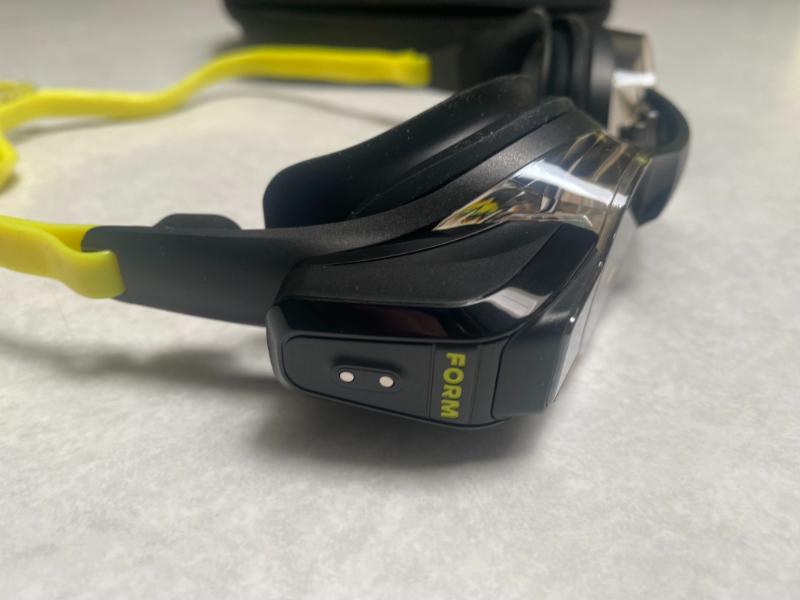
Smart goggles like the FORM Smart Swim 2 feature a heads-up display that gives us tons of actionable data to work with, from time elapsed, splits, stroke rates, and even heart rate.
But does this real-time data translate to faster swimming?
A graduate thesis out of the University of Kansas took the FORM 2 Goggles, gave them to some swimmers, and found some interesting little nuggets that we can use for smarter swim training.
Let’s take a lookie look.
The Effects of HR and Pace Feedback on Swim Performance
The thesis (Pellicotte, 2026) looked at a small group of adult swimmers training with the FORM 2 goggles over multiple swim workouts. Swimmers cycled through three different “dashboards” on the heads-up display inside the goggle lenses:
- Plain baseline screen with elapsed time and distance
- Heart rate feedback screen showing live BPM
- Pace feedback screen showing splits per 50m
Swimmers did several workouts with each screen to get a deeper sense of how each one affected performance.
Pace and Splits for the Win
Across the board and across the workouts, swimmers performed better with heart rate and pace feedback than without it. The elapsed time and distance produced the slowest average speed.
And between heart rate and pace feedback, it was seeing those splits pop up every 50m that naturally pushed swimmers to pick up the pace.
This taps into the motivational nature of seeing how we are doing in the water and intrinsic desire to do better. When you can see exactly how fast you are going, there’s that instinctive push to chase faster splits and results.
It’s immediate, concrete, and you don’t have to guesstimate your splits or wait until the end of the rep/set to see how you did.
Heart Rate Feedback Still Helped
The heart rate condition still improved relative to the baseline screen. And just because it didn’t perform as well as the pace feedback doesn’t mean you should ditch it in training.
Heart rate is valuable for a lot of reasons, including better managing effort and intensity (staying within a target heart rate range, for example).
If:
- The goal is to stay within a specific heart rate range, put that up onto the dashboard and focus on it.
- The goal is to hit a certain pace or “go faster” than having those splits pop up on the screen is the go-to move.
Swimmers Liked Using the Goggles, Too
Beyond the performance numbers, participants reported actually liking using the goggles.
This matters more than it might seem—there are plenty of tools that may improve performance but are annoying/uncomfortable/distracting to use. Participants indicated that the goggles were something they’d want to keep using in the pool.
This pairs nicely with a separate study (Eisenhardt et al., 2026) with 57 recreational swimmers that showed FORM swim goggles were much more likely to complete the prescribed number of laps in a swim workout.
See also: The Best Ways to Track Swim Workouts
Swimmers with the goggles better completed their sets and practices compared to having a printed workout at the end of the lane, particularly when the workouts were longer and more demanding.
This gives the smart goggles a more powerful one-two punch for swimmers—you’re more likely to complete your workout and hold a faster pace.
Wrapping Things Up
Smart swim goggles can be a bit overwhelming when you first get them set up and jump into the pool.
The heads-up display, and the apps that pair with them, can measure and track more times and information than the psych sheets at your local age group swim meet.
Use them to monitor pace to swim at a faster clip. Heart rate to stay within the right training zones. And use data to inform smarter, faster swimming.