

Swimmers have lots of metrics to work with in their pursuit of getting faster in the water.
And one of the most comprehensive tools for collecting all that data—and making smart training decisions—is the swim watch.
Swim watches track everything from pace and stroke rate to calories burned and heart rate. The big challenge, of course, just like any other kind of swim tracker, is accuracy.
And this is where heart rate monitoring in the water gets tricky. The pool is a particularly hostile environment for the sensors that try and accurately measure your heart rate.
Here’s a deeper look at how swim watches perform in the water for tracking heart rate and how to get more accurate heart rate data in the pool.
Why Heart Rate Monitoring is so Hard in the Water
Swim watches measure heart rate using optical sensors—photoplethysmography (PPG).
That’s a mouthful of a word for the flashing green lights on the underside of the watch that shoot into your skin. These lights measure changes in blood volume, and using algorithms figure out your heart rate.
It can also be fairly accurate under the right conditions. Swimming presents very wrong conditions.
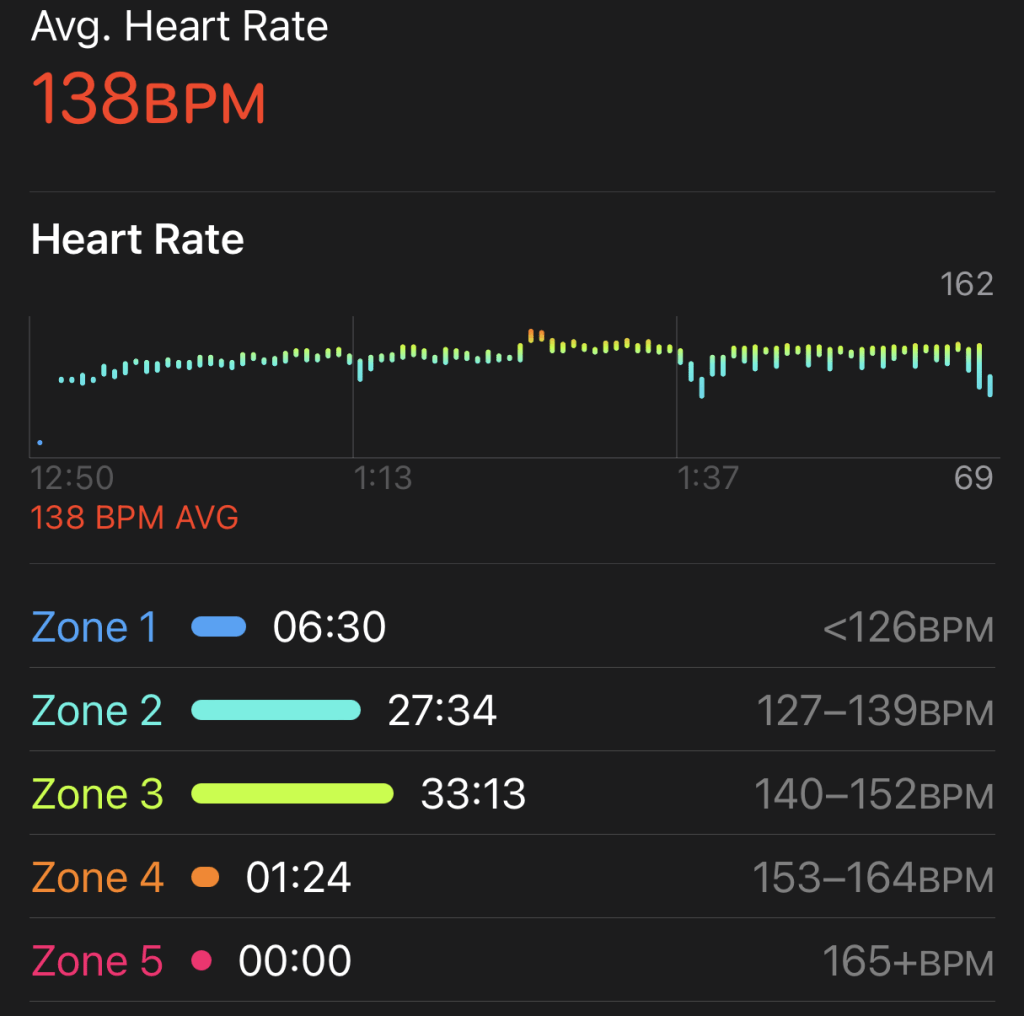
Water interferes with the optical signal. Water sloshing around the watch creating hydrodynamic noise that further muddies the signal. Arms are moving in and out of the water, jostling the watch with each stroke.
Not an easy environment to take an accurate heart rate reading.
Smartwatch Heart Rate Isn’t Perfect on Land, Either
Even when conditions are not wet—i.e. running on a treadmill or cycling—heart rate monitoring with a smartwatch isn’t as accurate as a chest strap.
A study (Jacko et al., 2025) took a group of 10 popular smartwatches—including the Apple Watch SE, Garmin Forerunner, Fitbit Versa 4—and had triathletes train with them and compared results to a chest strap monitor.
They ran on a treadmill, biked a big outdoor loop, and swam in a 50m pool.
When running on a treadmill, in controlled, dry conditions, the heart rate data on watches was not as accurate as the chest strap, with mean absolute percentage errors (MAPE) of 3.1% to 8.3% depending on the watch.
MAPE: The average percentage a measurement differs from the reference value. A MAPE of 5% means readings were off by 5% on average. The lower the better.
The Apple Watch SE did best, with an average-HR MAPE of 3.12%. The two Garmin watches were around 5%, while the Polar Ignite 2 was at 8.30%.
Interestingly, the biggest differences in HR accuracy weren’t even between devices but between individuals. Some participants produced highly accurate readings across almost every device. Others produced much larger errors, and it didn’t matter what watch they wore.
As for why, researchers didn’t have a clean physiological reasoning, although they suggested that individual differences in how they moved (e.g. step frequency) may have played a role in interfering with the optical signal.
Anyhoo, this is all to say that optical heart rate monitoring on watches is not perfect to begin with.
And things get much more challenging once we jump into the pool.
How Swim Watches Compare to Heart Rate Monitors
A recent study (Cosoli et al., 2026) shows us just how much harder it is to track heart rate accurately when swimming. Researchers took a group of competitive swimmers and had them use three different devices:
- Garmin Venu SQ (watch)
- Polar Vantage V2 (another watch)
- Polar H10 (chest-strap heart rate monitor)
The H10 was used as the baseline as it is highly accurate. Swimmers used all three devices at the same time (busy) so that measurements could be directly compared, and used them all in both the water and in dry conditions.
And the differences were not subtle:
| Device | Dry MAPE | Swimming MAPE |
| Garmin Venu Sq | 4.05% | 29.95% |
| Polar Vantage V2 | 8.00% | 17.17% |
The Garmin Venu sq (since discontinued, by the way) had percentage errors that increased from ~4% on land to basically 30% when swimming. The Vantage V2 had a big jump, too—from 8% to over 17%.
Okay. Not great.
But where were the errors coming from?
Swim Watches Can Underestimate Heart Rate
The easiest way to understand the discrepancies is to forget MAPE and percentages and look at the actual heart rates when swimming.
In the Cosoli et al. study, average heart rates were:
- Polar H10 chest strap – 152 bpm (actual)
- Polar Vantage V2 – 139 bpm
- Garmin Venu Sq – 101 bpm
Both watches—especially the Venu sq—significantly underestimated heart rate while swimming. And a lot of that is because watches can perform reasonably well when heart rate is somewhat stable, but struggle to catch rapid increases and decreases.
Because optical sensors don’t directly measure the heart’s activity—it estimates heart rate from changes in blood flow at the wrist and uses algorithms to process that signal—there can be a significant lag during changes in effort.
This creates more noise for swimmers who do a lot of training with changes in intensity. You swim hard, swim moderate, swim easy, rest at the wall, descend repeats, swim all-out—there are a lot of intensity spikes and transitions between effort levels.
Watches tend to struggle with catching these.
Olstad and Zinner (2020), for example, saw that the Polar M600 watch lagged significantly behind the chest strap at the beginning of high-intensity intervals when heart rate climbed sharply.
In practical terms, a swim watch is more likely to track heart rate more accurately once its settled at a steady intensity, but be less accurate when doing repeated hard/easy efforts.
Sensor Placement is the Game Changer
It should be noted that optical heart rate monitoring itself is not the challenge. It’s more about the placement.
Olstad and Zinner (2020) compared the Polar M600 watch with the Polar H10 (chest strap) and the Polar OH1 (an optical sensor placed against the temple).
The temple placement of the optical sensor yielded much better results, mapping almost perfectly onto the chest strap for max and mean heart rate:
| Metric | H10 Chest Strap | OH1 Temple | M600 watch |
| Max HR | 188.9 bpm | 188.1 bpm | 178.4 bpm |
| Mean HR | 140.6 bpm | 139.5 bpm | 131.1 bpm |
| Min HR | 75.3 bpm | 74.4 bpm | 75.8 bpm |
Why did the OH1 perform better on the temple?
Less movement of the device, for starters. The head moves less than the wrist when swimming freestyle. Pulse pressure is higher at the temple, too. And tucking the sensor under a swim cap can help reduce some of the “fluid film” that can distort results.
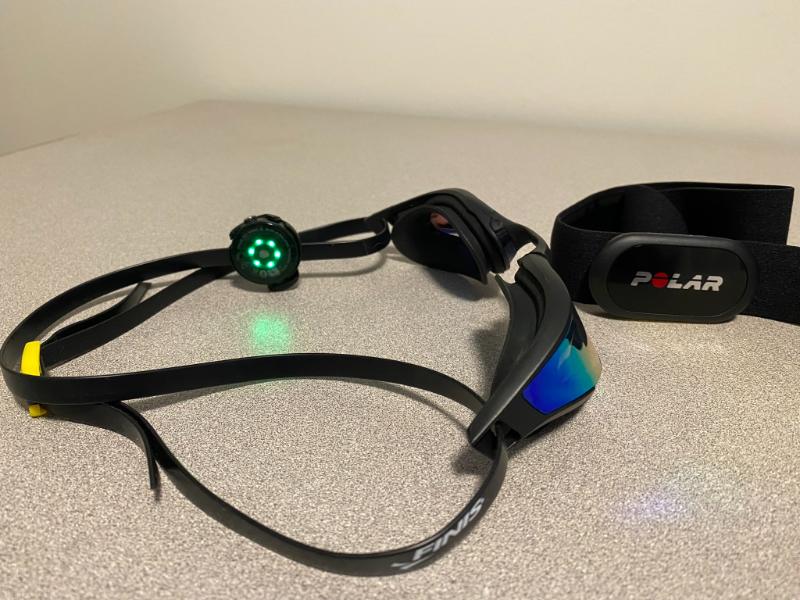
This suggests that optical heart-rate monitoring can be accurate when we have the right placement, and we aren’t trying to force an accurate reading from a wrist that’s constantly getting jostled around in the water.
This is also good news for swimmers who don’t want to wear a chest strap to measure heart rate when swimming, either because it gets in the way or struggles to stay in place from all of that upper body movement.
For swimmers who want more reliable heart rate data in the water, I’ve tested and reviewed the top waterproof heart rate monitors for swimming, including optical and chest-strap options.
So, Can You Trust Your Swim Watch’s Heart Rate?
The heart rate data coming from your swim watch can still provide useful information about workout intensity and longer-term training trends. But HR data should not be viewed as gospel.
The research with swimmers and triathletes tells us that:
- Wrist-based optical HR already has some measurement errors on land.
- Temple-based optical HR outperforms wrist-based measurements in the water.
- Accuracy can vary substantially from person to person.
- Swimming movement adds additional signal noise.
- Rapid changes in exercise intensity can create additional lag and error.
For swimmers who optimize their training primarily by heart rate, opt for a temple-based sensor like the OH1 or a chest strap.
For the rest, use heart rate from your swim watch as a loose guide of effort and utilize the rest of the device’s metrics for smart workouts and faster swimming.