
The training camp is in the rear-view. The miles have been logged. Now, standing between you and the big meet a couple meets away is the swimming taper period.
For a period of a few days, up to 3 weeks for our heavily muscled sprinting brethren, we fine tune our swimming while the volume of the work in the pool is cut drastically.
The swimming taper is a time of confusion for many young swimmers. While some swimmers feel great from the first day of taper, others take what feels like an eternity to reap the benefits.
This confusing, awesome period of training has befuddled many a swimmer.
Here is your guide to understanding the swimming taper, and how to make the best of it so that you can show up ready to destroy your best times on race day.
What is Tapering?
Tapering is a the planned reduction in training volume over the final days and weeks before a swim meet. Volume is decreased, frequency adjusted, intensity is mostly maintained, and swimmers sharpen their hard work in anticipation of competing.
The goal is fairly simple: Let your body and mind recover after months of hard work so that you arrive at the swim meet feeling fresher, stronger in the water, technically sharper, and more confident.
Over months of training, you’ve been building both fitness and fatigue.
Taper is the process of removing that fatigue so that the fitness built over all of those early morning workouts, sessions in the gym, and long main sets has a chance to shine on race day.
Hellard et al. (2013) summarized the point of taper as (emphasis mine):
“Consequently, to ultimately improve performance, the major challenge during the taper period is to maintain or further enhance the physiological adaptations while allowing the psychological and biological stresses of the overload periods to resolve.”
What Happens to Swimmers When They Taper
If you’ve shaved and tapered before you already know how great it can feel. You strap on your swim goggles and glide through the water effortlessly, you have the energy to spare, and your swimming?
Well, it feels just fantastic, thank you very much.
But what is happening exactly under the surface?
Here is how taper is changing your body and your swimming:
You swim faster
This is where it matters most–tapering improves swimming performance. Some examples:
At the Olympic level, Mujika et al. (2002) followed swimmers preparing for the Sydney Olympics in 2000–including most of Australia’s national team–and saw improvements of 2.18% after tapering. Improvements were also spread out across all distances and both sexes. Everyone got faster.
Trinity et al. (2006) followed Eddie Reese’s swimmers at the University of Texas through a full season and championship taper and saw improvements of ~5% at conference championships and NCAAs.
Younger, national-level swimmers can benefit, too. Aouani et al. (2024) found tapering dropped 50 free times by approximately 3.5%–from 27.45 to 26.49–while the non-tapering group showed no improvements at all.
So yeah–a well-planned taper can work at helping swimmers go faster on race day!
Power goes up
All season long you’ve been working hard and swimming under a blanket of accumulated fatigue, masking your power. Tapering lets your power fly.
A group of intercollegiate swimmers were tested with a stretch cord to see how strong they were before vs. after a season-ending taper. The swimmers, on average, were 5% more powerful after (Johns et al., 1992).
And a study (Trinity et al., 2006) with the Texas Longhorn swimmers saw that maximal power increased by a whopping 11.6% over the course of a three week taper, with swimmers improving performance by 4.7% in the water.
Fast twitch fibers increase
Heavy training blunts your most explosive muscle fibers–the ones swimmers lean on for fast starts, fast strokes, fast push-offs…. you get the idea. During taper, these muscles are growing and they are growing fast.
A study (Trappe et al., 2000) with a group of male collegiate swimmers measured their muscle fibers and power output monitored before and after a taper following 5 months of training.
Power output doubled, with type IIa muscle fibers (the short twitch, fast firing stuff that sprinters endlessly seek out) increasing by 2.5x. And yes, there were improvements where it mattered most–the clock–with swimmers seeing times improve between 3.0-4.7%.
Taper isn’t just for recovery but for allowing your body to re-tune towards the powerful, fast-contracting type of muscle fiber.
Stroke length increases
While the shave-down isn’t part of your taper workouts, it’s part of the overall taper, so we’ll add this little nugget.
Stripping off body hair reduces the drag pulling against you (maybe) and increases your proprioception in the water (more likely). As a result, swimmers glide further with less effort with each stroke.
The same group of NCAA swimmers in the Johns et al. study were also tested to see the difference in power and distance per stroke after doing a full body shave-down. While there was no difference in power output, distance per stroke increased by 5%.
Same effort, more stroke length.
Mood improves
While swimmers may have a love-hate relationship with tapering due to the increased tension that they continue to experience when shifting from hard training to stressing about competition, overall mood scores improve when swimmers taper (Raglin et al., 1991).
Hard training isn’t just hard on our muscles, but hard on our mindset. Anger, depression, fatigue, and confusion rise in accordance to the work that we are putting in the water and in the gym during those long months.
Tapering lets the air out of those feelings, with swimmers starting to feel better within days, with some swimmers seeing feelings of readiness, mood, and overall recovery taking up to a week to resolve (Collette et al., 2018).
The Two Types of Tapering Swimmers
While it’s tempting to seek out a boiler template for our taper, the truth is that we all react differently to the swimming taper.
Whether it is our genes, our event, or our muscle composition, the way that we react tends to fall into two different camps.
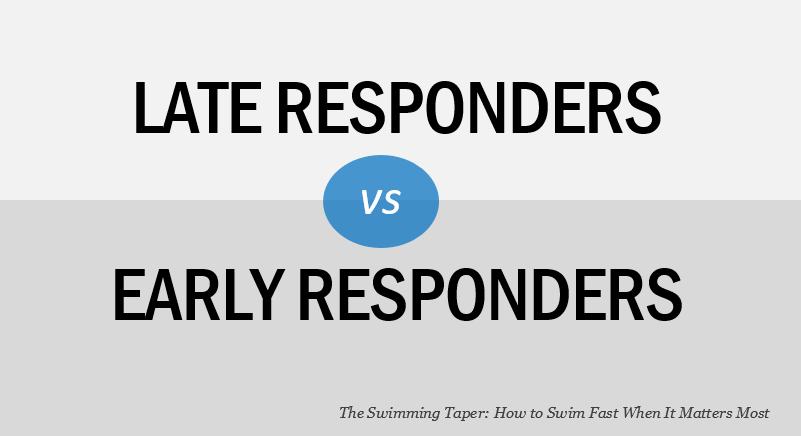
1. Late Responders.
For this poor swimmers they initially perform worse than when he or she was being inflicted with max volume. This brief spell of feeling awful in the water, of swimming slower than previous training, is temporary.
This scenario has caused many a panic-driven freak-out in the pool, and experiencing it leads you to thinking that you have only gotten worse in the pool. Awesome!
The accumulated fatigue is slow to disappear, and it takes a while for this athlete to fully recover and achieve that superhuman feeling we all crave during the taper phase.
These “late responders” tend to be older, sprinting dudes who require a longer taper as a result of the added time it takes for them to get rid of the accumulated fatigue (Avalos et al., 2003).
2. Early Responders.
In the second case, the swimmer has very rapidly adapted without this precipitous drop in performance.
In other words, this swimmer’s body has fully embraced the taper and is already feeling the hot sweetness that comes with added rest. (Much to the late responder’s chagrin.)
Younger, female distance-ish swimmers tend to fall into this profile, as they have a reduced training history, do less dryland, and have a reduced anaerobic component to their preparation and as a result are able to respond very quickly and early to added rest.
How to Nail Your Swim Taper
Ultimately, the way you taper and the way you perform is unique to you.
I know, I know…
You want a definitive answer to precisely how long you should be tapering in the pool.
Your taper can be typically broken down in overall volume, training frequency, and intensity.
Here are some general benchmarks to reason from:
Training Volume
Decreasing overall training volume is the most important lever swimmers have at their disposal during the taper.
Swimmers recover and swimming performance starts to increase with even a 20% decrease in training load, with peak performance falling within a 41-60% drop in training volume. More than 60% leads to inconsistent improvements (Bosquet et al., 2007).
Duration
How long you taper ultimately comes down to a lot of factors, including: training load, when the peak of your overload block was, accumulated fatigue (two swimmers can respond different to the same overload block), training history, and event choice. Generally, a 10-14 day taper is the sweet spot (Bosquet et al., 2007).
Frequency
Frequency–how often you are showing up to the pool–is another lever that swimmers have and one that should largely remain untouched. For starters, once training frequency dropped by more than 20% swimming slowed.
Frequency matters because maintaining your regular training schedule adds a sense of familiarity and normalcy to tapering, a time where swimmers can often struggle with overthinking performance and how they feel in the water.
Intensity
Intensity should largely be sustained during the taper. Reductions in training volume should be centered on “gray” yardage–the type of swimming that is too fast for recovery and too slow for genuine speed adaptations.
There is a reason you do lots of high intensity work during the taper (albeit with high rest). Doing so increases red blood cell counts, glycogen stores and increased mitochondrial activity. And yes, these are good things.
When tapering, drop the volume, keep most of the frequency, maintain the intensity.
How to Stay Mentally Sharp During Your Taper
From my own experience in the pool, I know that tapering is mentally challenging.
You feel stressed out that you aren’t feeling as good as you want in the water. You feel sluggish one day, like you are sailing over the water the next. Your mood and confidence wavers and yo-yo’s with each practice.
To combat the mental and emotional jitters that come with the taper, here are a few tips for you to help chill out a bit and enjoy the process of sharpening your swimming so that you swim fast when it matters most:
Relax
I always found taper to be more stressful than hard training. I knew what to expect during the tough stuff, after all. Taper, conversely, was a bit of a mystery. Your training today isn’t always an accurate reflection of how you are going to train tomorrow.
There is a lot stuff going on in your body. Accumulated fatigue is slowly being flushed out, type IIa fibers are being steadily recruited, and you are reaping the benefits of added sleep and energy.
Avoid last minute urges to train your brains out.
Added rest has a bizarre impact on tapering swimmers. On the one hand, they are starting to feel pretty darn good in the water, and on the other, they start to wonder if they trained hard enough.
Given how great they now feel, might as well sneak in a couple extra hard workouts, right? Nope.
Trust the plan.
With all of that time spent out of the water, swimmers have the opportunity to think over the taper, their training, and wonder if it was done properly. Did they do it right? Will it work?
For you late responders most especially, have faith in the process and trust the plan you have laid out for yourself. This can be tough particularly when you train with a lane-full of early responders, whose effortless swimming and boasts of “I feel, like, sooo amazing!” help fuel doubt in your own taper.
Coach’s confidence matters, too
Swimmers are looking for sources of confidence during the taper to make sure it’s working. Typically, this is in the form of prior training history, race pace results, comparisons to other swimmers, and how they feel in the water.
Interestingly, swimmers also judge how their taper goes by the body language their coach is giving off (Stone et al., 2025). A nervous tone, sudden technique overcorrection, or visible panic after a bad set or practice can make swimmers think something is off.
The best taper environments are calm, positive, and focused. Not fake cheery, overly intense, or frantic.
Journal your taper.
Summarizing how you are feeling at the end of the day, whether in your log book or wherever, can help you build a blueprint for how you mentally and physically react to tapering.
Additionally, performing a simple daily wellness check in your training journal can give you a better sense of where the recovery process is at.
Flatt et al. (2017) had NCAA swimmers rate sleep quality, fatigue, soreness, stress, and mood each morning right after waking up and found that it tracked perfectly with heart-rate variability–a standard method for gauging stress and recovery.
Having this record on hand for future tapers can be invaluable, troubleshoot last minute swings in stress/recovery, and help calm some of the see-sawing in confidence in the lead-up to the Big Meet.
Sleep like a boss.
The easiest way to boost your performance isn’t spending hours and hours dissecting your performance and the way you feel in the water. It’s getting more sleep.
With workout volume going down a bit, and the workout frequency decreasing as well, comes an opportunity to truly supercharge your body via sleep.
You know that trying to get magical nights of sleep during competition won’t always be possible, so build up a sleep surplus in the weeks leading up to your big races.
Don’t go overboard on how you are feeling.
Swimming, in a lot of ways, is a mystical sport. How else do you describe something like the way we “feel” the water? Or the sensation of riding the water? Swimming is a sport that predicates much on the way we feel in the water.
But the reality is, you don’t have to feel great in the water to swim fast.
Focus on the process, and forget about trying to attain an elusive “feeling.”
Wrapping Things Up
The taper is a personal thing.
The way you feel and perform during your taper, and consequently, in competition, is largely dictated by your training history, your specialty in the water, how you respond to the added rest, and so on.
Work with your coach to build a taper plan that works best for you and for your goals in the water.
May the swimming taper be with you.
- How to Prepare for a Swim Meet. Beyond the taper there is the practical considerations of getting yourself ready for the big meet. Here is a breakdown of how to get ready for the big meet.
- The Swim Meet Warm-Up: What You Need to Know About Getting Ready to Swim Fast. Not all warm-ups are created equal. Here are the things you need to know about priming your body to perform at it’s best.