
An elite reaction time for a swim start is between 0.60 and 0.75 seconds. The fastest swimmers on the planet, world-class sprinters in particular, get off the blocks with reaction times as fast as 0.55–0.60 seconds.
Reaction time is one of the metrics swimmers and coaches have at their disposal on race day.
It’s short hand for assessing how quickly swimmers get off the starting block.
Here’s more about how reaction time for the swim start is measured, the different types of reaction times, how to improve reaction time, and some quick tips on how to improve overall swim start performance.
Let’s dive in.
How Reaction Time is Measured
To more clearly understand what a good reaction time on the block is, it helps to understand that researchers track two distinct measurements here—and they mean very different things.
Reaction time (but actually block time)
Swimmers and coaches (and swim commentators) are most familiar with the reaction time that pops up on the scoreboard at swim meets.
You see it in the results sheets, scoreboard, and it’s discussed ad nauseum when sprint events appear on the program.
For example:
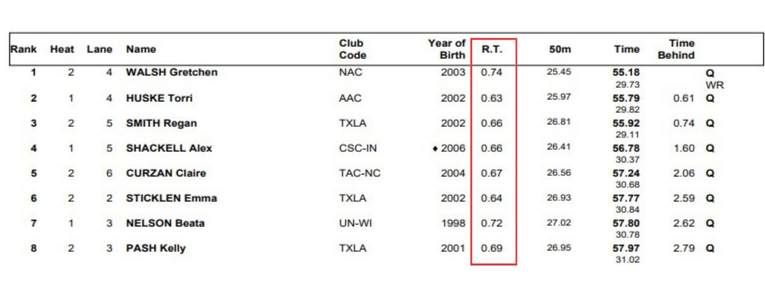
This metric is actually block time, because it captures everything the swimmer is doing on the starting block, from reacting to the signal, to initiating forward movement, to catapulting themselves off the block.
This version of reaction time (block time) is:
Block reaction time: Starter’s beep > Toe-off from the starting block
Block time (or “reaction time” in common swim use) is a very loose proxy for how fast a start is.
While it gives us a broad sense of start performance, it is largely worthless for telling us how much force swimmers generate on the block, their velocity when they leave the block, or how quick they get to 15m, which is the true measure of a booming start.
Reaction time (block timing) is most important in shorter races.
Below are the reaction times of the 50-400m freestyle finalists at the Paris Olympics:
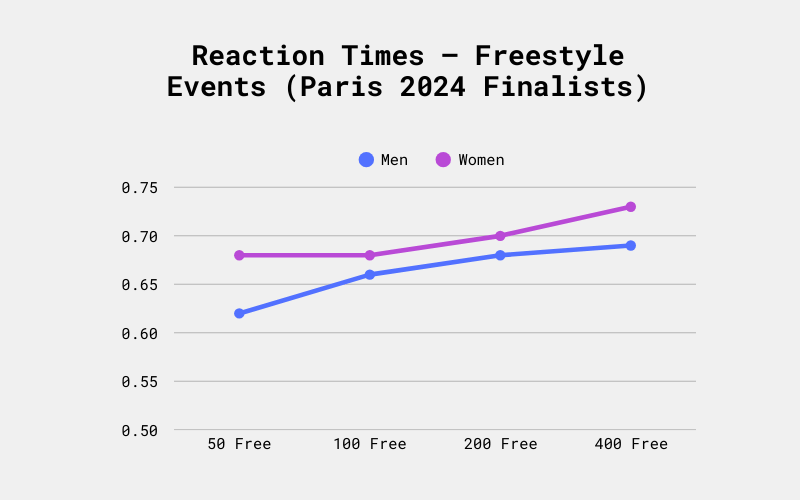
However, reaction times don’t tell the full story. Case in point–the screen shot above. Gretchen Walsh had the slowest reaction time in the field, but was first at the 50 and very first at the 100m.
Same at the Paris Olympics:
- Cam McEvoy won the race and had the fastest reaction time (0.56s), but in terms of who had the fastest overall start–time to 15m–it was Caeleb Dressel (4.97s).
- Sarah Sjostrom won her race with the fastest reaction time off the starting block (0.61s), but Gretchen Walsh was easily the fastest to 15m (5.88s) again with a slow (relatively) reaction time (0.75s).
Reaction time (the legit one)
And now, we have actual reaction time. This is the time between the starting signal and the first detectable application of force on the starting block. This is when your nervous system begins to respond, before any visible movement occurs.
It’s not measured by video, stopwatch, or visually (hence why it doesn’t show up on the scoreboard or heat sheet), but by force plates embedded in the starting block itself. This makes it far more precise than anything the naked eye could catch.
In one example, international-level competitive swimmers clocked reaction times of around 0.16–0.17 seconds—blink of the eye—from the starting signal to the first detectable movement on the block (Rudnik et al., 2023).
This led to block times of 0.72-0.75 seconds, giving us a better idea of what a proper reaction time and block time meshed together look like.
That reaction time triggers a precise sequence of forces (Thng et al., 2021):
- The rear leg begins driving into the kick plate as early as 15% of total block time
- Rear leg sustains that push through to about 80%
- The arms pull on the grab bar through the middle portion of the start,
- The front leg delivers its final horizontal push in the last stretch before take-off
Does Reaction Time Really Matter?
While commentators love to talk about it, swimmers love to obsess over it, and “winning” with a fast reaction time is certainly fun for bragging reasons, reaction time is a very incomplete assessment of what’s happening on the starting block.
- Block phase only accounts for about 11% of total time to 15m. Yes, the block phase is super important, from using the proper block phase set-up to building explosive power to get off the block fast. But it’s still just one part of what happens within the global start. Entry, underwaters, breakout–those things are vital. Don’t obsess over reaction time and instead focus on the higher-leverage aspects of the start.
- The biggest predictors of start performance are average power and horizontal take-off velocity, not reaction time (Thng et al., 2021). So if you are obsessing over shaving milliseconds off your reaction time, remember that there are far more important things to spend time and energy on.
Faster Starts, Not Just Faster Reaction Times
Reaction time, whether you want to consider the scientific definition or the more commonplace swimmer/coach definition, is important. But in both cases, it’s only the spark. What follows is what matters:
- Lots of horizontal force and power
- With the right stance and block set up
- And chase faster times to 15m than reaction times on the block
The start is where a lot of swimmers make or break their race day performance.
Knowing where reaction time stands in the scheme of things, and what a “good” reaction time is (and how it’s not as important as it’s made out to be), gives you the freedom to work on the things that do matter.
The Complete Guide to Starts
This article is part of our in-depth swim start series: