
Visualization is one of the most powerful mental skills swimmers have for improving performance. Here’s how to use it the right way for faster swimming.
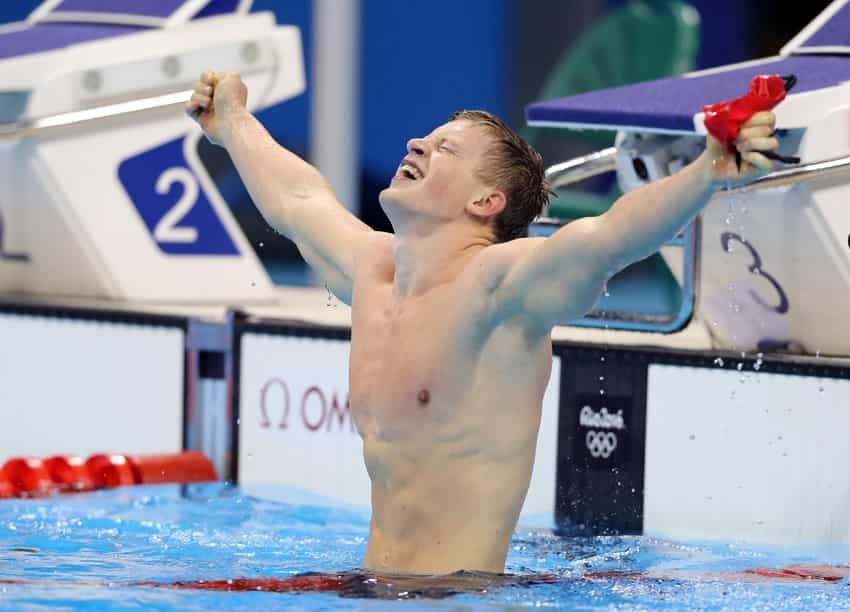
When Adam Peaty got behind the blocks for 100m breaststroke final at the Rio Olympics, he felt calm.
Not the forced calm of someone suppressing panic. But a quiet confidence. Despite the packed stands, the millions watching at home, and the pressure that comes with being the world record holder, Peaty was composed and ready.
He went on to smash the competition and his own world record—swimming a 57.13 in one of the most dominant performances in Olympic swimming history.
When asked afterward how he managed to stay so relaxed under that kind of pressure, Peaty said:
“I’d swum that race a thousand times in my head. I’m a big fan of visualization so I’ll always visualize my race beforehand.” — Adam Peaty
Peaty isn’t alone. Visualization is one of the most widely used mental training skills for swimmers. Olympic greats Michael Phelps, Katie Ledecky, Megan Jendrick, and Mark Tewksbury all used it as a key part of their race preparation.
Here’s how visualization works, and how to do it for faster swimming.
In This Article
What is Visualization?
Visualization, also called mental imagery or mental rehearsal, is a mental training skill where swimmers practice repeatedly and vividly imaging a performance in your mind before you swim it.
It can sound a little hokey at first—just close my eyes, imagine swimming fast, and then actually swim fast? That’s basically it, but the reason it works is grounded in how your brain processes experiences.
The brain has genuine difficulty distinguishing between a vividly imagined experience and a real one. The same neural pathways that fire when you physically execute a skill also fire when you mentally rehearse it (Ranganathan et al., 2004).
That means every time you do a well-constructed visualization, you are, in a very meaningful sense, practicing.
- Participants who spent time visualizing themselves weight training got 13% stronger—without lifting a single weight.
- Basketball players who visualized shooting free throws for several weeks improved their accuracy by 23% without touching a ball.
- A study (Volgemute et al., 2025) across 500 competitive athletes spanning 62 sports found that better performances consistently associated with stronger imagery abilities.
Although powerful, visualization doesn’t replace physical training. You still need to show up to the pool and put in the work between the lane lines.
If you want a deeper look at the research behind the benefits of visualization, here’s a detailed breakdown: Benefits of Visualization for Swimmers.
Think of visualization as a fuel additive that helps make your training spark and burn more brightly on race day, and not a replacement for the real stuff.
How to Use Visualization for Faster Swimming
Most swimmers who try visualization and give up on it aren’t doing it wrong, exactly, but they are doing it incompletely. Daydreams and bed-time wishful fantasies that pinball across outcomes and performances isn’t the same thing as deliberate mental rehearsal.
Here’s what goes into using visualization like a pro.
Make it Multisensory
The magic in making visualization work is in making it as real as possible. That means going beyond what you see in your mind’s eye and recruiting all your sense.
- What you see. The lane ropes. The tiles sailing by at the bottom of the pool when swimming. The officials on the pool deck.
- What you hear. The starter’s beep. That eternal silence before the beep. The crowd noise. Water sloshing past your ears as you swim. The silence under the surface when you dive in.
- What you physically feel. The textured surface of the block. The cold shock of the water. Your swim goggles snugly pressed against your face. The large volume of water being displaced with each pull.
- What you emotionally feel. The butterflies before the start. The determination as you push through fatigue. The satisfaction of finishing on a full stroke, with everything you had.
That last part, the emotional component, is where visualization can really pay off as it braces you for the inevitable surges of intensity and pressure of competition.
“If you start feeling your environment and seeing it at the same time—what will the water be like? Who’s going to be beside me? What’s it going to be like when you touch the wall?—you can prepare yourself for every situation and that’s something that really helps me.” – Adam Peaty
Rehearse the Process, Not Just the Outcome
The end result in competition is what gets us excited, and why swimmers set goals. Seeing a lifetime best on the clock is what we strive for, and while visualizing this outcome over and over has a place, it’s not where most of your visualization work should go.
Researchers at UCLA had two groups of collegiate students visualize their performance on an upcoming midterm.
The first group were instructed to focus solely on performing well on the actual midterm, while the second group was told to visualize themselves executing the process of doing well on the midterm.
Not only did the second group perform much better on the midterm, but they also exhibited much better study habits, and were more confidant and less anxious about the test.
So how do we translate this method of rehearsal to the pool?
The options are endless, but here are some ideas to get you going in terms of what to visualize:
- Showing up to early morning practice.
- Not giving up when the main set starts to crush you mentally.
- Doing extra work on your freestyle kick at the end of practice.
- Finishing the last rep with full power and excellent technique.
The process is where your race day performances are actually decided. Rehearse accordingly.
Rehearse Adversity, Not Just Success
This is where visualization can help you to prepare for adversity and the unexpected in competition—and where most swimmers use this skill improperly.
The reality is that despite your hard work and preparation, swim meets never unfold perfectly according to plan:
- Your top competitors come out guns blazing, dropping huge PBs
- Your stroke feels shaky and clunky on the first night of finals
- The swimmer in the next lane takes it out like a rocket, rattling your focus
The question isn’t whether these kinds of things will happen. But whether you’ve already rehearsed how you’ll respond to it.
Garrett Weber-Gale, part of the legendary gold-medal winning 4×100 freestyle relay at the Beijing Olympics, specifically used visualization to rehearse the pain that can hit like a freight train:
“I do visualize that moment–the moment when my arms feel like sandbags, when my legs are burning and my back feels like it’s tightening up like a rubber band. I get myself to the point where I am completely prepared for the pain. After imagining this point for a long time, I know I am able to endure the emotional stress and physical pain. I look forward to this point because I know I will conquer it!”
While many swimmers will inadvertently drift into visualizations where everything falls apart and they come up short, the smart swimmer builds in moments of adversity, and then visualizes themselves responding productively.
Scale Your Imagery to Your Actual Ability
Visualization works best when it’s believable. Mentally rehearsing a 1:50 when you’ve never broken 2:00 isn’t effective imagery training—it’s wishful thinking, and your brain knows the difference.
Set visualization goals that are just ahead of where you currently are. Chase a modest best-time drop, a race strategy you’re genuinely close to executing, a technical improvement you’ve been working toward in practice.
The closer your mental rehearsal maps to realistic outcomes, the more your brain internalizes it as something achievable rather than something to dismiss.
Be Consistent
Like other mental training skills, visualization is something that works best when done consistently. It gets better with practice, and its effects compound with consistency. A few minutes every day will outperform a single long session every two weeks every time.
The good news is you don’t need much infrastructure to do it. On the drive to practice (not while driving). In the locker room before a meet. In bed the night before a race.
The barrier to entry is low. The only requirement is showing up regularly enough to get good at it.
How the Best Swimmers Actually Use It
What’s interesting about elite swimmers and visualization isn’t just that they use it, but that they all use the skill differently.
Here are some examples of Olympic swimmers who use visualization:
- Adam Peaty used it to make the Olympic final feel like just another race. By the time he stood behind the blocks in Rio, he had rehearsed that moment so many times mentally that the pressure had been largely defused. It was just another rep. “If you can visualize it, you can do it,” said Peaty.
- Megan Jendrick had one of the most disciplined visualization routines I’ve ever come across. Every night before bed, she’d pull out a stopwatch, closed her eyes, and mentally swim the 100m breaststroke, timing herself each time. At the Sydney Olympics, she upset the world record holder and defending champion to win gold.
- Mark Tewksbury traveled to Barcelona the year before the 1992 Olympics specifically to see the still-unbuilt pool. He wanted a visual reference to make his visualizations more real. The following year, he won gold in the 100m backstroke, surging past the world record holder in the final meters. “I pictured winning in this pool,” he said afterward. “It was so exhilarating I had goosebumps just thinking about it.”
- Michael Phelps, the greatest swimmer of all time, used visualization extensively over his career. It specifically helped him win gold and set a WR in the 200m butterfly when his goggles leaked and he was effectively blind. When asked how it felt to swim blind, Phelps responded: “It felt like I thought it would.”
- Garrett Weber-Gale didn’t just visualize success, whether it’s winning gold or going a personal best time. He smartly visualized the process of suffering through the hardest moments of a race and coming out the other side. Visualization works best when it isn’t Pollyannish thinking but grounded in reality, hurting and all.
When to Visualize – A Practical Timeline
Knowing how to visualize is one thing. Actually sitting your chlorinated butt down, closing your eyes and doing it is another. Here’s how to fit visualization into your preparation at each stage of the season.
- Months out from the Big Meet. This is when to build your race map. Write down cues of the physical environment—smell of the air, the cool pool deck, the hustle and bustle of the meet warm-up. Run through the full day, experiencing the quiet moments hours before the race to the tension and butterflies of the minutes leading up to the race. 10-15 minutes several times per week is plenty.
- The week before. Keep it focused and positive. Swim your race two or three times in your head with full sensory detail. Rehearse random moments of adversity—the exact thing isn’t what matters, but your response is.
- Day of, between warm-up and your race. Find somewhere quiet, throw a towel over your head, breathe deeply. This is a final dress rehearsal. Run through your race strategy, performance cues, the crispness of your start, stroke, and turns.
- During practice, between reps. This is an underused window. Research (Hammoudi-Nassib et al., 2017) found that visualization is highly effective when done 1-2 minutes before a physical effort. Instead of hanging out on the wall daydreaming about snacks, spend 30 seconds picturing the technique and speed you’re aiming for on the next rep. You’ll be surprised at how quickly this sharpens your focus and technique.
Getting Started
If you’ve never done visualization before, start small.
Just five minutes tonight. Find a quiet spot, close your eyes, and swim one race from start to finish—full sensory detail, process not just outcome, one moment of adversity and your response to it.
It will feel awkward at first. Your mind will wander. Negative outcomes will creep in.
That’s normal. It happens to everyone, including elite swimmers. Each time it happens, reset and refocus. Like any skill, it gets easier with repetition, and the returns compound over time.
Put in the reps in the pool and between your ears, and your hard work will sparkle on race day.
Swimmers who take the mental side of the sport more seriously don’t just race better, but they have more fun, enjoy the process, and get more from the journey.
This guide to visualization for swimmers is part of our series on mental training for swimmers. You can read the main guide, and other articles below.