
Sighting is one of the most important skills for open water swimming.
When we are in the controlled environment of the pool, we have the black line to guide us.
In open water, those guides disappear, and on top of that, the environment is constantly messing with our sense of direction.
Currents pull us sideways without us noticing. Waves push us toward shore. Glare makes landmarks harder to see. Even in calm water, stroke imbalances can quietly send us off course.
Sighting is how open water swimmers stay on track.
By quickly raising the head to spot a buoy, landmark, the shoreline, or other swimmers—we quickly check direction and make the small corrections before they become big ones.
Poor sighting can cost minutes and places by forcing extra distance and late corrections to your race line. During training, the same errors can leave you exhausted, cold, and farther from safety than you realized, turning a swim that grows overly long into a genuine safety risk.
Fast open water swimmers sight accurately without breaking stroke rhythm or wasting unnecessary energy.
Here’s how to work this skill.
Use the quick peek
When sighting, you don’t need to raise your whole head out of the water. Instead, aim to raise the eyes and nose out of the water, and that’s it.
This technique, the “Quick Peek,” is smoother, faster, and less likely to break your stroke rhythm when using it.
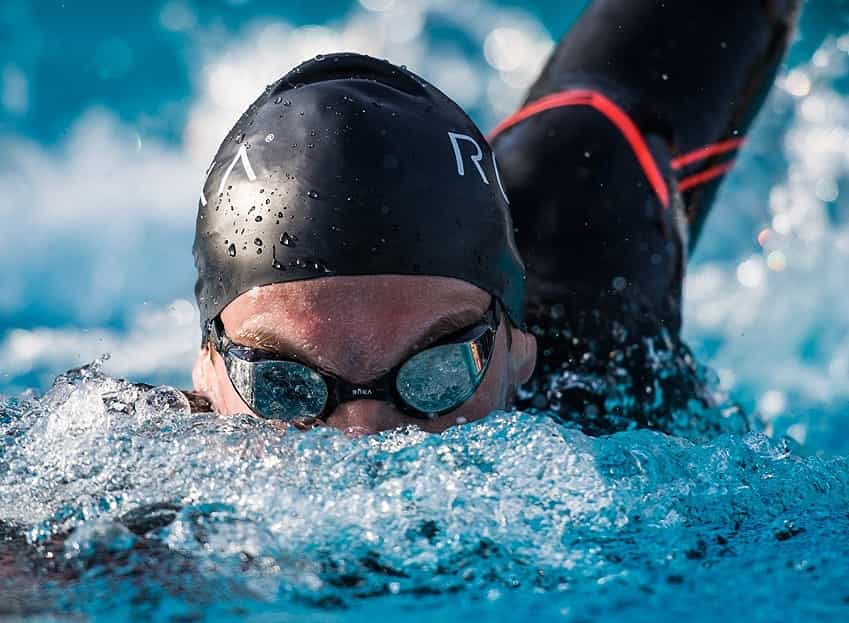
The bigger the movement, the more disruptive it is to your body position and stroke rhythm. The goal isn’t to get a big, panoramic view around you, but to quickly collect enough information to see if you are on track.
Get your eyes above the surface, find your reference point, and get back into your stroke.
Practice sighting in the pool
Sighting is done in open water, but it should be learned and practiced in the controlled environment of the local lap pool.
One of the things that catches newer open water swimmers is just how tiring sighting can be when they aren’t used to having to do it. Each time you lift the head, body position changes and you have to work harder to maintain speed.
A study (Cortesi and Gatta, 2015) demonstrated how sensitive swimming is to head position. When swimmers changed from a more streamlined head position to looking forward, passive drag increased by more than 10%.
That extra resistance forces swimmers to work significantly harder to maintain the same speed. More energy per meter, faster fatigue, and a measurable loss of efficiency each time the head is raised out of the water.
If you’ve got a long course pool at your disposal, practice with sighting several times over the course of the length to get used to the skill.
Use the press to shoot forward and up
Time your sighting with the “press” down of the pulling arm to create the lift necessary to raise the head out of the water within the natural stroke cycle.
Instead of trying to lift the body straight up, aim forward and slightly up with your head. This little cue helps swimmers sight without resorting to excess vertical movement which can really put a dent in stroke rhythm.
A lot of the deceleration that happens with improper sighting isn’t just in the “sighting stroke” itself, but in the subsequent 3-4 strokes where swimmers have to to re-establish stroke tempo and rhythm.
Timing with the press means that swimmers can sight within the natural rhythm of the freestyle stroke.
Don’t breathe when sighting
Breathing when swimming freestyle is obviously necessary, but try to separate sighting from breathing.
Two reasons why:
- Breathing is naturally disruptive to stroke mechanics and rhythm, and this especially the case when we try and breathe to the front while sighting. All that added vertical movement breaks stroke rhythm.
- Odds of inhaling a mouthful of water shoots up when breathing to the front. Breathing forward is hard enough in a pool, but add some wave and chop and the likelihood of accidentally sucking down a bunch of water increases big time.
Sight between breaths so that you can retain stroke rhythm, keep a clean bodyline, and avoid onboarding a bunch of open water when breathing forward.
Sight just frequently enough
How often you sight will come down to a host of factors, but whatever frequency you choose, it should be to ensure that your corrections stay small.
If you wait too long between peeks, a small adjustment can quickly turn into a large one. You then have to expend a ton of energy to change direction aggressively, wasting more distance and energy.
Sighting is a continuous course correction skill rather than the periodic “hey, where am I?” discovery of where you are.
Landmark it out
Before your swim starts, whether it’s a training swim at a local lake or an open water race with hundreds of other swimmers, pick out your points of reference.
Large, stationary landmarks behind or near your target work best, as race buoys can sometimes be harder to see through the waves and when there is a wall of white water going up around you from other swimmers.
Things like:
- Lifeguard tower
- A tall building
- A distinctive tree
- A mountain or hill
A large object on the horizon is always going to be easier to find when picking your head up to look around.
Use the right swim goggles
Swim goggles for open water swimming are designed specifically to give you excellent peripheral vision. This means:
- Wide, curved lenses, and more specifically to sighting, the ability to look forward and up without having to pull your whole head out of the water.
- Polarized lenses almost completely eliminate the refracting glare on the water’s surface that can make it harder to see when sighting.
Open water goggles like the Arena Cobra Swipe Tri and Aqua Sphere Kayenne have generous goggle lenses for added visibility.
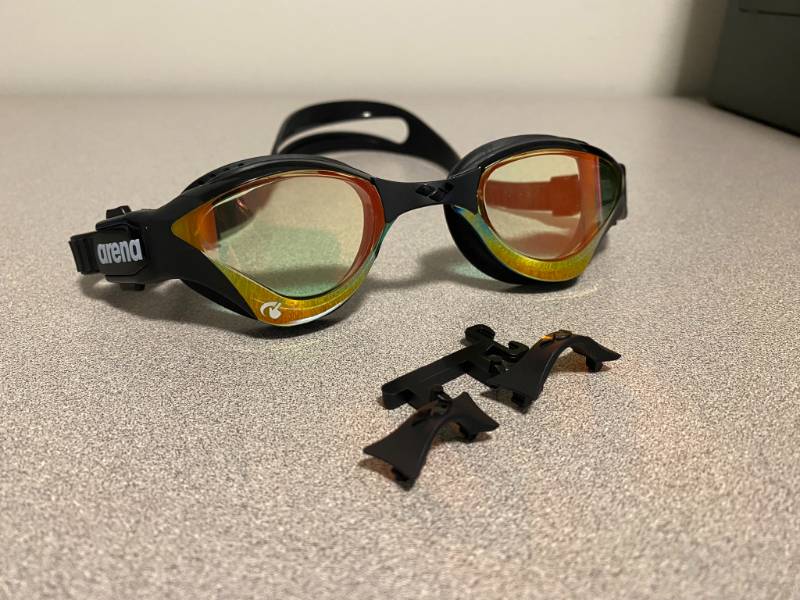
For swimmers who split time between the pool and open water, custom swim goggles from TheMagic5 are the best dual-use option. Slim and built for pool training while still offering the comfort and peripheral vision you need for swimming outside.
There’s also a “techier” swim goggle for swimmers who want extra help staying on course—the FORM 2 Smart Swim Goggles and its SwimStraight feature.
It uses the goggles’ heads-up-display to give swimmers a digital compass while you swim, giving real-time feedback on direction. This can be awesome for practicing sighting because you can compare the direction you think you’re swimming with the direction you’re actually going.
See also: Pool vs Open Water Swim Goggles – Understanding the Differences
Add head-up freestyle
Another way to strengthen the muscles and mechanics involved in sighting is using a classic freestyle drill—head-up freestyle!
Also known as water polo or Tarzan drill, head-up freestyle exaggerates the demands of sighting by having swimmers keep their head above the surface of the water and swimming freestyle.
Keeping the eyes forward forces you to work harder to maintain a stable body position and keep the hips from dropping. You don’t need to do a ton of it, and can easily mix it into the swimming you are already doing.
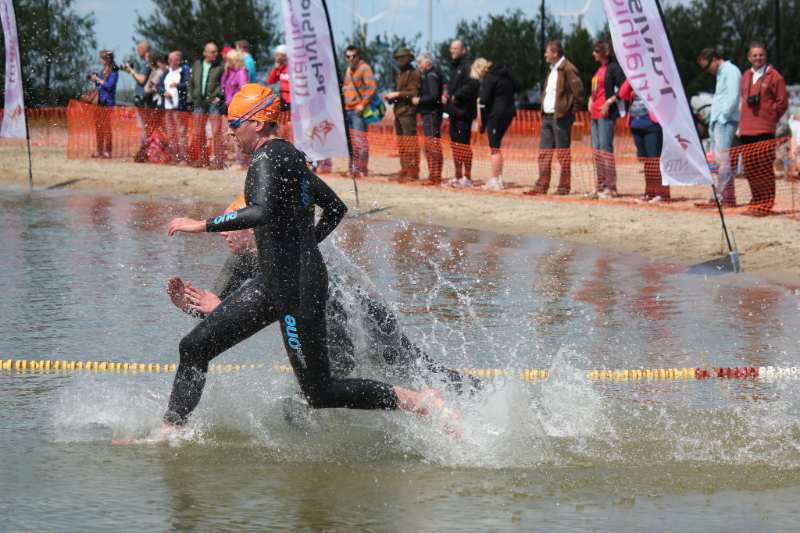
For example, instead of doing 10×200 freestyle swim at the pool today, you could break up those 200s to add a 25 of head-up freestyle. 25 head-up freestyle, 175 swim. And alternate with 175 swim, 25 head up freestyle to perform the drill under mounting fatigue.
Sprinkle in some head-up freestyle to your regular swim training and you’ll find that you can more smoothly sight while maintaining stroke rhythm.
Understand the conditions
Swimming straight isn’t purely a technical skill. Having a balanced stroke is obviously important for helping swimmers keep a straight line.
But the water has something to say about this, too.
The currents and tides will push you sideways even when you’re sighting frequently and properly aimed toward the correct landmark. Wind and waves can also gradually push you off course and make sighting more difficult.
Before hopping into the water, spend a few minutes looking at the conditions. Knowing that there is going to be a slight current or wind in one direction gives you the intel to route your swim instead of trying to swim over the elements.
GPS track your swims
One of the biggest challenges of open water swimming is that how straight you feel you are swimming and how straight you’re actually swimming can be two very different things.
GPS gives you a clear-eyed look at the difference.
A swim watch with GPS maps your route as you swim. The Apple Watch, Garmin watches, and other multisport devices have navigational options and GPS tracking for accurately mapping out swims.
Smart swim goggles with navigation features can also give you directional information.
Post-swim, look at the route you swam and see how it happened versus how it felt.
- Did you consistently drift toward one side?
- Did your line becomes less accurate as you got tired?
- Did you zig-zag a ton between sighting points?
You’ll almost certainly find patterns that are impossible to notice while you’re in the throes of swimming.
GPS turns “that felt like a straight swim” into “okay well here’s what I am doing and what I should do to swim straight.”
Wrapping Things Up
Open water swimming is challenging for a lot of reasons. The uninterrupted swimming (no walls and turns for micro-breaks), the sun, the white water blender of swimming in a big pack, and of course, the big expanse of water that makes swimming straight so challenging.
Like any other kind of skill, sighting gets better with practice. Sight in the pool during practice. Throw some head-up freestyle into your training. Build experience in different open water environments.
You’ll never be able to swim perfectly straight, but by using small sighting movements, separating sighting from breathing, and using easy-to-see landmarks, you can reduce wasted distance and improve your times in the swim.