
Swimming goggles are one of the essential pieces of gear that swimmers rely on in the water.
Goggles help us to see the environment around us, whether that’s navigating landmarks when swimming open water or the approaching bulkhead so that we can time out turn.
Within the broad category of swim goggles there are about as many brands, types, models, tints, and colors as there are tiles on the bottom of the pool.
And one of the main category distinctions are swim goggles that are designed for use in the pool while swimming laps, and goggles better suited for the demands of open water swimming.
Ultimately, a goggle is a goggle, but it’s the subtle differences that can make your swim more enjoyable.
Here’s a look at how pool and open water goggles differ, an example of how one brand differentiates the two goggles, and when you’re ready to shop, I’ll point you to the right guide at the end.
Pool Swim Goggles
Pool goggles are the most common type of swim goggle, and they function in an environment that is closed and predictable.
Pool temperature, lighting, length of the course—these things don’t change dramatically when you hop into the water to swim some laps.
Your eyes do the same job every lap; follow the black line, time the walls, catch splits on the pace clock, watch for swimmers breaking the circle-swimming pattern.
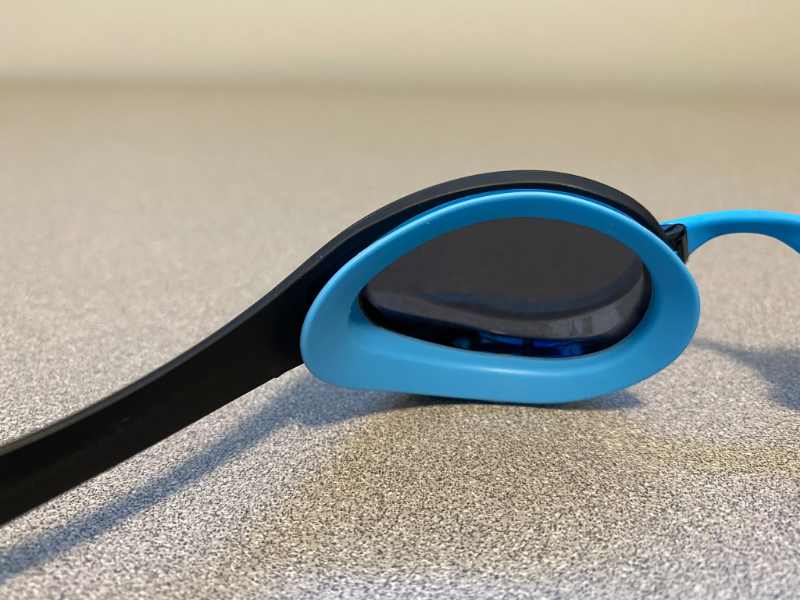
This makes the priorities for pool goggles:
- Low profile. Swim goggles, especially racing goggles, sit low and close to the face. This keeps the goggle lens hydrodynamic—okay for reducing drag but more importantly eliminates jostling of the lens from rushing water on dives and push-offs.
- Tints. Swimmers who train in darker, dimly lit pools use clear or lightly colored lenses to keep vision rocking and rolling, while bright artificial pool lights and outdoor swimming means mirrored or polarized lenses to reduce glare/
- Anti-fog. A high-performing anti-fog is particularly important indoors because of the sometimes insanely humid air that can cause condensation to roll in like a morning fog inside the lenses.
Because pool goggles operate in a controlled environment, they have minimal gasket size, strap thickness, and bracket construction.
Open Water Swim Goggles
Open water swim goggles are built specifically to help you deal with the elements when swimming in a lake, ocean, or river.
There’s no black line, no lane rope to pull on—err, guide you—or swimmer in the next lane to gauge position.
You’re sighting using buoys, landmarks, the splashing of a swimmer ahead of you. And this often happens in rollicking, choppy water, with variable light, and in the occasional blender of flailing arms and legs of a pack.
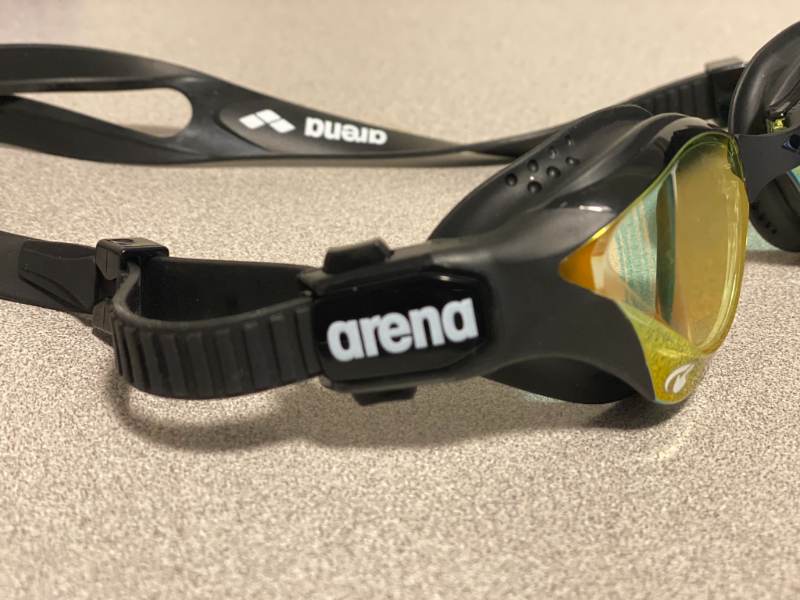
Open water swim goggles tend to be a lot bigger than pool goggles for several key reasons:
- Larger lens. An extra wide lens gives open water swimmers more peripheral vision, both to the side but also to look “up” to sight what’s in front of them. The more you can see without craning your head out of the water, the less you break stroke and rhythm.
- Tints. The tint on open water goggles becomes very important—a polarized lens eliminates the reflecting glare that stains eyes. Swimmers need a mirrored or dark tint to reduce eye strain and improve visibility.
- Increased build. Open water goggles are built “heavier” than pool goggles. They have a more robust gasket, larger seal for improved leak protection, thicker head straps for a more secure fit, and adjustment buckle at the side of the gasket for easier strap adjustments.
Open water swim goggles are built for dealing with the usually unpredictable elements and also with the realization that you can’t stop at the end of a lap to tinker with your goggles. This can make them seem overbuilt compared to pool goggles.
Key Differences at a Glance
Here is a big-picture look at the differences between pool and open water/swim goggles:
| Pool Goggles | Open water/Triathlon goggles | |
| Field of view | Narrower; only need to see the line, walls, clock, other swimmers | Broad; a wide, curved lens for sighting buoys, landmarks |
| Profile | Slim; tucked deeply into the face so that it doesn’t come loose when diving in the water/pushing off | Larger and “taller”; vision is more important than reducing drag |
| Fit and Seal | Snug, close fit; the goggles can feel like they are squished into the face | Softer, larger seal because of the bigger gasket seal |
| Strap and stability | Thinner straps; made of latex or silicone | Thicker, heavy-duty straps for maximum goggle security |
| Tint and lens | Mirrored/smoke for bright indoor and outdoor pools; clear/light colored lens for dimly lit pools | Polarized to eliminate glare; mirrored/dark lens to reduce eye strain over long swims |
| Anti-fog | Essential; indoor pools are very humid and fog goggles quickly | Same-same; no one wants to stop in open water to wipe fog from goggle lens |
| Where to use them | Swimming laps, training, racing in a pool | Lakes, oceans, triathlon racing |
A Case Study in the Differences Between Pool and Open Water Swim Goggles
The clearest way to see how these differences play out is to look at how a single goggle model has pool and an open water versions.
The Arena Cobra line of swim goggles is this example with the Arena Cobra Ultra Swipe (for the pool) and the Arena Cobra Ultra Swipe Tri.
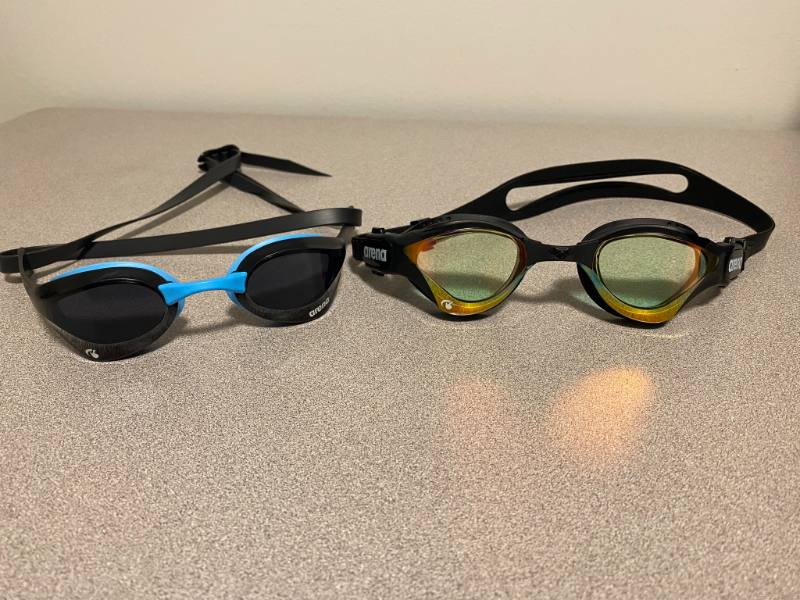
Both goggles share Arena’s advanced Swipe anti-fog system, where a gentle swipe of the inner lens resets the anti-fog. And both use Arena’s signature low profile lens, with the pool version just 0.5” and the Tri at 0.7”.
They look remarkably similar, but once you dig into the performance differences, they are actually quite different:
The Cobra Ultra Swipe (pool)
- Ultra-low profile gasket that sits deep in the eye socket. This keeps them locked into place when diving in, won’t wobble around when sprinting.
- Rigid side arms for added stability.
- Thin head straps that are adjusted at the back with a small plastic buckle
- Surprisingly good vision upwards for timing the finish and turns
- Trade-offs include the side arms can pinch larger heads and the goggle gaskets are small
The Cobra Swipe Tri (open water)
- Huge lens for a near-180-degree view for sighting buoys, landmarks
- Larger, softer skirt provides a wider and more reliable seal to prevent leaks and improve comfort over long swims
- Heavy-duty head straps that are adjusted at the side of the gasket
Swim Goggles That Pull Double Duty
Ultimately, a swim goggle is a swim goggle, even if the Cobra example shows us how one model can be split into two use cases.
Some goggles try the opposite approach, trying to pull double duty and perform in both environments.
Two examples do this in completely different ways.
The FORM 2 Smart Swim does it with tech. The goggles use a heads-up-display to show real-time swim metrics, in the pool or in open water.
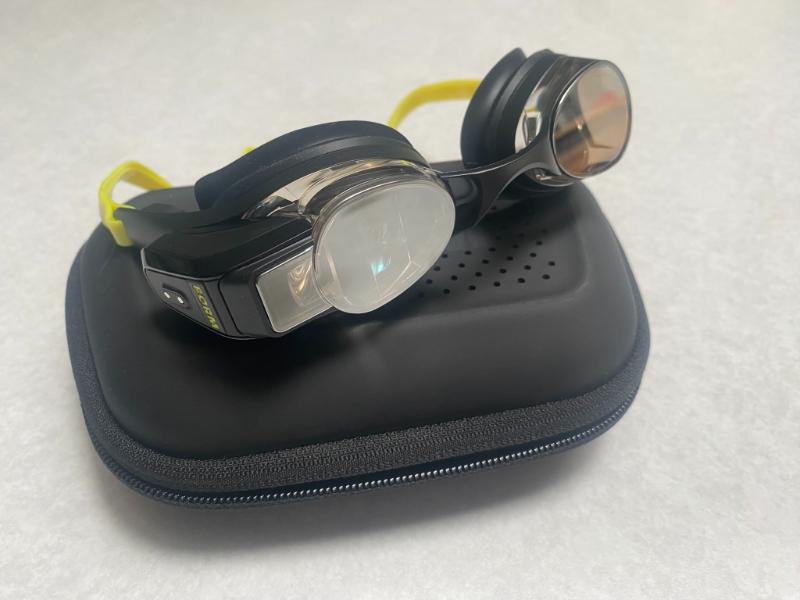
They also have a unique feature called StraightSwim which is essentially a compass that tells you how straight (or not) you are swimming in open water. GPS tracking is also done with a paired watch.
See also: FORM 2 Smart Swim Goggles Tested and Reviewed in the Pool
The goggles started out as a pool-based tool, tracking splits, stroke counts, stroke rate, heart rate, and so on. It has since evolved to be the smart goggle of choice for both pool and open water swimming.
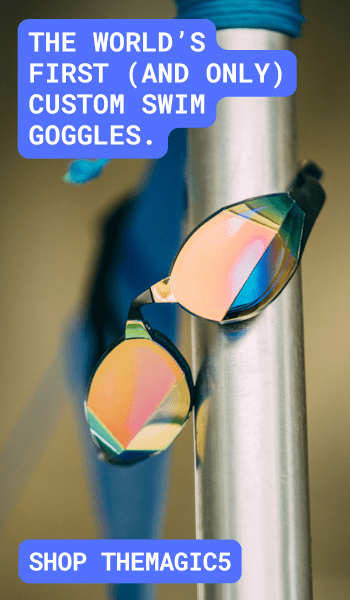
TheMagic5 goggles does it with fit. By using a face scan to measure the unique characteristics of your eye sockets and nose, they 3D print a goggle that is made to fit your face like a glove.
See also: TheMagic5 Swim Goggles Review – Are These Custom-Fit Goggles Worth It?
The benefit is that you create a seal that doesn’t require overly tightening the goggle straps, making them comfortable enough that you can wear them for long sets in the pool and longer swims outdoors.
The lenses aren’t oversized like specifically built open water goggles, but the custom lenses solve the seal and tint side of choosing goggles.
So which goggle is right for you?
Match the goggle to where you are going to be spending your strokes.
If you are a pool-based swimmer, a quality set of pool goggles is the obvious choice. They are inexpensive, there are tons to choose from, and select based on comfort and tint.
My guide to the best swim goggles covers the top picks for every type of swimmer, from elite racers and fitness swimmers to kids and beginners.
Triathletes and open water swimmers will want to opt for the wider vision and more confident seal of an open water goggle. Choose goggles that give you confidence out in open water.
For recommendations tailored specifically to open water and triathlons, check out this guide to the best open water swim goggles, where I compare goggles built for long-distance swims, race day, and changing conditions.
And if you are splitting time between both, there’s some do-it-all goggles like the ones mentioned above that can cover a majority of your swimming comfortably.
The Bottom Line
Swim goggles are one of those pieces of equipment that we don’t want to have to think about—we’d rather focus on improving technique, swimming faster, and giving the pace clock a run for its money.
But a little bit of thoughtful planning when selecting goggles based on your swimming goals and environment can go a long way to making your swims more enjoyable.
Understand what each type of goggle is tuned for, be honest about what you need from your goggles, and then pick the pair that works best for you.
Happy swimming!