
From first-time lap swimmers to elite competitors, these 27 workouts give every swimmer a structured, purposeful session to build speed, endurance, and technique.
One of the benefits of swimming is the endless variety of ways that you can train in the water.
Swim workouts can be a two-hour distance odyssey of intervals on short rest, or a high-rest, high-intensity 45 minute sprint-focused set.
Structured swim workouts give us focus and help us get faster, boost endurance, improve technique, and get more from our time circling the black line.
But here’s the challenge: most swimmers do random workouts that don’t match their goals or repeat the same sets over and over again.
In this collection, you’ll find ready-to-go swim workouts for beginners, sprinters, middle-distance swimmers, medley swimmers, and everyone else in between.
No fluff. No mindless swimming. Just swim training that is fun and high-performance.
The Ultimate List of Swimming Workouts
Get faster in the water, improve technique, and get in better shape with the following swim workouts:
Beginner workouts
- ↓Skills and Drills for Beginner Swimmers (40–50 min)
- ↓Beginner-Friendly Intervals and Pacing (35–45 min)
- ↓Beginner Endurance Swim Training (30–40 min)
Intermediate workouts
- ↓A Swim Workout for Turbocharged Weight Loss (60 min)
- ↓The Conditioning Ladder Workout (40–60 min)
- ↓The Distance Per Stroke Deluxe Set (60 min)
- ↓Six-Beat Deluxe Freestyle Workout (60 min)
- ↓The Triple Threat 50s Swim Workout (80–90 min)
- ↓The Lower Body Lactate Spike Workout (80 min)
- ↓A Swim Workout to Balance Your Freestyle Stroke (60–80 min)
- ↓The Bob Bowman Kick Set (45–60 min)
- ↓The One-Hour Medley Ladder Swim Workout (60 min)
- ↓The Ultimate Underwater Dolphin Kick Swim Practice (60 min)
- ↓The Descending Rest 100 Pace Challenge (60–90 min)
Advanced workouts
- ↓The Progressive Threshold Builder (90 min)
- ↓The Katie Ledecky Threshold Workout (90 min)
- ↓The Super-Set Breaststroke Swim Workout (80 min)
- ↓The Backstroker’s Super Pack Workout (75 min)
- ↓A Swim Workout for Building VO2max the Smart Way (90 min)
- ↓The Top End Speed Swim Workout (45–60 min)
- ↓An Advanced Resisted Sprint Set for Peak Power and Speed (90 min)
- ↓The Ultimate Power Rack Sprint Workout (60 min)
- ↓The Dirty HIIRTY Swim Workout (60 min)
- ↓A Swim Workout for Pacing Control (75 min)
- ↓Advanced Endurance Swim Training (90+ min)
- ↓The Bobby Finke Finisher Set (90–120 min)
- ↓A Swim Workout for a Successful Taper (60 min)
Resources
Let’s dive in.
Skills and Drills for Beginner Swimmers (40-50 Minutes)
Build fundamental swim skills with a drill-focused session designed for newer swimmers, emphasizing streamlining, balance, rotation, coordination, and feel for the water.
These skills are critical for swimming well at every level, and setting a strong foundation early will reduce plateaus and frustration down the road.
- 100 freestyle swim – breathe every 3 strokes
- 2x 20 seconds hand sculling (floating vertically, create tight figure eight motions with the hand—focus on “holding” water with the hands)
- 3 streamline push-offs for distance (how much distance can you get with your push-off?)
- 4×25 freestyle swim “overkick” – use regular arm turnover speed, but a fast kick
- 3 deep water streamline push-offs (float down to the bottom of the pool, push off as hard as you can in a tight streamline)
- 2x 20 seconds vertical hand sculling
- 100 freestyle breathing every 3 strokes
- 4×25 freestyle kick on your side, one arm extended in front of you
- 2x 20 seconds hand sculling
No need to rush the workout—the goal is improving your relationship with the water.
Swimming is so hard precisely because it is so inefficient—only around 30% of the power we generate in the water is used directly for propulsion (Morais et al., 2020).
Better technique starts on lap one.
Beginner-Friendly Intervals and Pacing (35-45 minutes)
Swim workouts are built around intervals and pacing—two things swimmers use in almost every session. The workout below introduces beginners to these concepts.
Intervals and pacing are also two key levers that swimmers have for improving performance in the water, so learning them early gives swimmers a head start on the fundamentals of effective swim training.
- 100 swim choice easy
- 4×25 build (start easy, finish a little faster) – 20s rest per repetition
- 6×50 freestyle swim (first 25 easy and smooth, second 25 a little faster) – Choose an interval where you get 20-25 seconds rest
- 4×25 kick with a kickboard (build each lap from easy > fast) – Take 30s rest per repetition
- 4×50 freestyle swim (go faster than the 50s from above) – Take 30s rest per repetition
- 100 easy
Beginner Endurance Swim Training (30-40 minutes)
This workout builds confidence in your ability to keep swimming without having to stop every 25. It’s not about speed—it’s about comfort, rhythm, and learning how to swim continuously.
- 4×25 freestyle swim easy and smooth – 20s rest per rep
- 4×50 freestyle swim smooth – 30s rest per rep
- 3×75 freestyle swim smooth – 30s per rep
- 2×100 freestyle swim smooth – 30s rep
- 1×150 freestyle swim smooth (if feeling good)
- 100 easy swim to warm-down
This type of set is endlessly versatile for swimmers just getting into the sport or those coming back from time away from the pool.
As you improve you can:
- Add rounds (2-3 times through the set)
- Extend the ladder (e.g., start with 8x50s > 7x75s > 6×100 > 5×150 > 4×200, etc).
Swim training can look repetitive and dull from the outside—just mindless churning around the black line—but once you get a sense of how much you can change and adjust distance, rest, and structure, you’ll never swim a bored lap again.
A Swim Workout for Turbocharged Weight Loss (60 minutes)
Swimming is already a high-calories workout, but with a few smart adjustments, you can significantly increase metabolic cost of your time spent in the pool training.
And one of the best accelerants for weight loss is doing more kick.
Kicking is more energetically expensive per meter than full-stroke swimming, meaning it burns more calories for the same distance (Morris et al., 2014).
Pair fast kicking with smooth swimming in “kick-swim” sets, and you’ve got a simple but brutally effective fat-loss combo.
- 600 with fins – 200 swim, 200 kick, 200 drill choice
- 12×25 freestyle kick with a board fast – 20 seconds rest after each repetition
- Extra minute rest
- 10×75 freestyle as 25 kick with a board fast, 50 swim smooth – 20 seconds rest after each repetition
- Extra minute rest
- 8×100 freestyle as 50 kick fast, 50 swim smooth – 20 seconds rest after each repetition
- Extra minute rest
- 6×150 freestyle – Odd reps: 50 kick fast, 100 swim smooth, Even reps: 100 kick fast, 50 swim smooth
- 10 deep water bobs to cool down
The Conditioning Ladder Workout (40-60 minutes)
Descending ladder sets are an exceptional form of swim training that improves your ability to hold pace as fatigue builds.
It’s a simple structured swimming workout that challenges conditioning, pacing discipline, and mental toughness—all in one set.
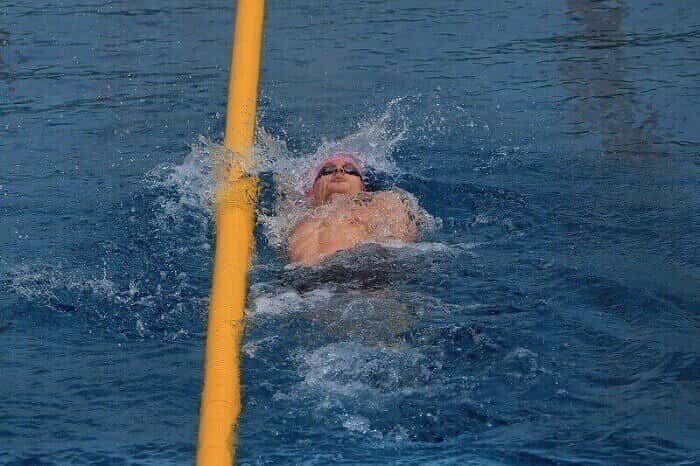
To do it properly, set a target pace per 100 that you have to swim relatively strong to make over 100. Extrapolate all the way up to the 500 and you have your intervals.
Set a pace per 100
- 400 as 100 swim, 100 IM drill, 100 kick, 100 swim
- 500 free swim on 7:30 (1:30 per 100 base)
- 400 free swim on 6:00
- 300 free swim on 4:30
- 200 free swim on 3:00
- 100 free swim on 1:30
- 100 easy cool down
The beauty of this workout is that it can be configured in countless ways according to your goals in the water.
- Want to build a stronger pull? Grab your pull buoy and an ankle band.
- Boost your kick? Split each rep between swim and kick (e.g. for the 500 = 250 swim, 250 kick).
- Or do the whole thing kick!
- Make it more speed oriented? Instead of doing 1×100 at the bottom of the ladder, do 5-10 of them.
As you improve, decrease the average 100 pace to keep progress rolling. Week one you might use a 1:30 base, week two 1:25, etcetera.
The Distance Per Stroke Deluxe Set (60 minutes)
Fast swimmers have excellent stroke length–they hold lots of water, work with the water to generate more rotation and power with each stroke, and hit faster speeds along the way. The workout is designed to improve distance pers stroke, or more specifically, how to hold water at speeds.
Efficiency is essential in the water. Swimming is an inherently inefficient sport—only around 30% of the power we generate in the water is used for actual forward propulsion (Morais et al., 2020).
The workout challenges you to swim fast while taking fewer strokes. This constraint will naturally promote a stronger, more powerful stroke.
- 600 warm-up as 300 swim, 200 kick, 100 drill choice
- 50 freestyle at 80% effort – count your strokes (i.e. 32 strokes). This is your baseline.
- 24×50 freestyle swim at 80% effort alternating [1 rep at baseline stroke count, 1 rep at baseline minus one stroke, 1 rep at baseline minus two.]
- 200 swim warm down
This set can also be done at shorter distances to help sprinters hold more water:
- 25 freestyle at 95% effort – count your stroke (i.e. 14 strokes).
- 24×25 freestyle at 95% effort, alternating [1 rep at baseline stroke count, 1 rep at baseline minus one stroke, 1 rep at baseline minus two.]
This kind of swim workout is awesome as it is very mentally engaging, keeping you present and dialed in on quality stroke mechanics and stroke length.
Six-Beat Deluxe Freestyle Workout (60mins)
Developing a strong, coordinated six-beat kick in freestyle is essential for swimmers looking to excel in the sprint and middle-distance freestyle events. It’s also a hallmark of fast freestyle.
Elite swimmers sync arms and legs with near-perfect timing, keeping propulsion steady and the body balanced. Less-skilled swimmers? Nearly all of them fall out of sync—wasting energy and disrupting rhythm (Menzencio et al., 2020).
See also: 6 Freestyle Sets and Workouts
And yes, a six-beat kick will improve freestyle speeds. After just 16 focused sessions of focused six-beat kick work, age group swimmers significantly improved 50m free times (Armen, 2018).
This workout builds and challenges that timing and endurance.
- 200 swim + 200 kick + 200 IM drill
- 6×25 freestyle overkick drill
- 8×50 freestyle as Odds: 25 kick fast, 25 free with six-beat kick, Evens: 25 free with six-beat kick, 25 kick fast
- 100 easy reset
- 8×100 freestyle as Odds: 50 kick fast, 50 free with six-beat kick, Evens: 50 free with six-beat kick, 50 kick fast
- 100 easy rest
- Test: Swim as far as you can with a six-beat kick to see how long you can hold it.
- 200 easy cool down
The Triple Threat 50s Swim Workout (80-90 minutes)
The workout was a favorite of the late Richard Quick as well as Bob Bowman, Michael Phelps’ longtime swimming coach. The workout is designed to build overall speed and endurance over the second 50 meters of your 100-meter race.
The first part of the main set is designed to help swimmers build 100 stamina, targeting race pace speed. The second part is a “buffering” set to better train the body to metabolize the lactate that is created in the first part.
- 200 swim + 200 kick + 100 drill + 4×25 swim build
- 30 x 50 @ 1:30 (or 1:15 for short course) alternate through swim (all-out), drill, kick. Cycle through 10 times.
- 10×100 freestyle swim smooth on 1:30 (choose an interval that gives you ~20s rest)
- 100 easy swim
The Lower Body Lactate Spike Workout (80 minutes)
This training session takes advantage of the inherent inefficiency of the legs—kick creates lactate much faster than full-stroke swimming—to build a better conditioned swimmer.
Fast swimmers are also fast kickers. While the kick doesn’t provide a ton of direct propulsion when swimming—even at higher velocities, the kick contributes just10-15%–legs that are fit, properly positioned, and don’t waste energy are essential.
- 600 choice warm up + 2×25 kick at 90% effort
- 4×25 freestyle kick fast – 10s rest per repetition
- 100 freestyle swim fast – 30s rest
- 4×25 freestyle kick fast – 10s rest per repetition
- 200 freestyle swim fast – 30s rest
- 4×25 freestyle kick fast – 10s rest per repetition
- 300 freestyle swim fast – 30s rest
- 4×25 freestyle kick fast – 20s rest per repetition
- 200 freestyle swim fast – 30s rest
- 4×25 freestyle kick fast – 20s rest per repetition
- 100 freestyle swim fast
- 10 deep water bobs to warm-down
Kick hard and fast, and then swim through the lactate, simulating what happens on race day.
A Swim Workout to Balance Out Your Freestyle Stroke (60-80 minutes)
Build a smoother, more balanced freestyle stroke with a constraint-based swim session that reduces gaps in propulsion and improves timing between strokes.
Fast freestyle relies on rhythm and continuity. When one arm dominates or there’s a pause between strokes, swimmers develop a “gallop”—a hitch in the stroke that disrupts momentum and wastes energy.
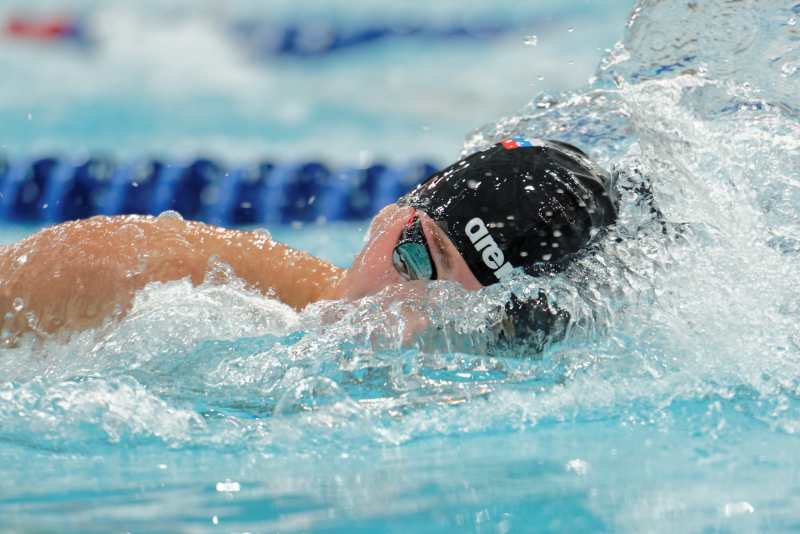
This workout uses tools like bilateral breathing and light resistance to even things out, helping you swim smoother and faster.
- 300 swim + 6×50 swim desc 1-3 (twice) + 100 kick no bubbles
- 2-3 rounds:
- 4×100 freestyle breathing every 3 (3-2 okay too) – desc 1-4
- 6×25 free with drag chute @ 80% effort
- 6×50 freestyle swim fast (~90% effort)
- 6×25 free with drag chute @ 80% effort
- 200 free swim fast (90% effort)
- Extra minute rest
- 200 swim cool down
Reducing stroke imbalance isn’t just about aesthetics—it’s tied to speed.
Research shows that more skilled swimmers have fewer gaps in propulsion compared to less-skilled swimmers, and even within the same swimmer, stroke continuity improves as velocity increases (Arellano et al., 2016).
Bilateral breathing and resisted swimming help close those gaps, reinforcing a steadier, more continuous stroke rhythm.
The Bob Bowman Kick Set (45-60 minutes)
In this workout, swimmers will develop a stronger and more efficient kick.
The kick set is a favorite of Bob Bowman, Michael Phelps’ longtime swim coach and now the coach to elite swimmers Summer McIntosh, Regan Smith, Leon Marchand, Hubert Kos, and others.
Adjust intervals as necessary—the intervals listed by Bowman are obviously intended for the most elite swimmers on the planet in a short course yards pool—so that you are getting around ~10 seconds rest on the 50s and 100s kick.
- 600 warm-up choice
- 4×50 free kick desc 1-4
- 5-10 rounds:
- 2×50 kick moderate on :50
- 100 kick fast on 1:30
- No rest between rounds
On whether swimmers should use a kickboard or not when doing this set, Bowman prefers that his swimmers use one:
“You can communicate with them and I believe that it stresses the legs more than inline kicking,” says Bowman. “Remember, every drill has a cost!”
The One-Hour Medley Ladder Swim Workout (60 minutes)
Short on time but big on medley goals in the water?
This one-hour individual medley swim workout checks a lot of boxes for swimmers. It uses a classic ladder design; build on the way up, increased speed and rest on the way down.
There is a heavy pacing and energy control element—both essential skills for medley success on race day.
There are also tons of opportunities to work turns and transitions between strokes. The volume and intensity also lay the aerobic foundation for medley success.
Get your medley on!
- 600 as 100 free swim, 100 IM drill, 100 free kick, 100 IM kick (no board), 100 free drill, 100 IM swim build to fast
- 2×100 IM swim – desc 1-2 @1:45
- 100 free cruise @1:30
- 3×100 IM swim – desc 1-3 @1:45
- 100 free cruise @1:30
- 4×100 IM swim – desc 1-4 @1:45
- 100 free cruise @1:30
- 3×100 IM swim best average @2:00
- 100 free cruise @1:30
- 2×100 IM swim best average @2:00
- 100 free cruise @1:30
- 1×100 IM swim RACE
- 10×25 freestyle warm-down – smooth, perfect technique
The Ultimate Underwater Dolphin Kick Swim Practice (60 mins)
Underwaters are essential for fast performances on race day. Up to 60% of short course races can be completed under the surface of the water, where swimmers can move faster than surface swimming speeds.
And this session is all about building a faster, more technically proficient underwater dolphin kick.
Swimmers will:
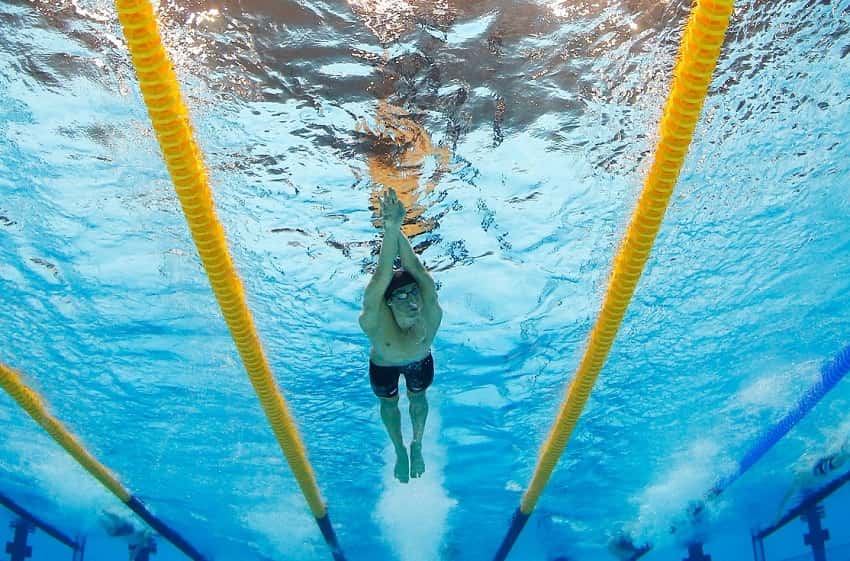
- Kicking on their back with arms at the side (works undulation)
- Kick on their side (works both phases of the kick)
- Kicking on their front, fast, with resistance (eliminates dead spots in the kick, boosts force).
Have a kick count ready for this set (i.e. “3 kicks per wall”) because from meter one we are working the walls.
- 400 choice swim and drill – hold kick count on all walls (open turns okay)
- 6×200 dolphin kick on back with fins, arms at side – fast. Hold kick count. Take 60s rest after each rep.
- 100 swim easy reset
- 12×50 dolphin kick on side (fish kick) with fins – fast. Alternate left/right side by 25. Take 30s per rep.
- 100 swim easy rest
- 16x15m dolphin kick fast with resistance (small drag chute or Drag Sox) on your front. Take 30s rest per rep.
- 100 swim easy cool down
Bob Bowman, who has coached some of the most prolific dolphin kickers in history, favors this “assorted menu” approach for helping swimmers learn how the kick works.
“I like to do a lot of kicking on their side in a streamline, I like to do kicking on their back, we do vertical kicking, so our athletes are going through a large menu of things that will help them develop that feel for what the real dolphining motion is,” says Bowman.
The Descending Rest 100 Pace Challenge Workout (60-90 minutes)
When the goal is coming back fast in 100 events, it’s all about managing lactate, fatigue, and technique that is coming apart like a cheap swimsuit.
This set challenges you to hit 100 pace over 50 at progressively decreasing amounts of rest. At first, with plenty of rest, it’s doable (still hard).
But as rest goes down, lactate pules up, and fatigue starts taking over, the challenge is maintaining your stroke (and dignity).
The set was a favorite of Michael Phelps, who did the set countless times over the years.
Michael Phelps was also a big fan of this set:
“That set is awesome! Came from the Aussies…. Done it 100s of times!”
It’s short on yards but high on metabolic stress, so balance with lots of recovery. The intervals were originally written up by the late Richard Quick for elite NCAA swimmers training in a yards pool, so adjust the intervals based on pool length and ability.
- 300 swim – build the 100s + 4×50 drill/swim by 25 + 4×25 swim build to 95% effort
- 10×50 swim @ 100 race pace
- 4 @ 1:30
- 1 @ 1:20
- 1 @ 1:10
- 1 @ 1:00
- 1 @ :50
- 1 @ :40
- 1 @ :30
- 6×100 choice swim smooth (25s rest)
- 10 deep water bobs + 5 minute hot tub
The Progressive Threshold Builder (90 minutes)
A defining attribute of elite swimmers is their ability to change gears and speeds when necessary. Over the course of this training session, you’ll be tested across a variety of intensities and speeds.
It’s built around legendary coach Jon Urbanchek’s color-coded energy zone system — a framework he developed at the University of Michigan that assigns a color to each training intensity, giving swimmers precise physiological targets instead of just swimming “hard” or “easy” and training by the seat of their Speedo.
The workout systematically walks you through four escalating energy zones, starting in relatively comfortable aerobic territory and finishing above anaerobic threshold.
Aerobic development is usually considered slow and easy, but this has some teeth.
- 300 swim choice + 3×100 kick/swim desc 1–3 + 3×50 desc 1–3
- 4×200 (White–EN-1) — 10–20 seconds rest. Aerobic comfort zone.
- 6×150 (Pink–EN-1+) — 10–15 seconds rest. Working, not suffering.
- 8×100 (Red–EN-2) — 10–15 seconds rest. This is where the biggest fitness gains happen.
- 10×50 (Blue–EN-2+) — 15–30 seconds rest. Finish strong, hold technique and stroke length.
- 200 easy choice
| Color | EN Zone | Heart Rate | What It Feels Like |
| White | EN-1 | 120–130 bpm | Comfortable, sustainable |
| Pink | EN-1+ | 130–150 bpm | Working, not suffering |
| Red | EN-2 | 150–170 bpm | Threshold — the edge of what your aerobic system can hold |
| Blue | EN-2+ | 160–180 bpm | Above threshold, digging in |
The Katie Ledecky Threshold Workout (90 minutes)
Modeled after some of the sets and training that Katie Ledecky did in the run-up to her dominant performance at the Rio Olympics, the threshold set below is geared towards building aerobic capacity.
The goal is to work around the threshold zone—where swimmers are working really hard but can still sustain speed over time.
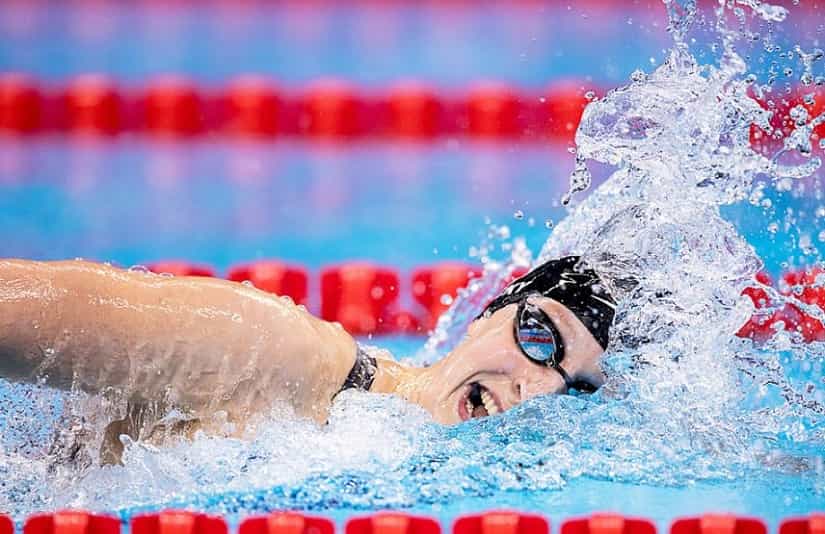
It’s one of the best ways to elevate your aerobic capacity to be successful in events from 200-1500m in the pool.
- 300 swim + 200 kick + 100 choice
- 4×50 swim build + 4×25 kick fast
- 3 rounds:
- 1×300 negative split
- 3×150 strong
- 3×100 fast
- 6×25 all out
- 60 seconds between rounds
- 200 easy cool down
The Super-Set Breaststroke Swim Workout (80 minutes)
Looking to power up your breaststroke? This swim workout has you covered. The main set of the workout was submitted by two-time Olympian and former US Open 100-yard breaststroke record holder Mike Alexandrov.
He loves this set as it mirrors super-set training in the gym—pairing a heavier lift (pulling in the water) with increased intensity/speed. This comprehensive approach is great for building a stronger, faster breaststroke.
The workout uses intensity descriptions that are based off of legendary swim coach Dave Salo’s gears system.
Higher the gear, higher the intensity:
Intensity Guide (Salo Gears System)
- 1st gear — Easy/warm-up
- 2nd gear — Smooth
- 3rd gear — Strong and controlled
- 4th gear — Hard race-pace effort
- 5th gear — Maximum sprint
- 800 warm-up: 200 free swim, 200 kick choice, 200 IM drill, 200 IM swim build each 50
- 300 pull (pull buoy and paddles) – Alternating 25 choice, 50 breast @ :20 seconds rest (4th gear on the breaststroke)
- 2×150 swim – First and last 50 breast, middle 50 choice @ :20 seconds rest (4th gear on the breaststroke)
- 3×100 breast swim with paddles – Descend 1-3 @ 30 seconds rest (build each one and 5th gear on the 3rd one)
- 4×75 swim @ 40 seconds rest (1st 75 = last 25 5th gear, 2nd = last 50 5th gear, 3rd 75 all fast, 4th = find way to go faster!)
- 6×50 paddles descend 1-3 @ 30 seconds rest
- 8×25 breast swim – 1 easy, 1 fast @ 30 seconds rest
- 200 choice swim easy
The Backstroker’s Super Pack Workout (75 minutes)
Fast backstrokers are efficient backstrokers—they have a longer entry and catch, maintain stroke length under fatigue, have a more powerful catch, and utilize their underwaters.
This workout targets all four of those things.
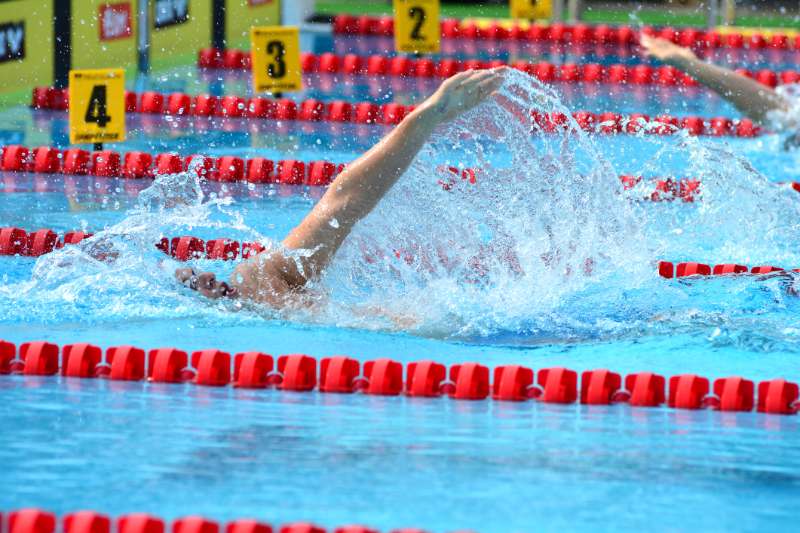
In terms of underwaters, backstrokers tend to be dolphin kick masters, kicking out further underwater than other strokes—particularly in 200m races.
World Championship data shows longer underwater distances are strongly associated with faster performances (Veiga et al., 2016).
- 600 choice swim/kick/drill by 100
- 8×50 alternating freestyle cruise, backstroke build
- 3-5 rounds:
- 4×25 backstroke with ankle band (focus on strong catch)
- 6×50 backstroke swim focus on distance per stroke – Swim at 80% velocity taking as few strokes as possible
- 75 backstroke swim fast (kick count +1 on every wall)
- 25 easy at the end of each round
- 100 easy to reset
- 8×100 as 50 freestyle smooth, 50 backstroke fast (use kick count +2 on both walls)
- 100 double-arm backstroke cool down
A Swim Workout for Building VO2max The Smart Way (90 minutes)
VO₂max sets the ceiling for how fast you can swim while still relying on your aerobic system. The higher it is, the longer you can hold speed without fading.
The workout targets that ceiling directly—training you to lock into a fast, sustainable pace and stay there.
Before doing the workout, you will need to find your VO2max pace. The simplest way to do it without a lab or a team of scientists is to swim 4-6 minutes as fast as you can (400-500 for most swimmers).
Research on elite swimmers shows time at VO₂max pace typically falls within this ~4–6 minute window, making it a practical benchmark for training intensity (Fernandes et al., 2008).
- 800 swim/kick/pull swim build by 200
- 2×50 freestyle at 90% effort
- 100 easy to reset
- 400 or 500 for time to get your 100 pace
- 100 easy to reset
- 4×150 at target pace – 20s per rep
- 100 easy
- 6×100 at target pace – 20s per rep
- 100 easy
- 12×50 faster than target pace – 20s per rep
- 200 easy
The Top End Speed Swim Workout (45-60 minutes)
Speed in the water is simple to develop but swimmers often over-complicate it.
An effective sprint workout has enough rest to replenish phosphagen stores, maintain peak power throughout, and incorporates resistance to overload the movement.
The goal is pure speed, so don’t be afraid to take too much rest between repetitions.
- 600 warm-up as swim/kick/swim build by 200
- 4×50 freestyle descend effort 1-4
- 4x10m swim at 95% effort with light resistance (Drag chute or power tower)
- 2 minutes rest
- 6x15m sprint with moderate resistance (Drag chute or power tower) – minimum 90 seconds rest between repetitions
Use moderate load/resistance to ensure that you are still moving forward, using the same drag forces in unresisted swimming.
An Advanced Resisted Sprint Set for Peak Power and Speed (90 minutes)
This advanced sprint swim set uses resisted swimming to increase force production and unresisted sprints to convert that power into speed. The result is higher-quality sprinting with better carryover to racing.
The goal is speed, not endurance or lactate tolerance. Don’t skimp the rest.
In terms of pure enjoyment, pairing resisted + unresisted sprints potentiates your muscles–the unresisted sprints will feel great, like you are getting shot out of a cannon.
- 600 with fins as 200 swim, 200 kick build, 200 choice drill
- 4×25 freestyle swim with medium drag chute at 90% effort – 45s rest per rep
- 100 choice to reset
- 3×10 strokes at 95% effort with heavy resistance – 90s rest between reps
- 2 mins extra rest
- 2×15 sprint unresisted – 90s rest between reps
- 100 kick easy
- 3×10 strokes at 95% effort with medium resistance – 90s rest between reps
- 2 mins extra rest
- 2×15 sprint unresisted – 90s rest between reps
- 100 kick easy
- 3×10 strokes at 95% effort with low resistance – 90s rest between reps
- 2 mins extra rest
- 2×15 sprint unresisted – 90s rest between reps
No warm-down after the hard work is wrapped up. The last thing your body should feel is pure, blinding speed.
The Ultimate Power Rack Sprint Workout (60 minutes)
For sprinters, this session is all about building more speed and power. Instead of going full load, maximum speed, swimmers will use variable load. Slightly less weight on the way up and down the ladder of the main set.
This promotes more neurological adaptations compared to steady-load sprint training (Gonzalez-Rave, 2018). Like all maximal effort swimming, take full rest between repetitions and use excellent technique.
- Dryland activation (planks, dynamic stretches, jump rope, plus 2×3 med ball slams)
- 300 swim choice
- 3×50 swim build
- 2x15m controlled fast (85% intensity) with medium resistance on the power rack – controlled fast
- 3 minutes rest
- 6x15m max effort on the power rack on 3 minutes.
- 1 repetition at 50% of 1RM
- 1 repetition at 60% 1RM
- 2 repetitions at 70% of 1RM
- 1 repetition at 60% of 1RM
- 1 repetition at 50% of 1RM
The 1RM load is how much weight you can put on the rack while still moving forward. The warm-up is relatively short but is hyper-focused—increase blood circulation and prime the muscle groups for pure sprinting.
The Dirty HIIRTY Swim Workout (60 minutes)
HIIRT—high-intensity interval resisted training—combines the resistance of added overload with a modified Tabata protocol that uses short, maximal efforts on quick rest turnaround.
Swimmers pair high-intensity resistance efforts with a modified Tabata-style protocol. Short efforts, short rest, for five repetitions, with lots of rest between rounds before going again.
- 400 swim choice + 4×50 kick desc 1-4 + 4×25 freestyle swim with light resistance – build each rep to 95%
- 5×5 seconds resisted sprint, all out + 10s rest between repetitions
- 2:00 rest
- 25 unresisted sprint from the blocks
- 100 easy
- 5×10 seconds resisted sprint, all-out + 10s rest between repetitions
- 2:00 rest
- 25 unresisted sprint from the blocks
- 100 easy
- 5×20 seconds resisted sprint, all out + 10s rest between repetitions
- 2:00 rest
- 25 unresisted sprint from the blocks
The different repetition lengths help target the stroke rates and physiological responses of the 50-100 events, respectively.
It’s also a way to quickly generate large amounts of lactate. A study (Sengoku et al., 2014) with elite Japanese swimmers saw that swimmers produced comparable lactate levels compared to other longer sets commonly used by swim coaches (e.g. 8×100 all out on 10 minutes.)
A Swim Workout for Pacing Control (75 minutes)
One of the most underappreciated skills that swimmers should develop is pacing. Being able to properly control their effort when swimming, whether it’s pacing the 100 freestyle properly or longer races like the 400 free or the mile, energy management separates
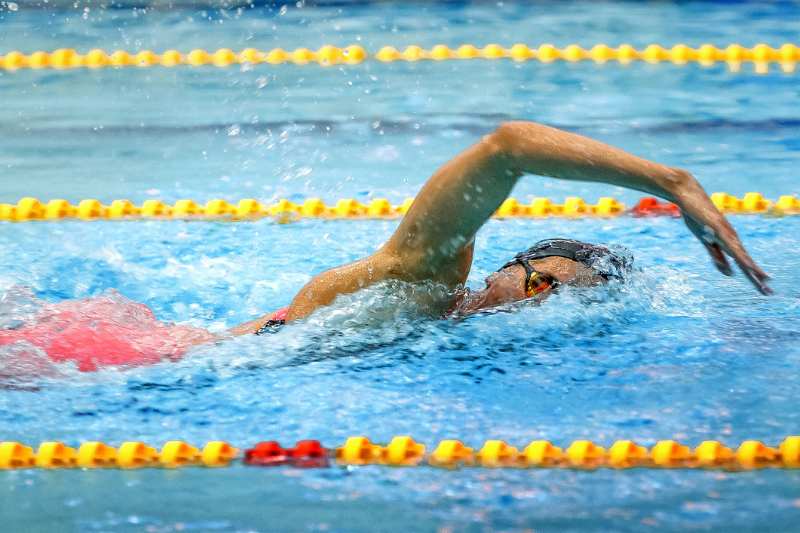
And this starts with learning how pace feels at different levels of fatigue and distances. The workout is designed specifically to reduce pacing errors in swimming.
The main set requires a FINIS Tempo Trainer Pro—a simple metronome device that can be set to target stroke rate or pace.
In the case of this practice, we are going to se a target time for each 50 freestyle (i.e. 35 seconds). Swimmers should aim to turn at the first 50 matching this time and also matching the pace on the second 50.
- 300 swim choice + 4×50 swim build
- 5×100 freestyle swim with metronome (target pace)
- 1×100 freestyle swim without metronome (match the pace)
- 4×100 freestyle swim with metronome (target pace)
- 1×100 freestyle swim without metronome (match the pace)
- 3×100 freestyle swim with metronome (target pace)
- 1×100 freestyle swim without metronome (match the pace)
- 2×100 freestyle swim with metronome (target pace)
- 1×100 freestyle swim without metronome (match the pace)
- 1×100 freestyle swim with metronome (target pace)
- 1×100 freestyle swim without metronome (match the pace)
- 4×50 faster than pace
- 100 swim easy
This type of swim training works well. A study (Fassone et al., 2025) with competitive swimmers showed that they saw immediate and meaningful improvements in unguided swimming pace.
After just one session, swimmers significantly reduced pacing error and variability when swimming without the metronome—and these gains were maintained across the week and retained for up to 10 days, whereas traditional feedback showed little to no short-term improvement.
Advanced Endurance Swim Training (90 minutes and up)
Swim workouts made for distance lean heavily on volume—long, grinding swims that build lots of general fitness but don’t always translate to race speed.
A race-pace-driven swim session inspired by the training of one of the best milers on the planet, Australia’s Kieren Perkins, swimmers will chase and master specific race targets.
This distance swim workout features a lot of high-quality aerobic work done at or faster than 1,500m race pace, with just enough rest to hold speed.
- 600 choice as 200 swim, 200 kick, 200 pull
- 4×100 desc 1-4
- 3-5 rounds:
- 400 @ strong aerobic / threshold pace – :30 rest
- 300 @ threshold (slightly faster) – :30 rest
- 200 @ ~1500 race pace – :25 rest
- 100 @ faster than race pace – :20 rest
- 100 easy between rounds
- 12×50 freestyle at 1:15 – fast, controlled speed, faster than race pace
- 100 easy
- 6×100 at mile pace or slightly under – :20 rest per repetition
- 200 easy
The Bobby Finke Finisher Set (90-120 minutes)
This set isn’t a full swim workout or even the main set, but a bolt-on to your distance training.
The set is one of the go-to sets for two-time Olympic champion in the 1500m freestyle Bobby Finke.
Finke, who also holds the world record in the 1500m freestyle, is famous for his fast and furious final 50s—the “Finke Finish.” At the Tokyo Olympics, his final 50m in the 1500m (25.78) was faster than the final 50 of the 200m freestyle finalists (!).
The set is typically done after a main set of 16x100s best average in a long course pool, where Finke and his Florida Gator distance teammates would then go inside and swim this set in yards as a “finisher.”
The 100 swim should be done on a relatively tight interval (~10 seconds rest) while the kick portion is about emptying the tank (25-30s rest).
- 500 swim + 400 pull + 300 kick + 200 drill choice + 100 swim build
- Your Choice Main Set
- The Finke Finisher: 20x [100 swim cruise + 50 kick fast]
- 20 deep water bobs and lots of snacks
Adjust to your abilities, training volume, and speeds, but keep the concept the same: smooth swimming on a tight interval followed up with fast kicking to build that rooster-tail kick at the end of your races.
A Swim Workout for a Successful Taper (60 minutes)
When the work is all done, and it’s time to taper and fine tune, swimmers should focus on three things:
- Sharpening feel for the water
- Rehearsing the rhythm of a meet
- Firing up your nervous system with high-quality efforts off the block
This type of swim workout should be used several days to a week out from the competition.
- Meet warm-up – include 4×25 sculling to boost feel
- 5-10 minute break.
- 3 rounds:
- Off the blocks race rehearsal: Sprinters do a 25 fast, 200 swimmers do a fast 50, 400 and up swimmers do a fast 100.
- 5-10 minutes between efforts.
- Warm down—use the same post-race warm down that you will use in competition
This workout is designed around acclimatizing swimmers to the pressure and rhythm of a swim meet. Bursts of swimming with bursts of rest and standing around.
Aim to raise the stakes by racing teammates and getting a taste of the butterflies of competition to normaliz
Key Terminology for Swim Training
The language of swimming is unique and can feel intimidating. Even different swim coaches use different jargon to describe the same type of training or set.
Fear not, my chlorinated friend—here are the basics for understanding how swim workouts are written:
- Distance – A “50” means two laps of a short course pool (25 meters or yards), or one length of a long course pool. Repetitions in swimming are described by distance. For example, 6×50 means six repeats of 50 meters or yards.
- Interval (send-off) – The time you leave on. For example, a 50 on 1:10 means you have 1:10 to complete the swim, and whatever time is left is your rest.
- Rest – A fixed break after each repeat. For example, “:20 rest” means you rest 20 seconds after finishing, regardless of how fast you swam.
- Build – Gradually increase intensity within a single repeat or across a set. A 50 build means you start easy and finish fast. A 4×100 build means each repeat gets faster.
- Descend – Another way to say build. 4×100 desc 1-4 means the same thing. First one is easy, second is a little faster, and so on.
- Drill – Technique-focused swimming designed to improve specific parts of the stroke. Single arm freestyle, or long dog paddle, or closed fist swimming are all drills.
- Kick – Isolating the legs with the use of a kickboard.
- Pull – Swimming with a pull buoy (and sometimes paddles. Emphasizes upper body technique and strength.
Once you have a handle of the basics, it’s time to learn how to build a swim workout that delivers results. Read our guide to how to structure a swimming workout.
What Gear Do Swimmers Need for Training?
You don’t need a ton of gear to get started, but a few key pieces of equipment can make swim training more enjoyable and effective.
Swimsuit. Form-fitting, comfortable, durable. Look for a swimsuit that has mostly polyester, it’s chlorine-resistant and won’t fade.
Swim goggles. A must-have. A good set of swim goggles helps you see the pace clock, other swimmers, and the wall. Pick a set that matches the environment (e.g. mirrored lenses for outdoors), are comfortable, and don’t leak.
If you’re looking for a new set of swim goggles, we’ve put together a comprehensive guide. Read our comparison of the best swim goggles for every kind of swimmer.
Swim cap. Protects hair from chlorine, keeps hair out of eyes, and common courtesy to other swimmers as it keeps your hair from floating off into the pool.
Kickboard. Isolate the legs and work on kick conditioning and technique.
Pull buoy. A floatation buoy placed between the legs to focus on upper body swimming.
Swim fins. Great for building leg strength, improving body position, and making technique work easier. Also—very fun!
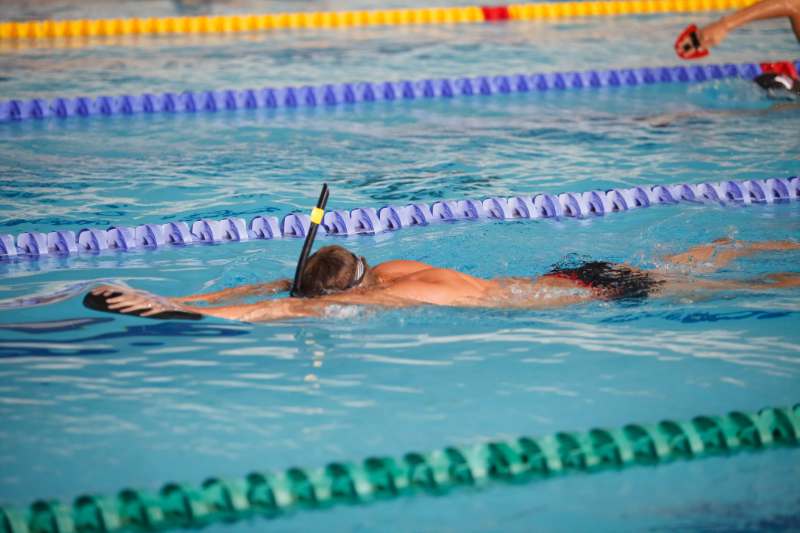
How long should a swim workout be to get a good workout?
Each individual is different, but you should aim for 45 to 60 minutes of swimming to ensure that you have a proper warm-up, a main set (the “meat and potatoes” of your swim workout), and some time to cool down.
One study (Lee & Oh, 2015) found that swimming for 60 minutes, three times a week over a period of 12 weeks significantly reduced overall body fat, increased cardiovascular endurance, and even improved flexibility.
Wrapping Things Up
Swimming workouts are a great form of physical exercise–the breath restriction of swimming, low impact nature means you can train longer, and the endless variety means you will never get bored.
But the best swim training does more than just leave you tired and hungry. They’re the ones that make you faster and more skilled in the water.
Swimmers who improve train with focus and purpose when they hit the water. With the swim workouts above, you’ve got lots of templates and ideas for how to structure a high-quality workout that drives results.
Happy swimming!