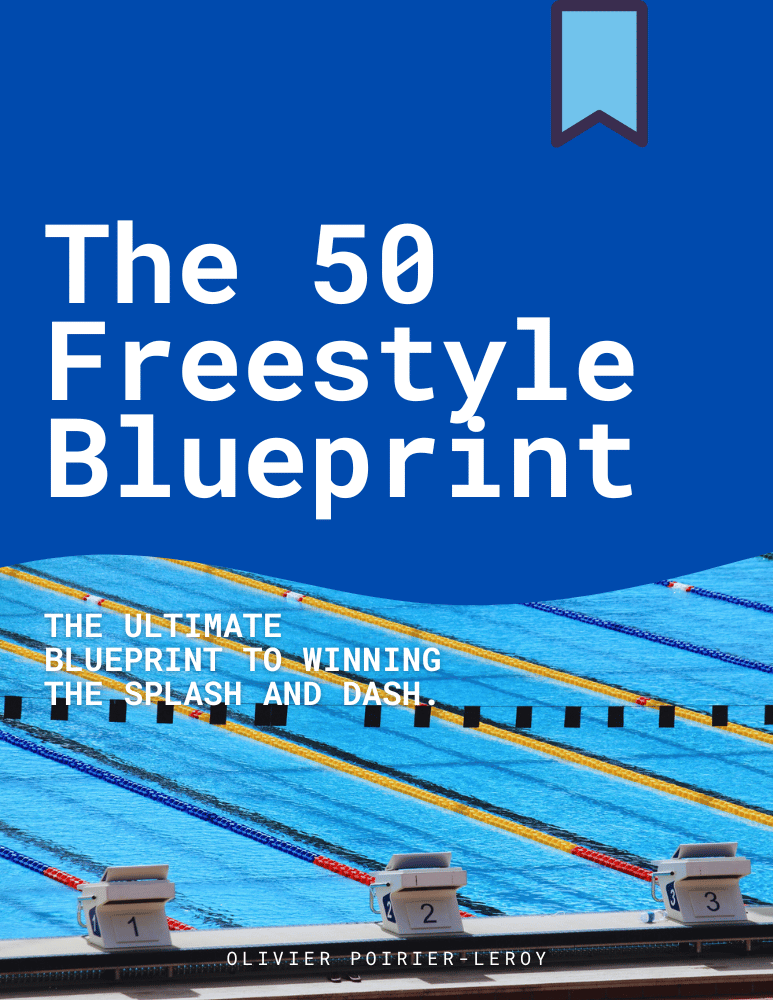


Curious how the fastest man in the 50 freestyle prepares for the splash and dash? Here’s a look at what Cam McEvoy is doing in training to win the fastest race on the Olympic program.
Cam McEvoy’s dominance in the 50 freestyle was fueled by a complete reinvention of how he trained for the event.
After years of grinding through high-volume training (he was an open water swimmer as an age grouper, after all), McEvoy pivoted to a strength-focused program that reduced yardage in favor of pure speed.
This article is part of our series on sprint freestyle. Read our complete guide to freestyle sprinting here.
He traded in the 30k weeks of volume for very brief sessions in the water and more time in the gym.
The results have been staggering. McEvoy won the 50 free at Worlds in 2023 in 21.06, the second fastest textile time in history and a massive personal best time. Won gold in Paris. Defended his world title in 2025.
And then at the China Open in spring of 2026, McEvoy broke the super-suit-era 50m freestyle world record, swimming a jaw-dropping 20.88s.
Olympic gold medalist. World champion. And now world record holder.
Here’s a look at some of the things that McEvoy is doing in training to dominate the 50 freestyle.
The Keys to Cam McEvoy’s Success in the 50 Freestyle
Cam McEvoy rebuilt his training from the ground up with one goal in mind: pure, unfiltered speed. Here’s an overview of some of the things behind his hyper-elite 50 freestyle:
- Train sprint technique
- Build strength in the gym (and pool)
- Kick like a sprinter
- Warm-up for high-performance
- Recover optimally
- Track the things that matter
Let’s zoom in on each and discuss how swimmers and coaches can adapt and learn from McEvoy’s success in the splash and dash.
Trains a sprint technique
One of the ongoing controversies around Cam McEvoy’s training and preparation is the reduced aerobic component. (And by aerobic, I mean it is bye-bye, gone.)
In interviews, McEvoy has detailed this significant reduction in yardage, with pool sessions rarely cresting over several hundred meters (you read that correctly).
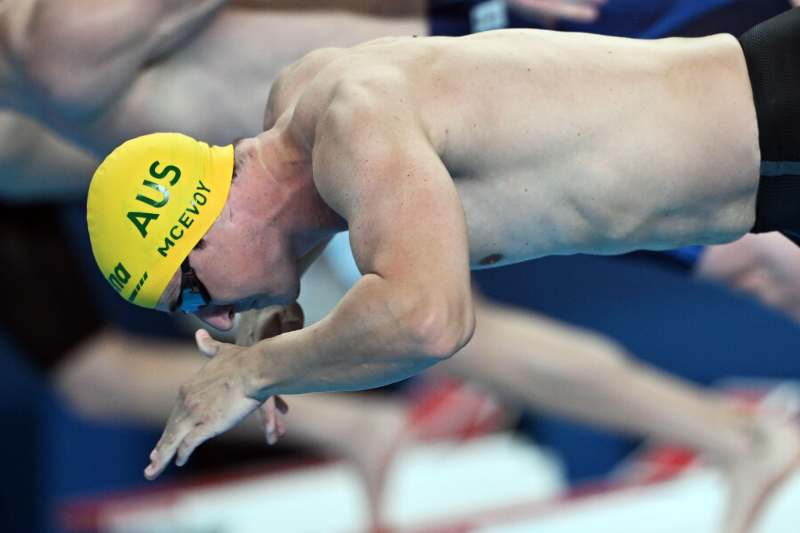
And while there is a lot of spirited debate how much aerobic work sprinters need (if you also race the 100 freestyle, it’s definitely essential), what matters most is whether you are sufficiently training sprint technique.
This is important because sprint technique is vastly different from “regular” freestyle:
- Stroke tempo (much higher)
- Stroke distance (slightly less)
- Body roll (shoulders roll the same, hips stay flatter)
- Shoulder roll velocity (way faster)
- Kick amplitude (narrowed)
- Glide (basically zero)
- Pull path (straight back, shortened exit)
- Body position (much higher, head not submerged)
- Stroke coordination (overlapping, no “hitch”)
- Kick importance (mandatory)
And so on.
McEvoy’s reduced yardage means that he is exclusively swimming like a sprinter. He’s refining the technique that will carry him to golden finishes in the event and not watering down his sprint technique with endless yards of distance technique.
“You don’t develop technique at speeds away from that [race speed],” says McEvoy. “So if I’m easy swimming, that’s not going to help me keep my race technique and it’s also actually going to take me further away from it.”
One of the reasons that swimmers struggle to master sprinting is that they simply don’t do enough swimming using sprint technique.
They try to sprint with what is essentially a middle-distance freestyle stroke. Or they water down the few meters of sprint technique they do with tens of thousands of meters of distance technique.
McEvoy’s approach prioritizes and protects his sprint technique from competing adaptations and different forms of freestyle technique that don’t help him sprint at his fastest.
Build strength in the gym (and in the water).
McEvoy’s training approach has meant less time in the water and more time in the gym.
This includes some of the more standard strength training exercises for swimmers, including deadlifts, pull-ups, bench pulls, and other common lifts. But it also includes lots of core training and a focus on building more muscle mass.
“I went from, let’s say, on average 30km a week in the water swimming,” says McEvoy. “And then trying to squeeze out three gym sessions as best you can with that type of workload to probably 2km at most in the water per week, and a lot more of an emphasis on the gym side of things.”
This approach means he can spend more time building strength and power in the gym, and then having those characteristics more effectively land into his stroke in the water.
“So you can actually train that new muscle and have that new strength be turned into velocity within the water,” said McEvoy.
This approach—building strength in the gym, transferring that strength to the water through resistance tools like chutes and racks, and then converting it into elite-level speed—is supported by research.
A meta-analysis by Wang et al. (2025) reviewed 36 studies involving swimmers and dryland training to determine which resistance training methods produced the best results. The clear winner: combining strength training in the gym with resisted swimming in the pool.
Get stronger in the gym. Get stronger in the pool. Get faster times on the clock.
Kick like a sprinter
Cam McEvoy has an absolute motorboat of a kick. It gives him a stable platform to drive shoulder and trunk rotation while sprinting and adds thrust to his stroke.
Unlike distance swimmers, a fast, thundering kick is essential for sprinters:
- A study (Strzala et al., 2021) showed that a tethered kick test better predicted 50m freestyle times than a tethered pull test or several common dryland tests.
- Another study (Mourouco et al., 2015) found that 29.7% to 33.4% of mean force in tethered sprint testing came from the legs.
Like other sprint legends, like Alex Popov and Cesar Cielho, who could LCM kick in sub 30 seconds, McEvoy rooster-tails across the pool with a kickboard. On Inside with Brett Hawke, McEvoy noted that he’d dropped a 28.4 seconds 50m free kick with a board and a swim snorkel.
Long course.
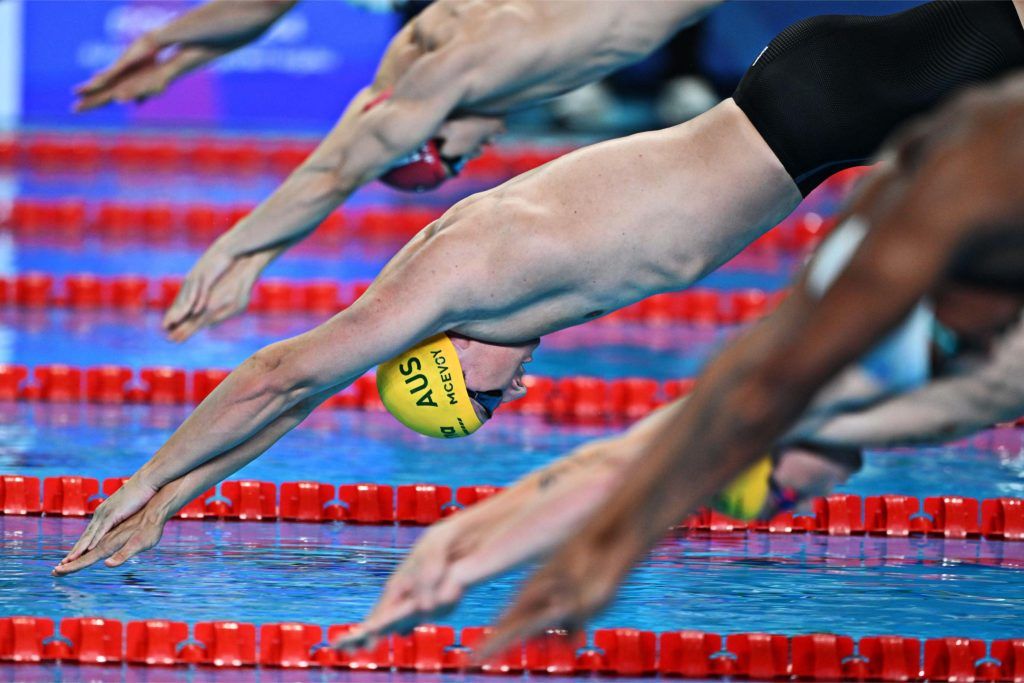
McEvoy doesn’t stop at being fast on a board. He’s all about developing a sprint-specific kick that translates directly to fast swimming.
In an example, a kick set he uses is kicking (without a board) against a power rack while holding a medicine ball underwater. As he kicks at max intensity, McEvoy rotates his shoulders slightly to mimic the upper body and trunk twisting that occurs when sprinting.
“I’ve been looking for a way to specifically train sprint kick without just using a board,” he notes. “It nicely replicates the anti rotational strength you want to feel at the end of the stroke.”
Being able to rip a fast 50 on a board is great and is a general indicator of kick endurance and power. But being able to kick fast while also managing rotation of the body is far more transferable to elite-level sprint freestyle.
Warm-up for performance
Following along with his philosophy of avoiding yardage that isn’t sprint specific, McEvoy does a hyper-focused warm-up that is geared specifically towards performance in his main set of the day.
In an interview on the Gold Medal Mel podcast, he shared the warm-up, which he uses consistently on his days that features pool training:
Part 1: 100-200 with fins easy
Part 2: 5-6 x 15-20m efforts with increasing intensity
- Starts with a large parachute on the first reps, then shifts to bodyweight, and then to fins, going down the strength curve.
- Builds intensity from ~70% to max effort
Part 3: Finishes with three dives off the block
- Easy dive and glide
- 15m sprint
- 25-30m swim, increasing intensity every four strokes
And that’s it.
There are lots of reasons why I love this warm-up, not the least of which include:
- No wasted yards. Every meter has a purpose. There is no filler, no fluff. The warm-up is geared towards performance and not logging an arbitrary number of meters.
- Mixing resisted, unresisted, and overspeed swimming. Layering in resisted and unresisted sprints at different intensities wakes up a broader range of muscle fibers that power sprint performance.
- Priming the nervous system. The hallmark of an effective warm-up is preparing you for the main set (or race). McEvoy’s warm-up targets the precise energy systems that will be used later in the workout.
Even though the warm-up is low on yardage, it’s through-the-roof in terms of focus and purpose.
Prioritize recovery
McEvoy’s training schedule sounds like a dream to any swimmer (or coach) who has lived the typical swimmer schedule of 10x weekly workouts, plus drylands. Perpetual fatigue and soggy swimsuits included.
By cutting down his pool time and focusing on quality versus quantity, McEvoy’s freed up space and time in his schedule to prioritize recovery and mobility, key ingredients for ballistic training in the water and max strength/power work in the gym.
Swimmers are naturally workaholics, and often go overboard when it comes to sprint and power training, whether that means insufficient rest between high-intensity repetitions in the water or not allowing for a recovery window following maximal effort lifting sessions in the gym.
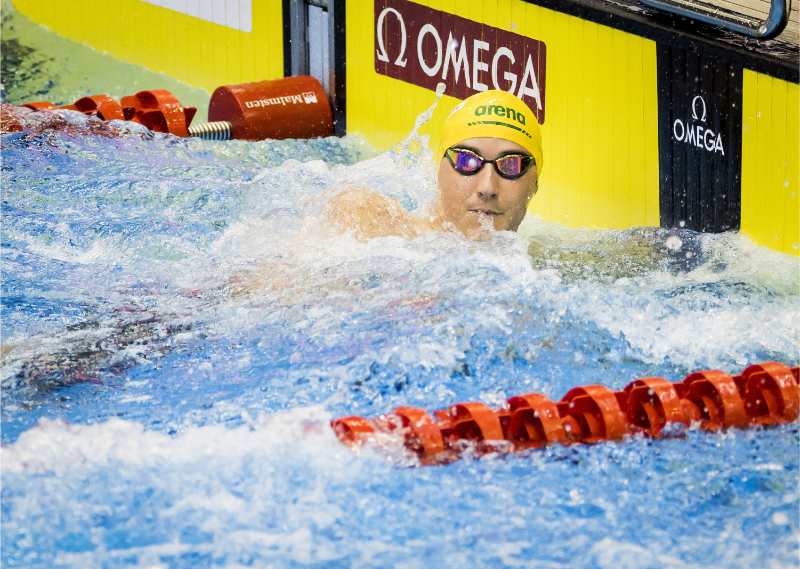
In an example of his schedule prioritizing recovery, during a four-month block of training in 2024, McEvoy focused tightly on strength and power development in the gym. Swim sessions were done just twice a week, with just a series of 10m bursts with fins and resistance on a rack, at 85% effort.
His routine followed a simple but effective rhythm: heavy gym work each morning, mobility and recovery each evening, and a full rest day every third day.
By planning recovery, swimmers can ensure that they are squeezing more high-octane performance from each session instead of limping with fatigue and sub-optimal results from workout to workout.
Track the stuff that matters
McEvoy has always been invested in the data and details of his swimming. No big surprise why—he’s a math and physics major. And this new approach has given him an opportunity to go hard in the paint with data so that he can tinker and fine-tune his preparation and performance.
“Basically, whatever you want to nerd out on, it’ll give you that data,” McEvoy says. “I’ve been doing that for a little over two years. We’ve got almost 2,000 different data points. Full spreadsheets of each rep that I’ve done off the block, and we’ll continue to get that.”
For example, McEvoy’s start has always been quick, but recently he has spent more time working on improving his vertical jump to make it more explosive.
Jumps have repeatedly been shown to be linked to faster swim start performance, leading to increased horizontal force and take-off velocity (Rebutini et al., 2016; Bishop et al., 2009).
And fast starts certainly don’t hurt when it comes to a fast 50 freestyle.
“My best vertical jump a week-and-a-half out of from Paris was 56 cm,” he said. “This year I hit 62 cm.”
McEvoy operates at a stratospheric level when it comes to blistering speed, but the practice of tracking the things that matter most to your swimming—whether it’s attendance, reps at race pace, or total volume—is something that can help swimmers of all speeds.
The Bottom Line
Cam McEvoy’s ascent to the sprint throne, and the slightly unconventional approach he has taken to get there, has been exciting to watch.
And when you break down what he is doing in the water and in the gym, it really isn’t that unconventional.
After all, stuff like:
- Practicing with the technique you are going to use in competition
- Building raw strength and transferring it to the pool
- Kicking like a legend
- Warming up to perform
- Optimizing recovery
- Tracking the things that count
… are things every swimmer should be focused on in training.
So learn from McEvoy, whether you are a 50 freestyle specialist or not, and take your swimming to new heights.
Happy sprinting!