

Level up your sprint speed with these proven sprint swim workouts. Build power, sharpen tempo, and master the mechanics that make you faster on race day.
Getting faster in the pool means spending time swimming fast. That’s where sprint swim workouts come in handy.
Whether you are aiming to boost top end speed, sharpen stroke timing, or build an absolute motorboat of a kick, this collection of sprint sets will help you level up your speed skills.
In this collection, we’ll break down some proven sprint sets that target different aspects of speed in the water, and show you how to add them smartly to your training.
Let’s get our sprinting cap on.
These sets are part of our collection of articles on improving sprint freestyle performance. You can find other resources below.
Sets for Sprint Swimmers
This collection of sprint sets for swimmers include:
- Power Stroke 10s
- Tempo Mastery
- The Superposition Set
- Sprint-Endurance Combo
- Top Gears
- Stroke and Kick Combo
Next up, we will look at each set in more detail, including how it will improve performance, key instructions on doing the set properly, and tips for smarter sprint training.
Power Stroke 10s
Sprinting in swimming isn’t all that complicated. Dive in, swim your brains out, post fast times on the clock. But it is often trained incorrectly.
Mistakes include taking too little rest between efforts (not allowing phosphagen stores to recover), using the wrong type of resistance, or doing too much volume for what should be a pure speed set.
This sprint set nails the essentials of a high-performance set:
- Resistance for increased power output. Added resistance (chute, tubing, power tower) forces swimmers to generate more force per stroke, building a stronger and more explosive pull.
- Lots of rest. Use at least 90 seconds rest between repetitions. The goal is maximal effort. Short rest turns this into an endurance set, not a speed set.
- Semi-tethered. Semi-tethered resistance provides the perfect balance by adding drag while still allowing swimmers to move forward naturally through the water. Tethered swimming can be useful for brute-force training but doesn’t transfer as well to real swimming mechanics.
The set is very short in meters but is very high in neuromuscular demand. Give it the same recovery considerations you would a gym workout.
The set:
6×10 strokes all-out with heavy semi-tethered resistance – 2-3 minutes rest between efforts
In the early days of his new approach to training, Olympic 50 freestyle champion Cam McEvoy did this set with a pair of drag chutes. Being new to resisted sprint training, he was surprised to see how hard it impacted his body:
“I wanted to do more but I could only do six and I just broke down. I got out of the water and went home and had a two hour nap because my nervous system was so fatigued,” said McEvoy.
Keep effort and resistance high, technique awesome, and place a heavy emphasis on recovery.
Tempo Mastery
Sprinters rely on high tempo to rocket them across the pool. At the Paris Olympics, the men’s 50 freestyle finalists averaged 60-65 strokes per minute. In the 100m freestyle, that dropped significantly to 48-51 strokes per minute. Tempo is that important.
Maintaining that kind of turnover, essentially redlining your upper body muscles and coordination skills, is very difficult to sustain. This sprint set tests your ability to hold tempo as distance gradually increases.
After a thorough warm-up and pre-set, get your target stroke rate, a FINIS Tempo Trainer, and let’s get to work:
2 rounds:
- 15m swim at target stroke rate
- 20m swim at target stroke rate
- 25m swim at target stroke rate
- 30m swim at target stroke rate
- 35m swim at target stroke rate
- Take 60-90s rest between repetitions, 5+ minutes between rounds
If you can maintain your stroke rate and continue holding water (not just spinning your arms), increase the challenge by adding light resistance (small chute, DragSox) or nudging your tempo slightly faster.
This set can also be done as a pyramid:
- 15m swim at target stroke rate
- 20m swim at target stroke rate
- 25m swim at target stroke rate
- 30m swim at target stroke rate
- 35m swim at target stroke rate
- 30m swim at target stroke rate
- 25m swim at target stroke rate
- 20m swim at target stroke rate
- 15m swim at target stroke rate
I like this variation as it builds tempo control as the distance ascends and descends. Even though you are fatigued, the decreasing distance will make the tempo feel “easier” on the way down.
The Superposition Set
This progression-style sprint set uses resistance to finetune the arm coordination used at top end speeds. You’ll start with controlled, medium-resistance efforts to lock in the rhythm and timing, then gradually turn down the resistance and increase the velocity.
Sprint freestyle uses a unique coordination pattern. Less glide, faster shoulder rotation, and overlapping arm strokes.
Adding resistance lets you replicate this sprint timing at lower speeds. Around 80–85% effort with a chute or tubing, swimmers begin to show “superposition,” where the arms overlap and the hitch disappears, just like with your sprint technique.
- 16×25 freestyle with medium chute at 80% effort – 25s rest per repetition
- 200 kick/swim reset
- 8×25 freestyle with medium chute at 95% effort — >60s rest per repetition
- 200 kick/swim reset
- 6×15 freestyle blast with small chute at maximal effort – >90s rest per repetition
Skip the warm-down for this set. The last thing your stroke and neuromuscular system should feel in the water is pure speed!
Sprint-Endurance Combo
Sprinters live and breathe in the high-intensity zones, chasing peak speed, power, and acceleration. But a solid aerobic foundation still matters. It promotes faster recovery between workouts, maintains better technique under fatigue, and helps us develop better control and feel of the water.
And while the 50 freestyle is almost purely anaerobic, research shows the aerobic contribution increases tenfold in the 100 freestyle (Seifert and Bardy, 2004).
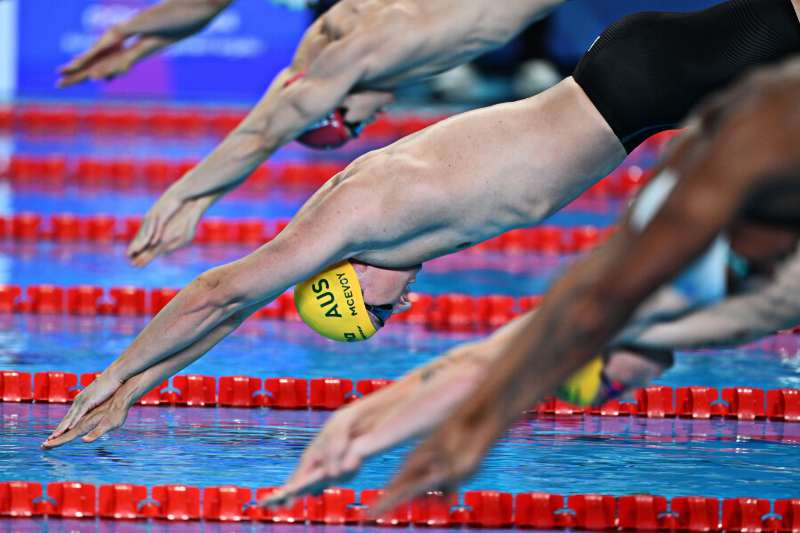
This sprint set hits both energy systems. Start with all-out sprints with generous rest to maximize speed and recovery. After the sprints, take a ~2 minute rest to get lactate to peak. And them move into the aerobic component of the set, teaching your body to process and use lactate as fuel.
- 8×25 fast off the blocks – 2 minutes rest/rep
- Two minutes rest
- 16×100 freestyle swim/kick at aerobic pace – 20-30s rest/rep
The sequencing of the set is the key. Sprint first when fresh and do the aerobic work afterwards.
Top Gears
This sprint set will help you shift gears at higher speeds, sharpening your feel for different intensities and revealing where your stroke starts to slip or “spin out” under pressure.
By changing intensity levels mid-length, you’ll train your ability to control your tempo, accelerate smoothly, and sustain power on race day.
2-3 rounds:
- 4×25 freestyle as: 12.5m at 80%, 12.5m at 90%
- 100 rest
- 4×25 freestyle as: 15m at 85%, 10m at 95%
- 100 rest
- 50 freestyle as: 5 strokes at 80%, 5 strokes at 90%, 5 strokes at 95%, remainder maximal effort to the wall.
Mastering sprint speed isn’t just about going flat-out, but knowing how different intensities and tempos can drive speed.
This set helps you feel those differences. You’ll learn to stay powerful at high tempos and when to throttle down just slightly to retain velocity.
Even world-class sprinters see tempo and velocity drop slightly in the final meters. That’s because the race isn’t a true 100% effort from start to finish. High-performance sprinting lives in the ~95% range that is more controlled chaos than pure all-out effort.
This set helps you find and command those gears so that you can sprint with precision and not panic.
Stroke and Kick Combo
This sprint set is all about connecting your kick to your stroke. You might be able to fly down the pool with a kickboard, but elite sprinters take that kicking prowess and seamlessly plug it into their stroke—syncing a thunderous kick with body roll and explosive arm action without missing a beat.
A powerful kick is also essential for sprinters. In one study with swimmers, 29.7 to 33.4% of total sprinting force came from the legs when swimming against resistance (Morouco et al., 2015). The legs contribute about one-third of propulsion when sprinting, but only if you can connect them properly to your stroke.
This set is all about strengthening that connection. Start with some overkick drill to highlight stroke coordination, move into some high intensity kick/swim, and then finish it off with pure sprint swimming to put it all together.
Focus on a full, thundering kick and smooth arm coordination throughout.
2-3 rounds:
- 12×25 Overkick drill – 30s rest per rep
- 8×25 Freestyle blasters – 30s rest per rep
- 4x25m freestyle all out – on 2mins
- 200 easy
Overkick = Freestyle swim with a six-beat kick and “regular” effort pull
Blasters = Fast kick in a streamline for 15m, then sprint swim the final 10m.
This set teaches your legs and arms to work together to create as much speed and power as possible. The result: a faster, more connected sprint stroke that carries your speed farther down the pool.
Tips for Better Sprint Swim Workouts
Here are some tips to get more from your sprint workouts in the water:
- Prioritize recovery. Sprint swim sets, especially when adding resistance, is demanding. hard on your body. Allow 48 hours between max-effort sessions. Even elite sprinters need 24–72 hours to fully recover and hit peak power again.
- Do sprints early. Sprint sets should be done early in the workout when you are fresh. Sprinting requires fast muscle contractions and neuromuscular response, and loads of swim yardage can blunt those all-important reactions.
- Prime your body for performance. Use a short pre-set at the end of your general warm-up to wake up the right energy systems and neural patterns for top-end speed. For example, doing 2-3 short burst sprints of 15m is a fast and effective primer for main set success.
- Keep things fresh. Sprinting has a simple goal—reach higher top-end speeds and do it for longer. There are lots of ways to achieve this goal without resorting to sprinting at 100% intensity every time. For example, pyramid sets (reps increasing in intensity from 70% to 100%) increase the number of adaptations available to you when sprinting while also reducing the stress of only ever going 100% all the time.
- Track what matters. Beyond the clock, measure what drives speed. Metrics like stroke tempo, race-pace distance, bar velocity in the gym, or jump height for starts give you actionable things to work on at the pool and weight room. Elite sprinters know exactly what they’re improving each session.
- Connect the gym to the pool. Building strength in the gym only matters if it transfer to the water. Use resisted sprint tools (chutes, tubing, or power racks) to bridge dryland power with swim speed.
The Bottom Line
Increasing top end speeds in the pool isn’t about throwing down maximal sprints in the water each and every day. It’s about training speed and power with purpose.
Sprint swim sets should challenge and increase your ability to master stroke tempo, coordination, pair the kick and arm actions, and exert more and more power in your technique.
By combining these sprint sets with smart recovery, tracking the stuff that matters, and integrating your resistance training on land with resistance training in the water, you’ll build a more explosive and race-ready sprint.
Happy sprinting!