
Want a faster 100 freestyle? Learn how to target the right energy systems, fine tune stroke kinematics, pace properly, and more for a blistering race day performance.
Improving your 100 freestyle requires a blend of explosive power, aerobic conditioning, and speed endurance.
Key strategies include training all three energy systems, sustaining race-specific stroke rate without sacrificing stroke length, splitting the race properly, protecting speed through the third 25, building a continuous six-beat kick, maximizing underwaters, and breathing efficiently under fatigue.
The 100 free is fast—but it isn’t just a sprint. It’s a hybrid event that blends explosive power with aerobic capacity and technical precision under fatigue.
Here’s how to train it properly.
How to Swim a Faster 100 Free
Effective ways to improve your 100 free include:
- Train the right energy systems
- Target higher stroke rates
- Split it properly
- Work the third 25
- Build a six-beat kick
- Improve your dolphin kick
- Breathe lots
We’ll also look at some sets specifically designed for boosting 100 freestyle performance.
Train the right energy systems
The 100 freestyle is challenging because it is the most balanced freestyle event in terms of energy systems. Unlike the 50, which is all power, or the 200 events and up, which are primarily aerobic, the 100 taps all the energy systems.
Per Rodriguez and Mader (2011), the 100 free draws roughly:
- Phosphagen (20%)
- Glycolytic (39%)
- Aerobic (41%)
That hefty aerobic contribution is what surprises a lot of swimmers given how much of a sprint the 100 freestyle feels like.
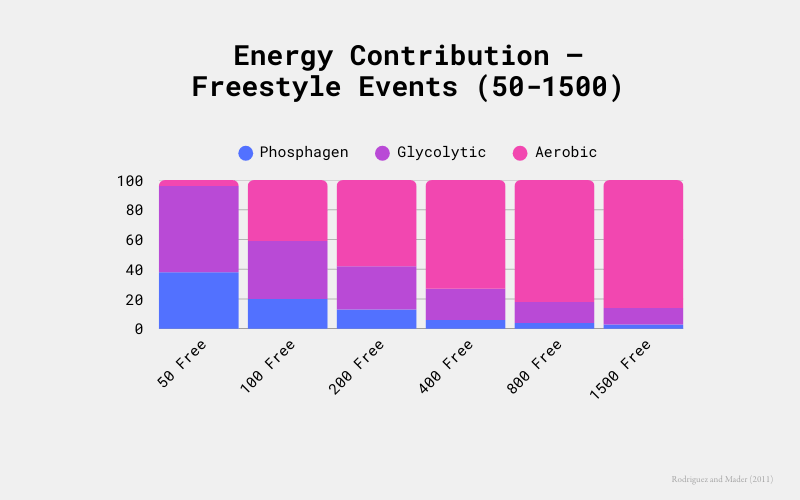
Phosphagen gets you off the block fast, powers the first ~10 seconds, provides the explosiveness off the wall, and powers crisp strokes throughout. The aerobic system takes command on the second half while the glycolytic system is heavily active for a majority of the race.
The unique blend of energy systems at work in the 100 free is one of the reasons this “simple” event is surprisingly complex to master!
Target higher stroke rates
The 100 free sits between the 50 free and 200 freestyle in terms of stroke rate. Nothing matches the 50 for sky-high turnover (55–65 cycles per minute in elite swimmers), and the 200 shifts toward a more measured tempo. The 100 free straddles these extremes.
See also: 50 vs 100 Freestyle – How to Train Both the Right Way
Data from the Paris Olympics gives us a clear idea of what this looks like:
| 50 free | 100 free | 200 free | 400 free | 800 free | 1500 free | |
| Men’s Avg SR (cycles/min) | 62.21 | 51.43 | 42.31 | 41.9 | 40.21 | 40.15 |
The drop from the 50 to the 100 is significant—nearly 11 cycles per minute. And from the 100 to the 200, there’s another ~9 cycle drop.
The 100 is not swum at 50-style redline turnover. But it also isn’t controlled like the 200.
Swimmers should work those higher stroke tempos via:
- Increased intensity – Increase tempo by swimming faster. Instead of banging out endless yardage at slower tempos, add high-intensity intervals (i.e. fast 25s and 50s) to your training and spend more time at higher stroke rates.
- Resisted swimming – Resisted swimming, via a drag chute, resistance tubing, etc., increases force production per stroke. Over time, this allows swimmers to apply force more quickly and reduce time spent in the glide and other non-propulsive phases, supporting higher stroke rates.
- Tempo training – A FINIS Tempo Trainer allows you to precisely target your 100 freestyle turnover. Train at race tempo, slightly above it, and slightly below it. The goal is to internalize the rhythm so you can sustain it under fatigue.
Mindless spinning of the arms isn’t the goal when it comes to working tempo.
It’s building the strength and coordination to hold those higher stroke tempos required for 100 freestyle success.
Split it properly
Even though the 100 free is often treated as a mindless sprint, it’s not. It has very clear pacing constraints.
A study (Robertson et al. 2009) analyzing Olympic and World championship found a consistent pacing profile that used a positive splitting strategy.
- First 50 – go fast
- Second 50 – bring it home ~2 seconds slower than the first 50
Men averaged a 2.06s split differential. Women averaged 1.95s.
Finals at the Paris Olympics replicated this pattern almost perfectly:
- Men: 2.07s
- Women: 1.99s
The fastest 100 freestylers on the planet front-load the race with speed, but within limits. Blow it out by 3+ seconds, and you fall apart. Go out too cautiously, and you never catch up. The 100 rewards controlled aggression.
Work the third 25
Speaking of pacing and strategy, there is one segment of the race that most strongly predicts the medals. And that’s the third 25.
Research analyzing elite 100m freestylers (Gao et al., 2024) showed that velocity during this segment was more predictive of final ranking than the start, velocity over the first 50, or turn performance.
Why?
Because this is where:
- Phosphocreatine is nearly depleted
- Lactate is rising sharply
- Aerobic contribution is peaking
- Stroke rate is getting challenged
The swimmers who can maintain speed through this 25, without breaking down technically, separate themselves from the field.
Build a six-beat kick
A strong, continuous six-beat kick is essential for the 100 freestyle. It directly contributes propulsion, but more importantly, it supports posture, rotation, and stroke stability at high speed.
A study (Seifert et al., 2005) with international-level 100 freestylers showed that they used a six-beat kick through every part of the race.
A properly timed six-beat kick:
- Stabilizes body position, keeping the hips high and reducing drag
- Anchors rotation, allowing you to pull with more ferocity.
- Protects stroke rate, maintaining steady propulsion.
- Prevents speed collapse under fatigue; tired legs increase hip roll, slowing turnover and speed.
As fatigue mounts in the second 50, swimmers often shorten and quicken the stroke to preserve turnover. Stroke length drops, rhythm breaks, and speed slides.
But race data from the Paris Olympics show that elite men’s finalists reduced stroke length by only ~3.5% from the first 50 to the second. This was powered in part by a continuous, well-timed kick.
Fun Fact: Paris Olympic men’s finalists averaged 2.34m per stroke in the 100 free—with only ~3–5% drop from first 50 to second.
Mezencio et al. (2020) further showed that elite swimmers synchronize their arm pull and leg drive more effectively during a six-beat kick, maintaining steady thrust and body alignment. Non-elites struggle with this timing, wasting energy and disrupting flow.
Improve your dolphin kick
For short course swimmers, a fast and powerful underwater dolphin kick is especially essential for a fast 100 freestyle.
When you dive into the water, or push off the wall, you are going faster than surface swimming. Capitalize on this speed with superior dolphin kicks.
Which means:
- Improve the upkick phase – The upkick (when swimmers “recover” the feet in the dolphin kick) is your quickest opportunity for improvement in the UDK. Fast toe velocity in this phase is linked to quicker dolphin kicking (Atkinson et al., 2014).
- Add resisted dolphin kicking – Use a tether or short resistance tubing belt and perform 4–5 rounds of maximal-effort dolphin kicking to build kick power and sharpen phase timing.
- Use a kick count – You have a chance to work on your dolphin kicks on every push-off. Use those opportunities to improve with a kick count. Start with something manageable (i.e. two kicks on every wall) and steadily increase as you improve.
Proficient dolphin kicking is essential when you consider:
- 30% of the 100 freestyle can be done underwater in a long course pool
- 60% in a short course meters pool
- And ~66% in a short course yards pool
Work those underwaters, and you’ll have them at your disposal when stepping up on the block.
Breathe lots
The 100 freestyle is not the 50—you can’t hold your breath and hold on for dear life. Roughly 40% of the fuel needed for success in the event comes from the aerobic system, especially over the second half of the race. Oxygen delivery matters big time.
Breathing frequency varies—men tend to breathe every two strokes while women breath slightly less frequently.
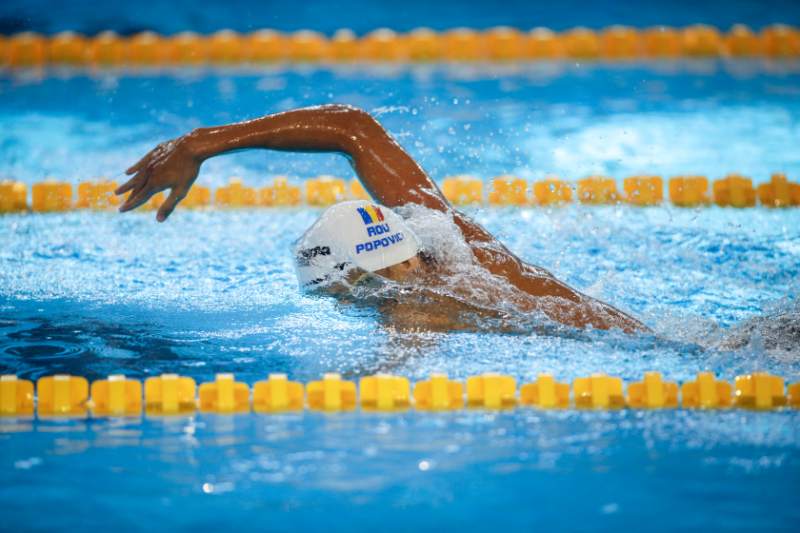
At the London Olympics, gold medal winner Nathan Adrian took 30 breaths, mostly breathing every two, on his way to winning the 100 free. Women’s champion, Ranomi Kromowidjojo, breathed mostly every four.
Elite 100 freestylers breathe more than most swimmers expect. But here’s the real challenge: breathing without wrecking your stroke and slowing you down.
Pedersen and Kjendie (2006) showed swimmers go faster when they don’t turn the head to breathe. Breathing increases drag, increases body roll toward the breathing side, and lengthens the pull by ~8%.
The solution isn’t breathing less but breathing better:
- Stronger inspiratory muscles.
- Controlling body roll.
- Stable pull path.
- Minimizing catch-up drift.
Master the quick breath—Adrian was exceptional at this, turning his head so fast you’d need slow-mo to tell he’d taken air.
Slurp down lots of air and do so in a way that doesn’t break your stroke or slow you down.
Sets for a Faster 100 Freestyle
Swimmers looking to excel in the 100 freestyle should focus on high-intensity interval training to mirror race intensity, hitting the gym to build strength and stability, and tacking on resisted sprint training to increase peak power.
Below are some sample sets that target the specific physiological components of an elite 100 freestyle—explosive speed, lactate tolerance, and sustainable tempo under fatigue.
Set 1 – Predict and Prepare
4×50 freestyle fast on 2:00
This is a classic race pace set for the 100 freestyle that prepares and predicts performance. Terzi et al. (2021) found that this set strongly correlated with 100 freestyle performance.
It targets the same factors that goes into a fast 100 free, including high velocity, stroke rate, and blood lactate.
Set 2 – Descending Rest, Rising Lactate
10×50 fast – target time: 100 race pace
- 4 @ 1:30
- 1 @ 1:20
- 1 @ 1:10
- 1 @ 1:00
- 1 @ :50
- 1 @ :40
- 1 @ :30
A brutal twist on the classic race pace set, popular with a lot of elite swim programs, most notably the late Richard Quick (6-time Olympic coach, 12-time NCAA champion coach).
The greatest swimmer of all-time—and also an elite 100 freestyler—Michael Phelps, was also a big fan:

As rest drops, fatigue spikes. The goal is simple: hold stroke rate, body position, and composure as lactate rises—just like the back half of a 100.
Intervals were designed for elite NCAA athletes in a short course yards pool, so adjust accordingly.
Set 3 – Smooth Aerobic and Race Pace
This 100 freestyle set, 2,000m/y in length, mixes a lot of steady aerobic freestyle with pace efforts. Similar to the Quick set, rest goes down as intensity takes over.
40×50 as:
- 16 @ 1:00 – every 4th fast
- 12 @ 1:15 – every 3rd fast
- 8 @ 1:30 – every 2nd fast
- 4 @ 2:00 – all fast
The non-fast 50s are to be swum smooth with excellent technique—not sloppy and slow.
The final round is where things really get interesting, testing your mental toughness and ability to keep your stroke and speed deep into accumulated fatigue.
The Bottom Line
The 100 freestyle is such a compelling event because it demands so much from swimmers. You can’t hide behind pure speed or Energizer-bunny levels of endurance.
You need elements of both—some of that white-water and bulkhead rattling speed of the 50 and the endurance of longer events.
So:
- Train all three energy systems.
- Build sustainable tempo.
- Protect your stroke under fatigue.
- Train smart and fast in training
Do that consistently and the 100 stops being frustrated chaos and more controlled speed and excellence.