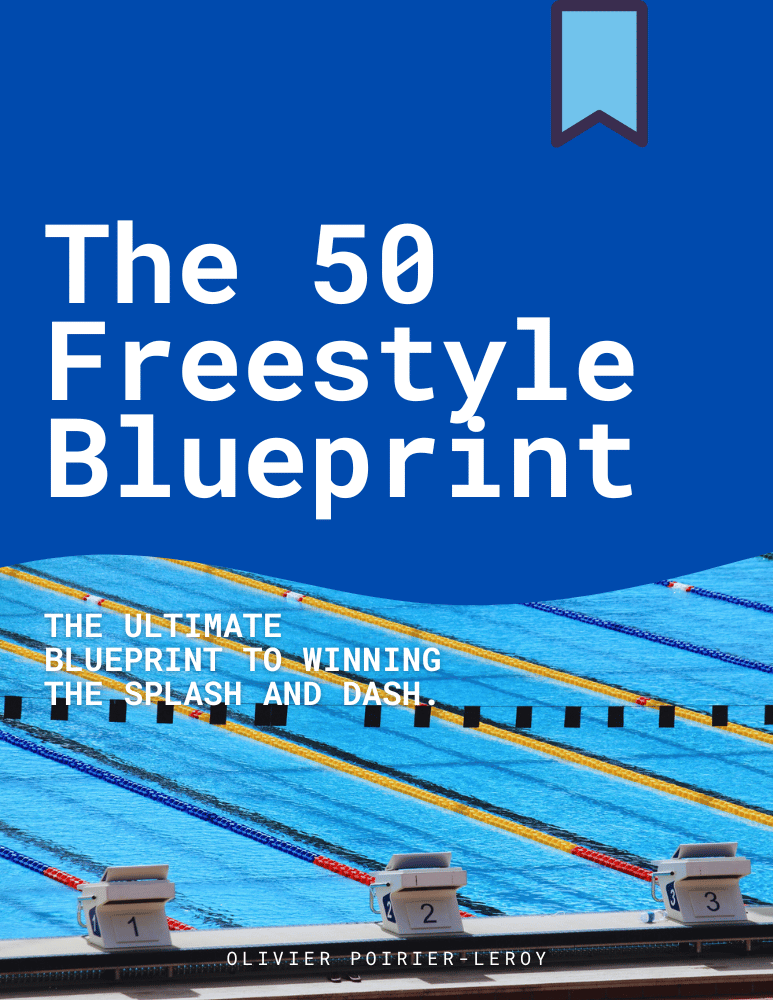
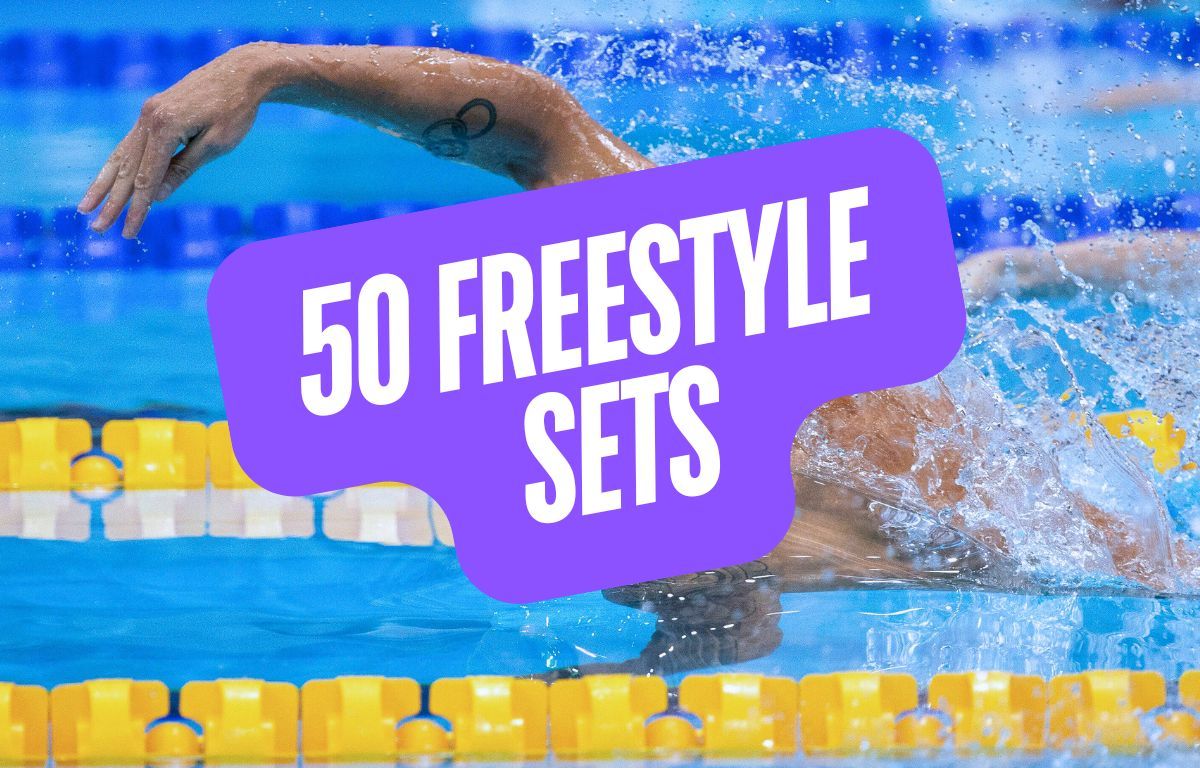

The best sets for 50 freestyle focus on developing peak power, sustaining stroke length, explosive starts, and mastering high stroke rates.
This collection of sets for the 50 freestyle targets all of the stuff that goes into mastering the splash and dash.
From resisted sprint training, stroke count sprints, explosive starts and breakouts, to maximal power training in the water, these sets arm swimmers with the power and coordination to dominate the 50 freestyle.
Let’s dive in.
These sets for the 50 freestyle are part of our series on improving sprint freestyle performance. Read more below.
Sets for a Faster 50 Freestyle
- Peak Power
- Top-end Velocity
- Paddles and chute power
- Power pyramid
- Stroke length under speed
- French Contrast starts
We’ll also discuss some fundamental principles of sprint freestyle training so that you can build sets of your own that will drive better results in the 50 freestyle.
Peak power
Goal: Maximum force production with sprint mechanics
The Set:
- 6x15m all out on 3:00
- Max resistance (i.e. large chute) with forward movement
- Rest: 300 between reps
Why it works:
- Use semi-tethered resistance (rack, chute, tubing) — not full tether. Semi-tethered better replicates real race mechanics and drag forces.
- Power drops quickly when fatigue creeps in, so keep output brutally high. The set is designed to increase your peak power ceiling.
Top end velocity
Goal: Potentiate speed and sharpen race tempo
The Set:
Part 1 – Heavy resistance > Speed
- 3×10 strokes at 95% effort with heavy resistance – 90s rest between reps
- 2 mins rest
- 2×15 sprint unresisted – 90s rest between reps
- 100 kick easy
Part 2 – Medium resistance > Speed
- 3×10 strokes at 95% effort with medium resistance – 90s rest between reps
- 2 mins rest
- 2×15 sprint unresisted – 90s rest between reps
- 100 kick easy
Part 3 – Light resistance > Speed
- 3×10 strokes at 95% effort with light resistance – 90s rest between reps
- 2 mins rest
- 2×15 sprint unresisted – 90s rest between reps
Why it works:
- The goal is speed, not endurance or lactate tolerance. Don’t skimp on the rest.
- Alternating resisted and unresisted work potentiates the nervous system so the stroke feels electric when resistance comes off.
- Skip the warm-down on this set. The last thing your stroke and nervous system should feel is potentiated speed.
Paddles and chute power
Goal: Increase sprint velocity and stroke efficiency
The Set:
3 rounds:
- 6x15m freestyle all-out with paddles + chute
- 60s rest after each repetition
- 5min rest between rounds
Alternate with:
- 2x [4×25 fast with paddles and chute
- 90s rest between repetitions
- 5min rest between rounds
Why it works:
- Alternate versions on different days (i.e. the 3 round set on Monday, the 2 round version on Wednesday, etc.)
- A study (Valkoumas and Gourgoulis, 2024) with swimmers doing this specific pair of sets for 11 weeks saw significant improvements in sprint velocity (+3.57%). Even more notable was that the control group, who did the same sets but without paddles and drag chute, did not see the same boost in speed.
- On top of that, the intervention group also saw an increase in stroke rate (+3%) and a huge reduction in non-propulsive phases of the stroke (-12.7%). These stroke kinematics are essential for a fast 50 freestyle.
Power Pyramid (Rack)
Goal: Develop race-transferable power, manage training stress
The set:
6×12.5m max effort on power rack
- 1 @ 50% 1RM
- 1 @ 60% 1RM
- 2 @ 70% 1RM
- 1 @ 60% 1RM
- 1 @ 50% 1RM
Rest: 3-5 minutes between reps
👉 1RM = heaviest load you can pull while still moving forward.
Why it works:
- Creates less accumulated stress/fatigue compared to steady max training.
- Research (Gonzalez-Rave et al., 2018) with national-level swimmers that shows this approach is more effective compared to constant heavy loading.
- Addresses a fundamental reality of the 50 freestyle—it’s not swum at one fixed power output. Force and velocity drop across the race. Training under different loads better prepares you for the real-world racing experience.
Stroke length under speed
Goal: Maintain stroke length at intensity
The Set:
4 rounds:
- 4×25 freestyle fast with target stroke count (i.e. 13 strokes)
Rest by round:
- Round 1: 50s
- Round 2: 40s
- Round 3: 30s
- Round 4: 20s
Why this set works:
- Stroke rate separates sprinters from middle and distance swimmers. But stroke length is what separates elite sprinters.
- An analysis (Staunton et al., 2025) showed that elite sprinters all had high stroke rate—but stroke length is what discerned the truly elites from the rest. This set uses speed and stroke count constraints to force you to keep your stroke under mounting fatigue.
- High stroke rates are only helpful for sprint speed if you can still hold water.
French Contrast starts
Goal: An advanced 50 freestyle set for fine-tuning the start and breakout timing and speed
The Set:
2-3 rounds:
- Heavy start: One start with heavy DragSox + 30s rest
- Reactive/plyometric start: Relay takeover start + 30s rest
- Speed-strength start: One start with light/small DragSox + 30s rest
- Overspeed start: Running start
Rest: Take 30s rest between starts, 3-4 minutes between rounds
? For each start, sprint to 15m.
Why this set works:
- Based on the French Contrast potentiation model, which combines heavy, explosive, light resistance, and overspeed movements to improve muscular power (Elbadry et al., 2019).
- Quality over quantity. If pop off the block drops, abandon the set. This is a neural power session—not conditioning.
Training the 50 Freestyle
The 50 free is a simple event in theory but difficult to master. It’s not just moving your body at full blast through the water, but training in a way that develops peak force production, high stroke rates, the right stroke mechanics, and the right energy systems.
Here’s how to do it properly.
Train for peak power 2-3x per week
The 50 free is heavily powered by the phosphagen (ATP-PC) system. To target this energy system, focus on:
- Short, maximal efforts (~10 seconds)
- Full rest (between 1:30 and 3:00 between true sprints)
- Space out the sessions for proper recovery (~48 hours)
Quality is the name of the game with sprinting.
Hit the weights
Strength training sometimes produces mixed results with swimmers, usually because its layered on tons of aerobic swimming, creating competing adaptations.
But for a power event like the 50 freestyle, hitting the gym works:
- Maximum squat strength predicts start performance (Keiner et al., 2011; West et al., 2011)
- Bench press performance correlates strongly with tethered swim power (Morouco et al., 2011).
- It’s also fast acting. Heavy-load training (~95% 1RM) improved sprint performance in as little as three weeks (Yang et al., 2025).
Two sessions per week is plenty. Focus on high load, low reps (3-5 reps), explosive intent, and supplemental power work (plyometrics, med ball throws).
Strength training gives you the materials to increase force application in the water, especially when paired with in-water resisted swimming (Amara et al., 2022).
Train speed endurance
Even though the 50 is short, it still has a strong lactate component at the end of the race. Add lactate tolerance work to your training to help you close out your races.
- Broken 50s (25 fast + :10 rest + 25 fast)
- 35-40m efforts
- Sprint kick paired with sprint swim (e.g. 4×25 kick all out with Drag Sox > 25m swim sprint)
This teaches you to hold stroke rate and stroke mechanics when fatigue sets in.
Sprint fresh
Speed training requires a fresh nervous system. When uncorking sets designed to boost 50 freestyle performance, whether they are:
- Starts
- 10–25m sprints
- Race-pace 50s
Do them after the warm-up and before any other sets you have planned for the day. Don’t bury speed and power under 3,000-4,000m of swim training.
Even small amounts of fatigue significantly reduce power output.
The Bottom Line
Sprint swim training goes wrong when swimmers don’t rest enough, sprint only when tired, or confuse fast with sprint training.
Training for the 50 means:
- Producing more force
- Producing it faster
- Repeating it with precision
- And holding technique (i.e. “holding water”) when fatigue sinks in
Even though the 50 freestyle is short and sweet, training for it requires being smart and maximal with intent, effort, and recovery.
Happy sprinting!