
The 50 freestyle is the purest test of power and speed in swimming—how fast can you move through the water in a straight line?
The answer lies mostly in the pull. The sprint kick matters—it stabilizes the body and generates meaningful propulsion—but the arms drive roughly 85-90% of sprint freestyle speed.
If you want to swim a faster 50 freestyle, the pull is where you should be focused.
This is what the sprint freestyle pull actually looks like, how it differs from your “regular” freestyle, and how to build it like a pro.
This guide to sprint freestyle pull is part of our series of articles on improving freestyle sprinting. You can find other articles below.
Sprint Freestyle Pull Mechanics
Freestyle sprint technique is different from the freestyle you use during warm-up, middle distance swimming, warm-down, and even shorter freestyle events like the 100 and 200 freestyle.
It has a series of very specific constraints and characteristics that allow it to generate epic amounts of propulsion.
Here’s what enterprising sprinters need to know about the pull:
Overlapping arm pulls
The sprint freestyle pull is built around continuous propulsion. Where distance freestyle has moments in the stroke where neither hand is generating force, sprint freestyle is all propulsion, all the time.
The arms overlap during the pull so that one hand is always displacing water backward.
Faster freestyle speeds follow the same pattern: increase stroke rate, reduce dead time between propulsive phases, and spend more of each stroke cycle actually displacing water.
Higher velocities are caused by pushing more continuously and not pushing “harder” on each stroke (Schnitzler et al., 2021).
Researchers measure stroke timing in the freestyle pull using Index of Coordination scores (Chollet et al., 2000). A negative score means more catch-up, more gallop, with breaks in propulsion between pulls.
A positive score means there is overlap between the arm pulls—the arms are generating constant propulsion, essential for sprinting.
Understanding this difference is key in fine tuning the sprint pull and training it properly.
Less time in the glide and entry
Sprint freestyle strips out the hand entry and glide phase of the pull almost entirely.
Where your regular/distance freestyle stroke reaches out, hangs out in the glide, and then reaches into the catch, sprint freestyle technique requires swimmers moving straight down into the catch.
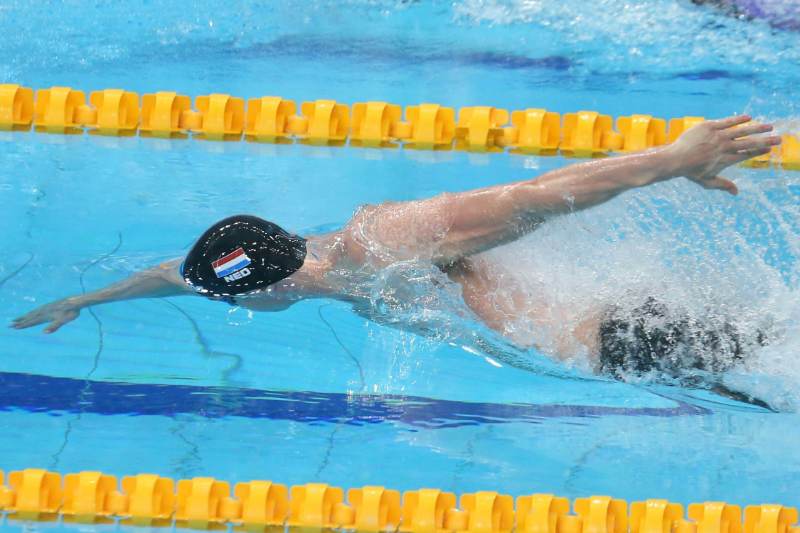
A study by Samson et al. (2015) compared this part of the stroke at sprint and middle-distance speeds. The entry and stretch phase lasts:
- 0.20 seconds at sprint speeds
- 0.31 seconds at mid distance speeds
- 0.46 seconds at distance speeds
The hand entry runs 55-130% longer compared to sprinting. That’s a lot!
This part of the pull—non-propulsive, by the way—is compressed as aggressively as possible so sprinters can get back to generating force as soon as possible.
Ride the vertical lift
When the glide is removed and the hand drives down into the catch with higher force and speed, the water pushes back, creating a lot of upward lift on the upper body.
A study by Samson et al. (2015) saw that vertical lift forces almost doubled at the beginning of the stroke when swimmers sprinted versus middle distance pace—roughly 40N versus 21N.
This elevated position is awesome for the sprint freestyle pull. It creates room for the shoulders to rotate more aggressively and for the arms to clear the water and come over the top with more force.
A deep catch for more power
The catch in sprint freestyle is deeper—the pulling arm is slightly more extended and as a result, reaches further down. This creates more frontal drag, but also significantly more power to overcome it.
A modeling study done by a Johns Hopkins mechanical engineer, and in partnership with USA Swimming, tested the freestyle strokes of two Olympic-level swimmers.
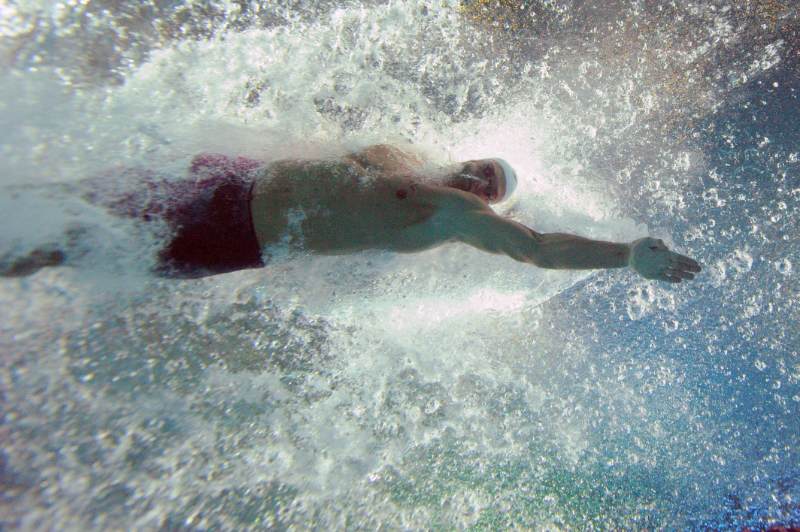
When they used a deep catch, they produced nearly 50% more thrust compared to the standard pulling style with lateral sculling motion.
This type of pull is demanding, requires more upper back and shoulder strength to perform repeatedly at max intensity, but it’s the catch of choice for swimmers looking for pure power.
Press hard into the catch
The catch is often treated as a setup move in sprint freestyle—get the hand in position, then generate power through the pull and push.
But the ability to press hard at the very start of the stroke is a meaningful predictor of overall swimming power.
A study of collegiate swimmers found that shoulder extension strength from an overhead position—essentially the ability to press the arm downward from a fully extended position—was strongly correlated with maximum swimming power (Awatani et al., 2018).
This movement closely mirrors what happens at the start of the freestyle catch, when the hand begins pressing down and back on the water. Swimmers who could generate more force in this position produced more power in the water.
Use a “straight back” pull
There is little to zero lateral movement of the hand in the pull. There is no exaggerated “S” pull in sprint freestyle. Swimmers grab the water, and then use the hand to displace as much of it as possible in a backward oriented direction.
A review of hand and arm propulsion research showed that sculling movements in the stroke reduce total thrust, because lateral movement of the hand means the hands are not moving backward.
The lift forces generated also don’t compensate for this loss in propulsion (Van Houwelingen et al., 2017).
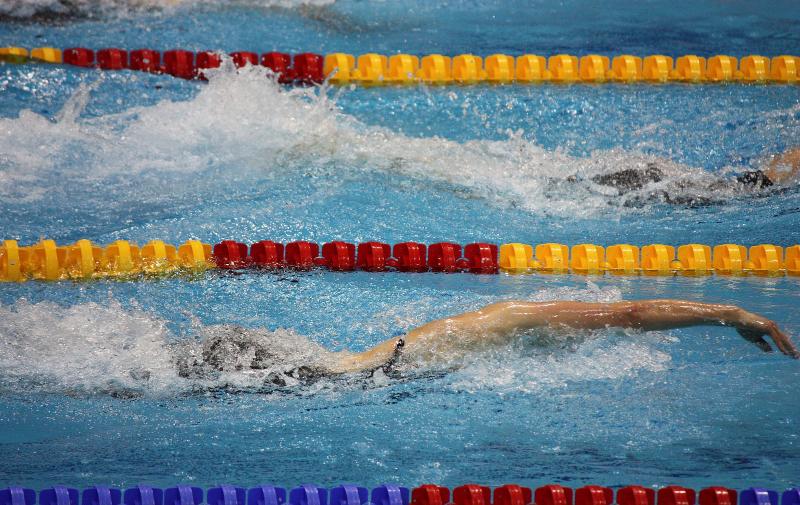
Drag-based propulsion—a fancy way of saying the hand is pulled straight back—consistently produced more thrust than lift-based sculling techniques.
The goal in sprint freestyle is maximum backward force in minimum time. The pull path should be direct and backward.
Accelerate the hands
During the sprint pull, the hands should accelerate rapidly under the body. This creates more power than the hands moving at steady-state speeds. Why does this subtle difference matter?
Hand acceleration means sprinters catch a meaningful amount of water and then drive the hand through with increasing speed. Steady-speed hands—moving the hand at the same speed from catch to hand exit—rushes the pull and leads to poor hand pitch and reduced water displacement.
This difference can be big.
Van Houwelingen et al. (2017) found that when swimmers accelerated their hands through the pull phase (instead of moving them at a constant speed) they produced a healthy 22-40% more forward-driving force.
Elite sprinters produce a firm hold on the water and then rapidly displace it backwards.
The sprint pull is chaotic (and that’s good)
World-class freestyle sprinters tear through the water in a way using a pull that looks choppy compared to the smooth as glass stroke of an elite distance freestyler.
This explosive choppiness is the point.
A study (Bouvet et al., 2024) tracked the movement patterns of 91 swimmers ranging from recreational to world-class. The fastest swimmers showed the most variability in their stroke.
Within each stroke, their bodies surged and accelerated sharply, particularly in upward and forward directions. Slower swimmers were smoother and more consistent. And that was actually the problem.
Maximum force application is never smooth. An explosive catch grabbed hard and driven through with all of your chlorinated might produces acceleration spikes.
Distance swimmers suppress these surges to conserve energy, whereas sprinters lean into it.
Stroke Rate and the Sprint Pull
A high stroke rate is essential for freestyle sprinting. Faster arm turnover, faster speeds. But there’s a ceiling, a natural maximum where more turnover produces little to no additional speed for way more effort.
Once swimmers spin the arms beyond this maximum:
- Stroke length drops dramatically
- Hand position and orientation break down
- Velocity flatlines or drops as energy cost explodes
A study (Koga et al., 2020) looked at what happens when swimmers tried swimming at 120% of their maximum stroke rate. The hand’s angle of attack collapsed during the push phase, breaking water pressure and killing propulsive force. The arms moved fast but pushed against less water. The classic “spin out” stroke.
But just under that ceiling was something more interesting. Three of the eight swimmers in the study went faster at 110% of their maximum than 100%, with higher hand propulsive force to match.
Which means that what feels like our maximum stroke rate is not necessarily the stroke rate that creates the most propulsive pulling.
Sprinters serious about performance should play and experiment with stroke rate, occasionally pushing beyond what feels sustainable.
How to Improve Your Sprint Freestyle Pull
Understanding how the sprint pull works is one thing. Let’s get to the good stuff—how to train it. Here’s where to start.
Train the pull with a chute.
Sprint resisted swimming with a parachute produces stroke adaptations that go beyond getting stronger.
A study (Valkoumas and Gourgoulis, 2024) saw that 11 weeks of training with a chute improved 50m velocity by almost 4% and also built a stroke that reduced time spent in non-propulsive phases.
The added drag forced swimmers to spend less time in the stroke where propulsion was not being generated.
Resisted swimming replicates sprint coordination.
One of the hardest parts of building the sprint pull is that it’s hugely taxing to train! True sprint coordination is hard to replicate at lower intensities.
See also: The Best Sets for 50 Freestyle: Power, Speed, and Explosive Starts
Resisted swimming fixes this too. Adding a chute or other resisted swim tool naturally increases stroke overlap at around 80% intensity, mirroring the timing of full-intensity sprinting.
For example:
- 16×25 freestyle with a medium chute at 80-85% effort + 30s rest per rep
Resistance means you can fine tune sprint coordination without having to sprint through a wall in training.
Prime the pull
Dryland stretch cords, those familiar rubber tubes with paddles or handles, can activate the neuromuscular system before you hit the water for a more explosive pull.
A study found that 2×5 max banded arm pulls, about eight minutes before swimming, increased arm-pull thrust by 13-19% through post-activation potentiation (Barbosa et al., 2020).
The heavy effort primes the muscles to fire harder in the sprint that follows. Use at the end of your warm-up before a race or a quality sprint set.
Tempo training
Play with different stroke rates in training to see how your pull responds. What feels like your maximum rate probably isn’t, and the only real way to find out is to push past it occasionally.
Add light resistance to make higher tempos feel more manageable and to reinforce good mechanics under fatigue.
The FINIS Tempo Trainer Pro is an essential tool here—plug in some rates, experiment with where tempo and pull mechanics click into place, and you’ll start to learn exactly where your stroke uncorks a truly sprinty pull.
Pull for Sprint Success
If you’ve been reading along in our series of sprint freestyle articles, including our flagship freestyle sprint guide, you’ve come to understand that the sprint pull is not an amped-up version of your regular free pull.
It’s a different animal—more aggressive, more continuous, and yes, more chaotic.
The good news is that it’s also highly trainable when you focus on the right things.
Chase those higher stroke rates. Spend more time with a pull that is constantly generating propulsion. Hit up those resistance tools to boost pull power and mechanics.
Build a more powerful pull, and the water—and your personal best times—won’t know what hit them.
Happy sprinting!