
Swim goggles shouldn’t leave your eyes aching. Learn how tight swim goggles should be, why smaller goggles create more pressure, and how to stop leaks comfortably.
Swimming goggles are one of the most important pieces of equipment you take to the pool.
They protect your eyes from pool chemicals (and their real yucky byproducts), reduce glare when swimming outdoors, and let you see everything from the pace clock to the touchpad at the end of a race.
But for all the technology packed into modern swim goggles, one question lingers:
How tight should swim goggles actually be?
Tighten them too much and your eyes and forehead spring soreness and even pain before the workout is over. Leave them too loose and you’re stopping every third stroke to empty out the lenses of pool water.
Here’s how to find the sweet spot, where some of that pressure actually comes from, and why tighter isn’t always necessary.
Goggle Tightness is a Trade-off
The tighter your swim goggles, the less they are going to leak.
This is just simple physics—the more tension in the straps, the more the gasket is pulled into your face, the less it’s going to wobble around or slide out of position, causing a leak.
But that same strap tension is also cranking up the pressure on your eyes. Over time, excessively tight swim goggles can cause some real problems, including:
- Migraines (Pestronk, 1983)
- “Swimmer’s headache” or supraorbital neuralgia (O’Brien, 2004)
- Temporary double vision (Plaut, 1998)
And then there are the “racoon eyes”—the deep red marks around your eyes.
As well as general soreness in the nose and eyes, and milder headaches that aren’t migraine-level but still not pleasant.
How Tight is Too Tight?
Let’s dive into some real numbers so you don’t hurl that brand new set of swim goggles into the garbage.
Researchers (Ma et al., 2007) had swimmers wear goggles for an hour straight while measuring intraocular pressure (IOP)—a fancy term for pressure inside the eye.
Wearing goggles increased eye pressure by about 2.4mmHg, and it remained elevated for as long as the goggles stayed on.
To give you some perspective, here’s what other everyday activities do in terms of spiking eye pressure:
| Activity | Increase in Eye Pressure |
| Tight necktie | ~1.6 mmHg |
| Swim goggles | ~2.4 mmHg |
| Yoga headstand | up to 15.8 mmHg |
| Playing trumpet | ~20 mmHg |
The encouraging part for swimmers stressing about the long term impact of goggle use is that eye pressure returned to normal once swimmers removed their swim goggles.
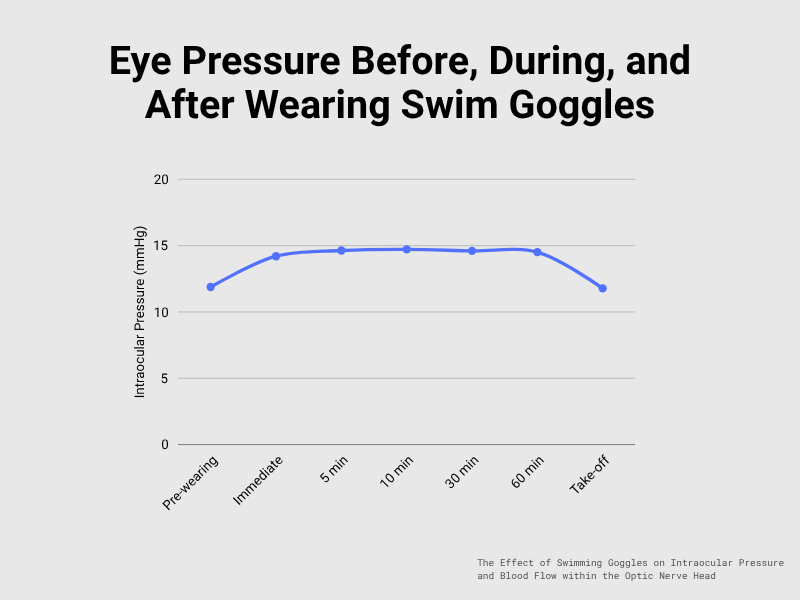
Researchers also found no meaningful reduction in blood flow to the optic nerve. For most healthy swimmers, properly fitted goggles aren’t going to be a problem.
Things get a little more hairy when we compensate for poor fit by cranking the straps like we are pulling in a lane rope.
Smaller Swim Goggles Create More Pressure
How tightly the head straps are wound isn’t the only thing that determines how “tight” a pair of swim goggles feels.
Goggle size matters, too.
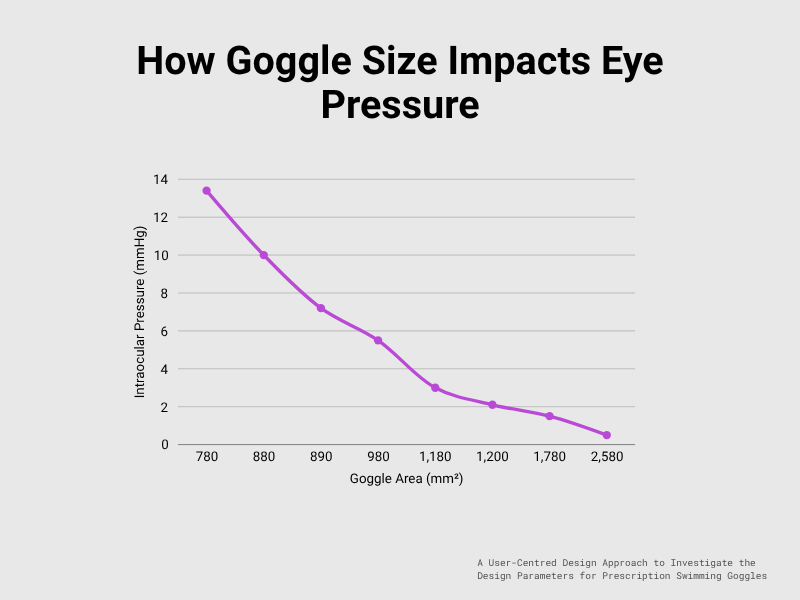
For example, a study (Kumar and Bisht, 2019) compared different styles of swim goggles and measured how much pressure they generated against the face.
They found that smaller goggles produced higher localized pressure, even when strap length remained the same.
When viewed through the lens (ha) of contact area, it makes sense:
- A small goggle concentrates all of that strap tension into a tiny surface area.
- A larger goggle spreads the tension out.
With a larger goggle, peak pressure stays lower, the goggles stay comfortable deeper into your swim, and your muscles are the ones that are sore after practice, not your eyes and forehead.
Tightness isn’t just about the straps. Smaller goggles concentrate pressure into a much smaller area, making them feel significantly tighter even with identical strap tension.
Prescription Swim Goggles and Eye Pressure
Even though there are heaps of swim goggles on the market, there are surprisingly few options for swimmers who need prescription lenses.
Which is odd considering how many swimmers have some sort of visual impairment. Kumar and Bisht (2019) surveyed 95 swimmers and found that 38 of them had a refractive error, most commonly myopia (nearsightedness) or hyperopia (farsightedness).
Goggle tightness is especially important for this group.
Swimmers with certain eye conditions may already carry a higher baseline risk of glaucoma than healthy-eyed swimmers, making lots of eye pressure something to be cautious about (Morgan et al., 2008).
If you wear prescription swim goggles—or have been diagnosed with glaucoma or another eye condition—don’t rely on strap tension alone to stop leaks.
Choose goggles that fit your face well, and if you’re unsure of what’s appropriate, circle back with your optometrist.
Looking for a new set of prescription goggles? While there aren’t a ton of them available, there are some good options for swimmers. Read my review of the best prescription swim goggles here.
So how tight should your swim goggles be?
Your swim goggles should be tight enough to create a watertight seal. That’s it. Not one notch tighter.
On race day, it’s understandable to button down the straps so to speak before stepping up on the blocks. No one wants to lose their goggles on the dive.
But in training, focus on a fit that seals comfortably and doesn’t require excessive pressure around the eyes to do it.
If your goggles are tighter than a drum and they are still causing issues such as pain (not ideal) and constant leaks (also not ideal), there are two other things swimmers can try to fix it.
Go for a larger goggle size
Old-school Swedish goggles are a classic goggle for competitive swimmers because of their low profile, fully custom straps/nose piece, and affordability.
They also illustrate the downside of small goggles perfectly.
Swedes have no soft gasket—it’s hard plastic versus the skin of around your eyes—and because they are so small, they concentrate strap tension into a tiny contact area. Laser-precision soreness.
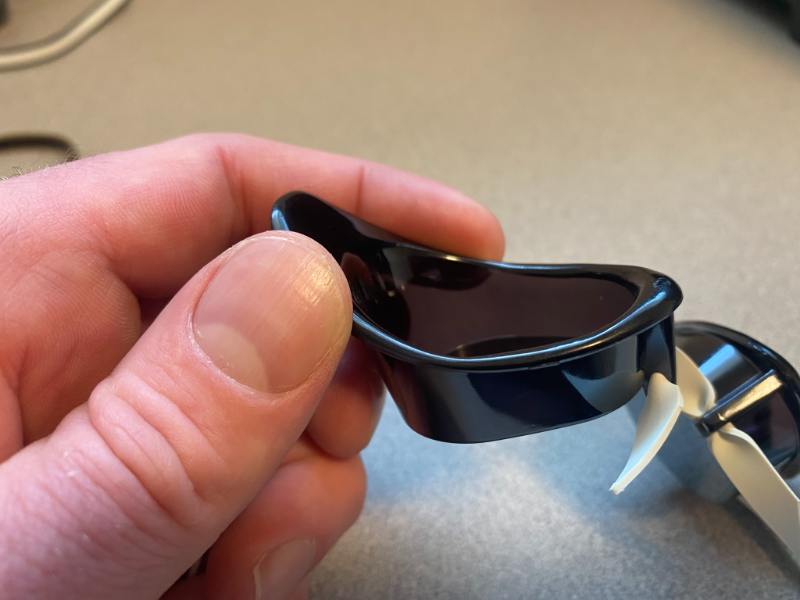
That’s why so many swimmers who try them for the first time find the Swedes really uncomfortable.
They’re an extreme example, but they highlight an important point. Smaller goggles create more pressure, even when the goggle straps are adjusted to the same length/tension.
If your goggles constantly feel too tight, move up to a larger gasket design. Goggles with a wide, soft gasket distribute pressure around the eye socket.
For a deeper look at the top swimming goggles on the market, read my flagship roundup of the best swim goggles for every kind of swimmer.
Go custom
If sizing up doesn’t sort out the tightness and pressure, the next step is to get a goggle gasket that isn’t fighting the natural contours of your face.
Custom swim goggles are designed to fit your face, allowing the seal to come from the fit rather than how tightly you can crank the straps.
A group of engineers at Texas A&M (Park et al., 2020) demonstrated this by 3D scanning swimmers’ faces and manufacturing goggles that matched each swimmer’s eye sockets and nose bridge. The result was goggles that created a watertight seal without needing the thick rubber gasket found on conventional swim goggles.
This lab concept is something swimmers can also just… buy.
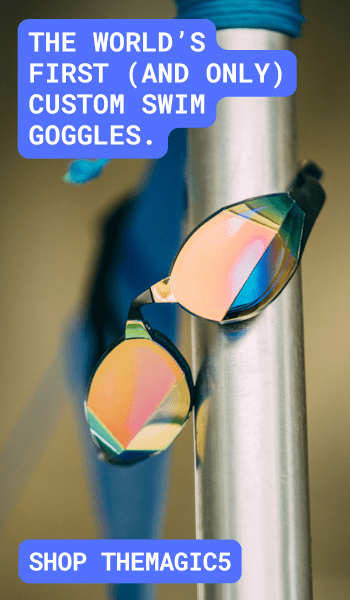
TheMagic5 is the only goggle brand that is doing this right now. Take your smartphone, scan your face with their app, and a week or so later a set of custom-made goggles show up on your doorstep that have been built to the specific measurements of your face.
See also: TheMagic5 Swim Goggles Review
This kind of tech obviously runs higher in terms of cost than your standard Vanquishers or Speed Sockets.
But if you’ve spent years fighting leaks—or tightening your straps to the point it feels like your head is going to pop—they solve the underlying problem instead of masking it.
With custom goggles, the seal comes from the fit, and strap tension becomes secondary.
The Bottom Line
Swim goggles are at their best when we don’t have to think about them. This means they are just tight enough to create a leak-free seal and not a smidge tighter than that.
For swimmers battling this issue, start with a larger gasket design, and if that fails, consider investing in some custom-fit goggles.
The better fit will create that watertight seal, reduce excess pressure on the eyes, and let you focus on what matters—your stroke, your technique, and your times on the clock.