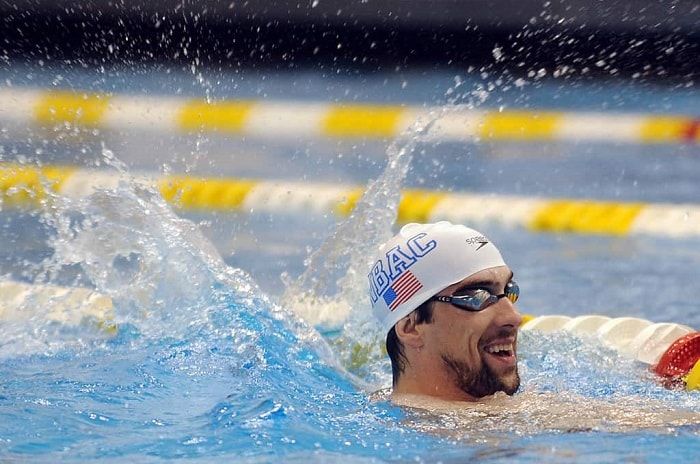

Michael Phelps didn’t become the most decorated Olympian in history by accident.
Behind the years of training, 23 Olympic gold medals, and countless world records was a clear, systematic approach to goal setting.
If you want to understand how the greatest swimmer of all time actually set and chased his goals—the goal sheets, the journaling, the long-term targets, where he kept his goals—we got you covered.
Want to learn exactly what it takes to set high-performance goals? Read our complete guide to goal setting for swimmers.
Here’s how the GOAT set goals, and what you can take from his process to enrich your own goals and swimming.
How Michael Phelps Approached Goal Setting
Michael Phelps’ longtime coach, Bob Bowman, never made of a secret of the fact that Phelps centered his motivation and training around specific goals.
“He may be the most goal-oriented person on the planet.” – Bob Bowman
Talent was certainly part of Phelps’ success, and elite coaching, but the engine underneath was his methodical and clear relationship with his goals. From an early age, he had very clear goals that provided structure to what he was doing in training.
In a Fox Sports interview with Joe Buck for the show Undeniable, Phelps shared a goal sheet that he had crafted at just eight years old:
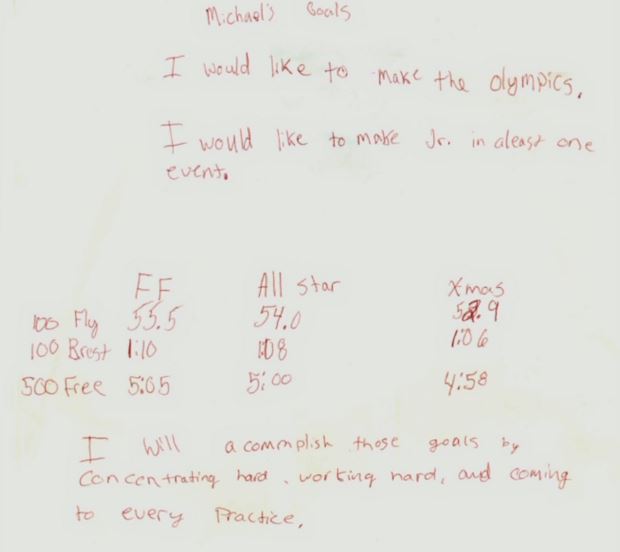
This goal setting sheet was something Phelps used every season.
“Every year since I have been swimming competitively, I have set goals for myself. In writing. The goal sheet was mandatory. I got used to it and it became a habit.”
What is most striking about the goal sheet isn’t that ambition—that’s the easy part. It was the structure and process behind it. He wrote down big goals, but also noted the progression (the times he would swim at each point in the season) and the concrete actions he planned to take to reach them.
“I will accomplish these goals by concentrating hard, working hard, and coming to every practice.”
That instinct—set a big goal, clear progression, and a process to knock them down—became the foundation of everything that followed.
The Goal Sheet
Writing goals down wasn’t a ritual for Phelps. It was part of his training and racing as the smell of chlorine.
Research shows how powerful writing goals down can be. A study from Dominican University found that people are significantly more likely to follow through on goals they write down versus goals they simply think about.
But writing them down was not the only thing he did. Phelps kept his goals somewhere visible—somewhere he’d see them every single day.
“I have my goals somewhere I can see them, so when I get out of bed I know I’m waking up to work on what I’m trying to achieve.” — Michael Phelps
That daily visual reinforcement kept his targets from becoming abstract. They stayed immediate, present, and actionable.
If your goals are sitting in a notebook you haven’t opened in three weeks, they’re not doing their job.
The Beijing 200m Butterfly
A cool window into how precisely Phelps set his goals is his crowning meet–the Beijing Olympics in 2008. For each event, he set specific goal.
In the 200 butterfly, a race he swam essentially blind after his swim goggles flooded with water after the start–he finished in 1:51.5. His goal time had been 1:51.1.
Just four tenths off of a second. On the way to a world record. Swimming blind.
This is the result of someone who has spent years practicing the discipline of setting targets that are ambitious but targeted in reality. When asked about how it felt to essentially swim the race blind, Phelps simply said:
“It felt like I thought it would.”
Vague goals produce vague results; Phelps’ goals had decimal points.
The Setbacks
Big goals carry an obvious risk–there is the possibility you won’t achieve them and you’ll experience big disappointment. Michael Phelps big dream of winning eight gold medals in a single Olympics wasn’t born in Beijing.
He’d tried the feat four years earlier at the 2004 Athens Olympics, where he fell short. The goal was also widely mocked, including by fellow superstar swimmer Ian Thorpe and Australian coach Don Talbot.
The setback informed his motivation, training, and goals moving forward.
“It doesn’t matter if you fall short; it is never a failure to go after your goals with everything you’ve got.” — Michael Phelps
Similarly, in the year leading up to the Beijing Games, Phelps broke his wrist when slipped and fell on ice outside of a Michigan restaurant. He couldn’t swim for weeks.
Training was limited to a stationary bike and eventually some kicking–which ended up helping powering his legendary kick and underwaters in Beijing.
Adversity and “failures” can derail our big goals, or they can be the information and motivation required to excel.
Putting It Into Practice
Goal setting looks simple, but that’s because swimmers stop at dreaming the big dream. It’s the process of goal setting where elite swimmers separate themselves:
- Set the goal in writing. No wishy-washy goals, no fantasies, no more day dreaming. Write it down. Be specific.
- Make it visible. Your phone lock screen, your water bottle, inscribed on your kickboard. Goals work best when they direct daily behaviors, and that starts with making them part of your environment.
- Write out the plan. A goal without a plan or process is just wishful thinking. Jot down what needs to happen in training and your daily habits to see the goal come to fruition.
- Involve your coach. Phelps and Bowman operated as a partnership. Bowman couldn’t read Phelps’ mind–the athlete decides the goal, and together coach and swimmer build the plan. You coach can only help you reach goal they know about.
- Handle setbacks like a pro. Adversity and setbacks will happen on your journey to the big goal. Your job is to handle adversity (“how can I make this the best thing to happen to my goals?”) and charge forward.
The Bottom Line
Big goals aren’t just the result of dreaming hard or wanting something really badly.
Michael Phelps shows us that they are built goal by goal, season by season, with a process that starts early and is rooted in performance, consistency, and specificity.
The goal sheet. Keeping them visible. Using setbacks for fuel.
None of these things are inherently complex and they are not beyond you—but the consistency and hard work that comes with big goals is tough.
Dream big. Write them down. And get to work in the pool.