
Plateaus for swimmers can be frustrating and demoralizing. Learn what they are, why they happen to swimmers, and how you can physically and mentally break through them.
Swim long enough and it’s bound to happen.
No matter how hard you work, how committed you are to your goals, or your spotless attendance record… the clock won’t budge.
The dreaded performance plateau.
Plateaus are one of the most common—and misunderstood—experiences in competitive swimming. And they literally happen to every swimmer who dips their toes in the water.
The difference is knowing that plateaus are almost never a dead end, but a signal that the body has adapted to its current training, technique needs attention, and that your mental approach needs recalibrating.
This guide covers everything swimmers, parents, and coaches need to know about plateaus, from why they happen to a set of powerful strategies to blast through them.
Let’s dive in.
IN THIS ARTICLE
What is a Performance Plateau?
Performance plateaus happen when a swimmer’s times stop improving despite continued training effort.
While frustrating, plateaus are a normal and expected part of athletic development—not a sign that a swimmer has reached their absolute limit. Plateaus happen because the human body is remarkably good at adapting to stress and training.
When you first start the season, or a new training block, or level up a group, your body responds by getting faster, stronger, and more efficient. Over time, even those workouts become “easy,” and unless we give our body something fresh to train with, improvement slows to a crawl.
For swimmers, this can show up as putting up times in training that are no faster than last month or even last season. Meet times that have stagnated. And the sense that your hard work is all for nothing.
Plateaus don’t have to be forever, however—resolving them usually requires a deliberate change in training stimulus, technique focus, or recovery strategy.
Why Plateaus Happen in the Pool
Plateaus are a huge pain in the neck because swimmers don’t always have a clear understanding of why they happen.
So swimmers will then do the illogical thing and declare that their swimming career is likely finished, they were never going to go that far anyway, and this chlorinated sport can just go ahead and kick rocks.
No need.
The first step in dealing with plateaus is understanding why they happen—and the honest answer is that it’s usually a combination of things, most of which are pretty standard for a majority of swimmers.
Gains always slow down
Early in a swimming career, or even at the beginning of a new season after a bunch of time off, the gains come fast and heavy. Training volume goes up, we get in better shape, and times drop—sometimes dramatically.
But those gains thin out as swimmers get better. That’s not a failure of effort or coaching, but just the reality of athletic development.
Early in the process, swimmers’:
- Muscles get stronger
- Lungs get more efficient
- Movement patterns sharpen up
Pair this with physical maturation and the steady increase of training volume and intensity and it makes sense that improvement is going to skyrocket.
For example, a study (Tate et al., 2012) tracking age group swimmers over the course of their career saw a steady increase in training volume over the years:
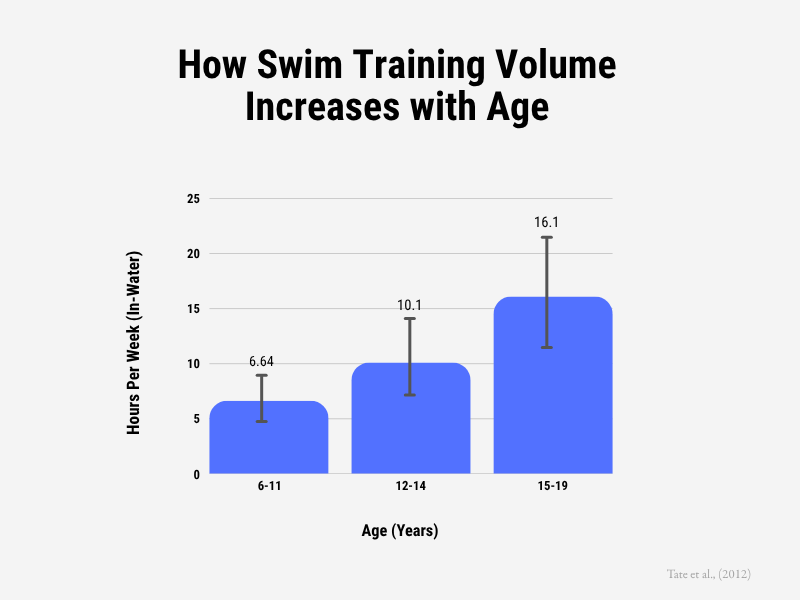
But after years of training, the body has made the easy gains, and what’s left are the smaller, harder-won improvements that take longer to show up on the clock.
This steady physiological progression is something that swimmers (and certainly swim coaches) will recognize:
| Early Career | Later |
| Big increases in yardage, intensity, frequency | Training load can’t increase forever |
| Physical maturation | Load stabilizes |
| Big drops in time—PBs practically weekly | Performance gains slow |
This progression is normal and can often feel like a plateau when it’s just the natural state of things.
Plateaus hit at different times
Plateaus are universal, but they don’t hit us all at the same time or follow the same improvement curve.
Plateaus by distance
Middle-distance and distance swimmers tend to plateau earlier than sprinters.
In one large analysis, performance gains began to level off around ages 17–18 for distance events, while sprint events continued improving into the 19–20 range (Ruiz-Navarro & Born (2025).
The reason is mostly physiological:
- Aerobic capacity (distance engine) develops and peaks earlier
- Anaerobic power and neuromuscular speed (sprint engine) can keep improving later
At the same time, the study showed that annual improvement declines steadily across all distances from childhood to early adulthood—so even before a full plateau, progress is already slowing year by year.
Female swimmers often plateau earlier
Female swimmers often encounter the plateau phase earlier than males, especially in the 100–400m events.
That doesn’t mean progress is over.
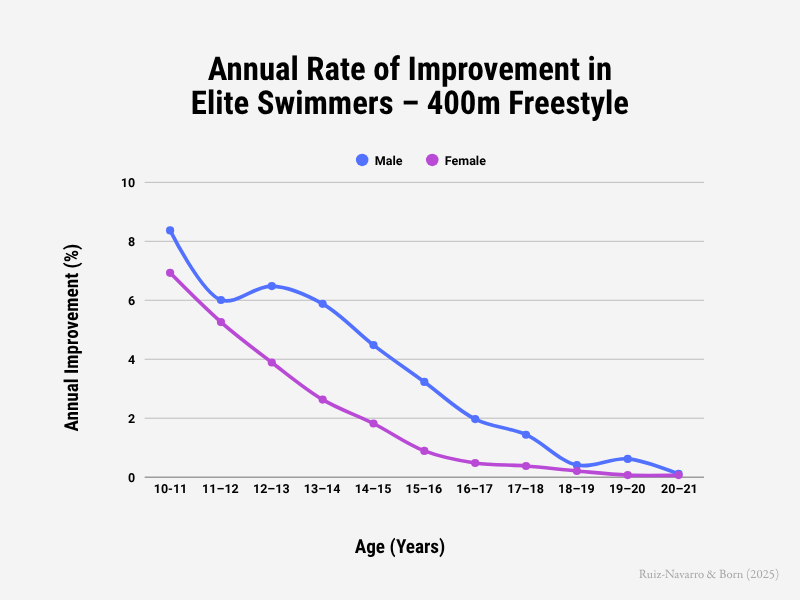
It means the rate of visible progress changes sooner, which can make it feel like you are plateauing faster than your teammates.
Elite swimmers plateau later
Better swimmers are not the ones who avoid plateaus. They delay them, manage them better, and continue progressing when others flatten out.
Ruiz-Navarro & Born (2025) also showed that some of the lower-level swimmers had better earlier annual progression but tapered off.
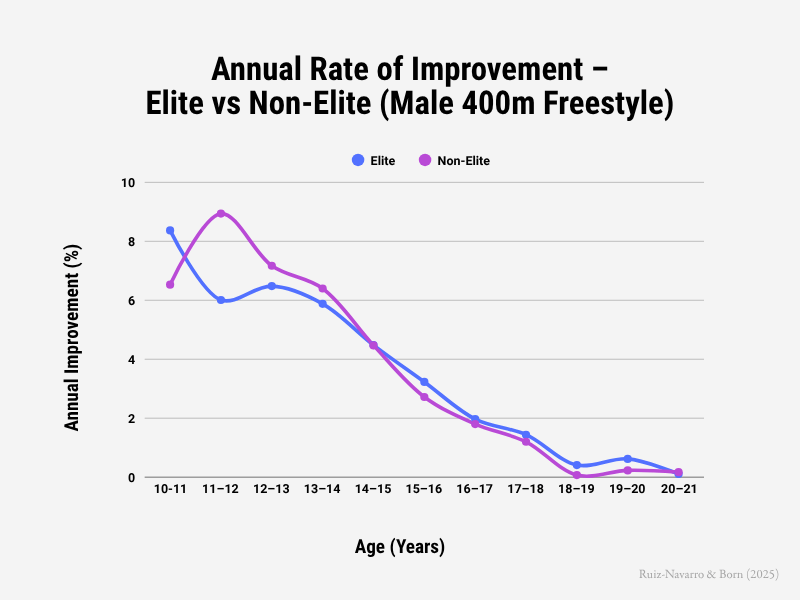
Top swimmers separated themselves by playing the long game and continuing to improve into older age categories.
So yes, those big, early time drops are impressive, but long-term progression matters more and the real test is who keeps improving later.
Conditioning outruns technique
A sneaky and powerful reason that swimmers plateau is that conditioning outruns technique.
A swimmer can be strong, well-conditioned, and work their butt off at every workout, but if stroke mechanics aren’t dialed in, there is only so much runway they can use to swim faster.
Technique is what extends this runway, giving swimmers more room to improve as their career goes on.
A study with 12-year-olds showed that faster swimmers weren’t just bigger or stronger than slower peers, they were already more technically efficient. They combined a longer stroke with a higher stroke rate, producing a stroke index that was 31% higher than the slowest group (Santos et al., 2023b).
One of the main reasons that elite swimmers separate from lower-level swimmers over time—and the gap widens with age—is differences in motor skills and swimming technique (Ruiz-Navarro and Born, 2025).
Pushing physiological development too hard, too early can even backfire.
Emphasizing high training volumes and intensity early can create quick results, but mediocre technique can lead to an earlier plateau once physiological gains are exhausted.
In other words, the fitness gains eventually run out.
When they do, technique is what determines whether a swimmer still has room to improve or has already hit their ceiling.
- Higher-level swimmers are still improving at 20–21
- Lower-level swimmers have already plateaued—or are getting slower
Good technique is more than just pretty swimming. It’s long-term investment that extends your runway for improvement.
Progress is noisy
One of the biggest mistakes swimmers make when evaluating their training is expecting improvement to be consistent and linear.
Work hard in the pool > taper > shave down > swim a perfectly predictable time on race day
That’s the expectation. But it’s not reality. Performance trends upwards over time, but it is a jagged line, not straight. Minor fluctuations are part of the process, not necessarily a sign that something is amiss.
For example, a study (Stewart and Hopkins, 2000) looked at how national-level swimmers competed in the same event just 20 days apart and saw that times varied by 1.4% between meets.
That sounds small, but in swimming, it’s a lot:
- In a 50m freestyle (25.0), that’s 0.35 seconds.
- In a 200m freestyle (1:50), that’s 1.65 seconds.
Faster swimmers are more consistent (~1.1%), while slower swimmers showed more variability (~1.5—1.9%). What swimmers interpret as a bad meet or a “plateau” is often just normal performance noise.
Even at the same meet, performance can vary widely.
A study (Santos et al., 2023a) looked at the entry times and the heats, semis, and finals performances of 50, 100, and 200 swimmers at the 2022 FINA World Championships.
Swimmers:
- Often swam slower in heats versus their seed times
- Swam fastest in semis
- Plateaued or swam slower in finals
Across events, swimmers didn’t follow a predictable improvement pattern. Some got faster each round, others didn’t.
Plateaus Are Usually Expectation Errors
By this point, one thing should be clearer than a freshly chlorinated pool:
Plateaus aren’t rare, random, and they happen to everyone.
But a lot of plateau frustration is expectation based.
If a swimmer expects:
- 5–7% improvement each season
But reality becomes:
- 1%
- Then 0.5%
- Then barely drops at all
It feels like something is wrong—even when everything is progressing exactly as it should.
This mismatch happens when:
- Early progress becomes the benchmark. Progression can create some expectations that aren’t, well, realistic. “I dropped two seconds in my 100m freestyle with three months of training, so I should be able to drop two more seconds with another three months of training.”
- We don’t realize we are approaching a physiological ceiling. Training load, physiology, and adaptation all have limits. Improvement shifts from big gains to small refinements.
- We overestimate the work we are doing. Swimmers can inflate the work they are doing, which creates expectations not rooted in what’s happening in reality. This can present the illusion of a plateau.
- Training stops evolving. Repeating the same sets, paces, and structure leads to stagnation. Same inputs > same outputs.
- We ignore other mechanisms for improvement. As they say, the clock never lies—but it doesn’t tell the whole truth. There are countless other levers that smash plateaus and power faster swimming.
Once you understand what plateaus actually are, the next step is knowing what to do about them.
How to Break Through a Swimming Plateau: Training
Drop-kicking a plateau isn’t about working harder, but about applying the right physical levers to create new adaptations.
Forget grinding, let’s give your body some new things to work on:
Focus on Technique
The best time to work on technique is before a plateau hits—it gives you more runway to improve—but the second-best time is today!
When progress stalls, technique is often the fastest way forward. It gives you immediate, controllable levers you can work on in the water today.
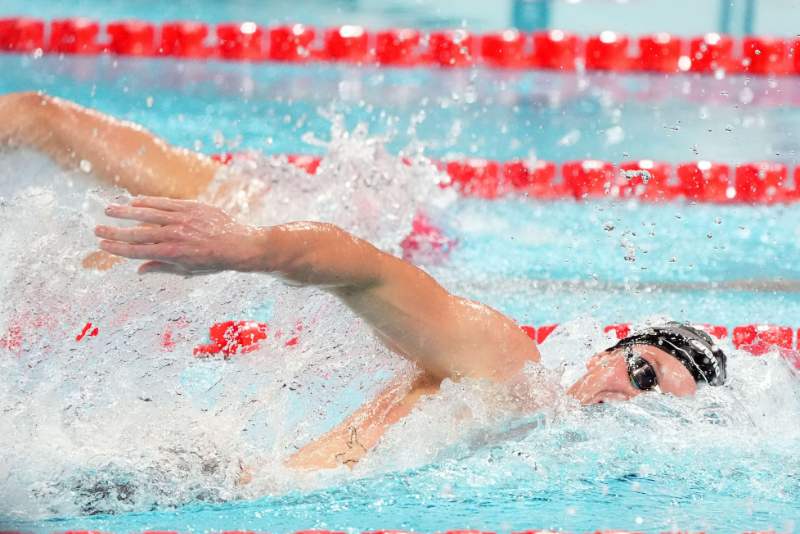
Are you overly dominate on one side of your body? Hands slipping through the pull? Streamlines not as tight as they can be?
Small adjustments can create meaningful differences:
- Pressing firmly into the catch when sprinting – Increases lift and raises shoulder position so you can rotate faster and more powerfully.
- Extended arms in streamline – Goes further and faster with each push-off, giving you more “free” speed with each turn.
- Higher hip position – Reduces trunk angle so you’re swimming horizontally instead of uphill, cutting drag and improving propulsion.
- Stroke counts – Count your strokes per lap and then try to maintain speed with fewer of them—forcing better bodyline and more power per stroke.
You don’t need to do a total technique rebuild.
Pick 2-3 small technical details and layer them into your swim workouts, make them stick, and rinse and repeat.
Periodize your training
Going to Poundtown with the same volume and intensity week in and week out gets you a good workout, but it’s a recipe for plateauing. Or worse—burnout.
The body needs progression and recovery, not just work, work, work.
- Progressive overload. Gradually increase volume or intensity. You adapt to change, not repetition.
- Deload to reveal gains. Adaptation happens when fatigue drops and the body has a chance to recover. A well-timed deload can expose improvements that were hidden by accumulated fatigue.
- Think in phases. Training should look like a staircase, not a rocket launch:
push > consolidate > push again.
Add variability to promote new adaptations.
The body is adaptation machine. Just think back to a couple of years ago and how much your body has soaked up since then. It can adapt like crazy, but only if you give it something to adapt to.
Do the same thing over and over, and progress will stall.
Introducing variability into training programs—changing intensity, duration, load patterns rather than following rigid fixed regimens— is the primary mechanism for breaking through those adaptations (Gelman et al., 2022).
Keep in mind that:
- Plateaus in muscle strength can appear after as little as 4 weeks of consistent training,
- Cardiovascular adaptations can plateau within 8-12 sessions of a given protocol.
Shocking the system with new stimulus can help swimmers break through a plateau, and this is often why you see swimmers drop a ton of time seemingly overnight when they switch groups or teams.
Use constraints
A way to chase improvement is simply changing the rules of the task.
Let’s say you are stuck on a set like this:
6×50 freestyle fast on 3:00, holding 27s
To bust through the plateau and force improvement, apply different constraints to the task:
- Swim the same speed – fewer strokes
- Swim the same speed – less rest
- Swim the same speed – broken swims (3×25 with short rest – :10)
- Swim the same speed – fewer breaths
- Swim the same speed – breathe to your off side
- Swim the same speed – adjust tempo
- Swim the same speed – more repetitions
- Swim the same speed – two extra dolphin kicks
This forces adaptation and improvement within the context of your main set and doesn’t rely on the clock.
One of the characteristics of elite swimmers is that they are constantly on the hunt for ways to improve within the main set. They don’t wait for their coach to tell them what constraints to apply—they seek them out themselves.
Once swimmers grasp this concept and apply it—which is the hardest part, constraints don’t make things easier—a world of improvement opens up to them.
Plateaus can be the result of not working hard enough, or simply not being creative enough in finding ways to impose constraints that yield improvement.
Dryland training
Long-term success in the pool depends on your ability to handle more training over time.
As volume and intensity increase, not every swimmer is physically prepared to absorb that load.
Strength, resilience, and movement capacity determine how much progress you can sustain.
That’s where dryland comes in. When done properly, it allows you to:
- Handle more training
- Recover more effectively
- Stay consistent
As swimmers develop, force production becomes increasingly important. While often associated with sprinting, force is a key performance factor even in middle- and long-distance events.
A study (Correia et al., 2019) with middle-distance swimmers found that—even in the 400m freestyle, an event dominated by the aerobic system—aerobic capacity didn’t explain performance differences.
Instead, swimming speed and anaerobic alactic power were the strongest predictors, accounting for 92% of performance variance.
At that level, everyone already has a strong aerobic engine. What separated swimmers is how much speed and force they could extract from each stroke.
This is where dryland becomes a plateau breaker.
While it doesn’t directly improve swim performance—a subtle but important distinction—it gives swimmers the raw materials to apply more strength and power to their stroke, turns, and starts.
How to Break Through a Swimming Plateau: Mindset
The plateau battle is mostly with the clock, but the real battle is between your ears.
When progress pumps the brakes, it’s easy to lose confidence, focus, and perspective.
Mental skills keep you grounded in the process and prevent a temporary valley from turning into a long-term setback. Here are the key mental skills to help you navigate plateaus:
Goal setting
Plateaus open a chasm between where you are and where you are trying to go—that end-of-season goal feels like it’s suddenly shot out further from your grasp.
This is where goals matter.
Goal setting works best for swimmers when targets are specific, there are short and long term goals working together, and when you own them. For plateaus, hit those goals with a strong process:
- Executing your race strategy
- Hitting stroke counts
- Controlling pace and effort
Process goals give you something to win at daily, while we wait for the clock to catch up.
Confidence
Plateaus are confidence killers. Swimmers are doing the work, the clock is telling you the same thing over and over, and doubt starts filling the quiet moments between laps.
Confidence is one of the strongest predictors of actual performance—which means that when a plateau chips away at it, self-doubt can become a self-fulfilling prophecy. The less you believe you can swim fast, the less likely you are to.
Stay on top of your confidence by treating it like a skill, focusing on the process, and logging/tracking your daily wins.
Being a confident swimmer isn’t just believing that you can swim fast on race day, but that you can handle the doubts and uncertainty that come with the ups and downs of the swim season.
Self-talk
The internal noise during a plateau can get negative pretty quick—doubt, uncertainty, and the creeping sense that the work isn’t working.
Self-talk with swimmers shows that deliberately managing that internal dialogue produces measurable performance gains (Hatzigeorgiadis et al., 2014).
| Situation | Negative Self-Talk (Threat) | Productive Self-Talk (Challenge) |
| Times aren’t dropping | “This isn’t working.” | “Progress is not linear—trust the work and the process.” |
| Stuck at the same pace in practice | “I’m stuck.” | “This is where I refine technique and efficiency.” |
| Bad or flat meet | “All that work for nothing.” | “This is one data point—learn and move forward.” |
| Comparing to teammates improving | “Everyone is getting faster except me.” | “I am on my own timeline—keep doing the work, my turn will come.” |
The point isn’t to be “fake” optimistic when things are challenging, but your self-talk should certainly reflect that this is a challenge and not a threat to success in the pool.
Pressure training
Competition plateaus are incredibly frustrating, especially when you know for a certified fact that your hard work deserved a better result.
Swimmers getting better in training—but not in competition—are typically struggling to perform under pressure.
Bridging the gap means more pressure training in the lead up to competition to get better at handling it when you step up on the block:
- Race pace sets
- “Get out” swim
- Suit-up or race simulation days
- Reward/forfeit sets
The conditions don’t need to be Big Meet-level of nerves—even moderate amounts of nerves and anxiety are enough to help swimmers get better at swimming fast under pressure (Oudejans & Kegelaers, 2024).
Mindfulness
Mindfulness training helps swimmers get better at staying present, control negative thoughts, and even manage anxiety. Perfect for the mental yo-yo of a plateau.
- “What happens if I never improve again?”
- “Why am I not improving—this isn’t fair at all!”
Mindfulness pulls you back to the present where performance has a better chance to flourish.
It helps you:
- Stay focused during sets
- Reduce overthinking
- Manage frustration and pressure
When progress feels like it’s come to a grinding halt, the ability to stay locked in the moment becomes a huge competitive advantage, leading to better technique and increased effort.
The Bottom Line
Even though we have a hate-hate relationship with plateaus, they are not the enemy.
They’re uncomfortable, test our confidence, and endlessly frustrating—but they are also very valuable in the hands of the smart swimmer.
A plateau is an opportunity and its feedback.
It’s telling you that your body has adapted to the work, and it’s hungry for more. It wants cleaner, more efficient technique. Smarter training. And that the mental approach needs the same kind of attention as the physical.
Where most swimmers will see a stop sign, you will see a long list of levers to charge improvement.
Remember that progress was never a straight line. It slows down for everyone.
The big, easy drops from your early age group days might be behind you—but the opportunities for improvement aren’t. They’ve just changed shape.
The swimmers who recognize that are the ones who keep getting faster long after everyone else has stalled.
This article on performance plateaus for swimmers is part of our series on mental training for swimmers. To learn more, read the articles below.